Showing posts with label Censorship. Show all posts

Tuesday, May 24, 2022

The Unburnable Book

To support free expression and fight censorship, author Margaret Atwood has joined forces with Penguin Random House and others to produce an unburnable version of The Handmaid's Tale, which is now being auctioned by Sotheby's. All proceeds go to benefit PEN America. The current bid is $42,000, and the auction closes June 7, 2022. 

Here are the technical specifications for the highly engineered edition of one: 

8vo. Printed on black-and-white-coated aluminum Cinefoils, used in film production to wrap hot lights, which are stable to 660°C/1220°F, textblock hand-sewn with nickel wire, often used in electrical components, which is stable to 1400°C/2,600°F, head and tail bands are woven stainless steel, used in aerospace manufacturing, which are stable up to 1530°C/2790°F. Boards 3mm phenolic sheets, used in electronics manufacturing, which are stable to 540°F/282°C, opaque white and CMYK printing produced on an OKI five-colour digital press, with inks stable to 1200°C/2200°F. 

In the video above, Atwood is demonstrating proof of concept. Of related interest are earlier Common Curator posts on censorship, including Books Are Weapons in the War of Ideas

Monday, September 23, 2019

Banned Books Week

Sponsored by the American Library Association and allied organizations, Banned Books Week is an annual celebration of the freedom to read. It began in 1982 in response to widespread censorship of books, and since that time over 11,000 books have been challenged in communities throughout the United States.

The American Library Association's Office for Intellectual Freedom has been documenting cases of challenged and banned books since 1990, and the ALA's Library Bill of Rights strongly supports free and unfettered access to information and ideas. Internationally, the Index on Censorship is an organization that promotes and defends the right to freedom of expression.

Tuesday, June 4, 2019

1989 Democracy Movement at Tiananmen Square: 八九民运在天安門廣場


Sunday, February 24, 2019

A Student Free Speech Landmark: Tinker v. Des Moines Independent School District (1969)


Fifty years ago today, on February 24, 1969, the U.S. Supreme Court in a landmark decision held that First Amendment free speech rights applied to students in public schools. The case, Tinker et al. v. Des Moines Independent School District et al., 393 U.S. 503 (1969), was decided by a 7-2 vote, with Justice Abe Fortas delivering the majority opinion of the Court; Justices Hugo Black and John M. Harlan II each wrote dissenting opinions.

At issue was the right of several students to wear black armbands in protest against the Vietnam War and to support the Christmas truce called for by Senator Robert F. Kennedy in December 1965. The students included four members of the Tinker family (John, 15; Mary Beth, 13; Hope, 11; and Paul, 8) and Christopher Eckhardt, 16, who wore black armbands at their respective schools in the Des Moines Independent School District. Mary Beth Tinker and Eckhardt were suspended on December 16, and John Tinker on December 17. The controversy lead the Iowa Civil Liberties Union and the American Civil Liberties Union to support the suspended students, and after losing in U.S. District Court, the case was appealed to the U.S. Court of Appeals for the 8th Circuit, and eventually the U.S. Supreme Court, where attorney Dan L. Johnston argued for the petitioners on November 12, 1968.

In his opinion, Justice Fortas observed that:
"First Amendment rights, applied in light of the special characteristics of the school environment, are available to teachers and students. It can hardly be argued that either students or teachers shed their constitutional rights to freedom of speech or expression at the schoolhouse gate. This has been the unmistakable holding of this Court for almost 50 years."
Fortas articulated further that:
"In order for the State in the person of school officials to justify prohibition of a particular expression of opinion, it must be able to show that its action was caused by something more than a mere desire to avoid the discomfort and unpleasantness that always accompany an unpopular viewpoint. Certainly where there is no finding and no showing that engaging in the forbidden conduct would 'materially and substantially interfere with the requirements of appropriate discipline in the operation of the school,' the prohibition cannot be sustained."
The standard of material and substantial disruption has subsequently become known as the Tinker Test in determining free speech rights for students.

Pictured to the right are Mary Beth and John with armbands, circa March 4, 1968, when the U.S. Supreme Court agreed to hear their case. The armbands originally worn in protest were simple strips of black cloth, unadorned with peace symbols, as shown below by Mary Beth in a photo from December 1965.

The Tinkers have ever since remained strong advocates for free speech and civil liberties, particularly for the young. Mary Beth and John, along with other Tinker family members, guests, and students, are featured in the video above that commemorates the 50th anniversary of their landmark case. The event was held at the State Historical Museum in Des Moines on February 22, 2019, and aired on Iowa Public Television.

Sunday, September 30, 2018

Books Are Weapons in the War of Ideas

Sponsored by the American Library Association and allied organizations, Banned Books Week is an annual celebration of the freedom to read. It began in 1982 in response to widespread censorship of books, and since that time over 11,000 books have been challenged in communities throughout the United States.

The American Library Association's Office for Intellectual Freedom has been documenting cases of challenged and banned books since 1990, and the ALA's Library Bill of Rights strongly supports free and unfettered access to information and ideas. Internationally, the Index on Censorship is an organization that promotes and defends the right to freedom of expression.

Note: The World War II poster shown here features a quotation by Franklin Roosevelt and was illustrated by S. Broder. Published in 1942 by the U.S. Government Printing Office, it was distributed by the Division of Public Inquiry within the Office of War Information.

Saturday, December 2, 2017

Net Neutrality Is Being Upended


Net neutrality is the principle that all data or content should be treated equally, without discrimination, by every Internet Service Provider (ISP). Net neutrality thus ensures that all stakeholders share an equitable platform for communication, commerce, and other purposes.

The Federal Communications Commission (FCC) will be voting on December 14, 2017 to approve or reject Chairman Ajit Pai's draft order to undermine the current framework as articulated in the FCC's 2015 Open Internet Order. Organizations such as the Electronic Frontier Foundation (EFF) and the American Civil Liberties Union (ACLU), among many others, are partners in the Battle for the Net coalition, which is actively advocating for the complete rejection of Chairman Pai's new order.

To learn about what you can do to make your voice heard, visit the Battle for the Net website, which provides links to an online petition, information about upcoming protests around the United States, and details about contacting your elected officials as well as communicating your views directly to the FCC.

Saturday, September 23, 2017

Banned Books Week: Challenge Censorship

Sponsored by the American Library Association and allied organizations, Banned Books Week (September 24-30, 2017) is an annual celebration of the freedom to read. It began in 1982 in response to widespread censorship of books, and since that time over 11,000 books have been challenged in communities throughout the United States.

The American Library Association's Office for Intellectual Freedom has been documenting cases of challenged and banned books since 1990, and the ALA's Library Bill of Rights strongly supports free and unfettered access to information and ideas. Internationally, the Index on Censorship is an organization that promotes and defends the right to freedom of expression.

Tuesday, January 31, 2017

ALA Opposes New Administration Polices That Contradict Core Values

American Library Association (ALA) President Julie B. Todaro on January 30, 2017 released the following statement on behalf of the ALA that reasserts the association's commitment to core values concerning access to information, intellectual freedom, diversity, social responsibility, and other issues:

“We are shocked and dismayed by recent executive orders and other actions by the new administration, which stand in stark contrast to the core values of the American Library Association. Our core values include access to information; confidentiality/privacy; democracy; equity, diversity and inclusion; intellectual freedom; and social responsibility.

“The American Library Association strongly opposes any actions that limit free access to information, undermine privacy, or discriminate on any basis. This includes the temporary suspension of visas and entrance to the US based on anyone’s nationality or religion as well as the increased scrutiny of any individual’s communication such as mobile phone and/or social media activity.

“Our nation’s 120,000 public, academic, school, and special libraries serve all community members, including people of color, immigrants, people with disabilities and the most vulnerable in our communities, offering services and educational resources that transform communities, open minds, and promote inclusion and diversity.

“ALA believes that the struggle against racism, prejudice, stereotyping, and discrimination is central to our mission. We will continue to speak out and support efforts to abolish intolerance and cultural invisibility, stand up for all the members of the communities we serve, and promote understanding and inclusion through our work.

“We will continue to speak out and support our members as they work tirelessly for access to library and information resources on behalf of all of their community members, while advocating for privacy, intellectual freedom, critical global research, information literacy, ongoing access to scientific research, and fair and equitable treatment for everyone.

“As our strategic plan states, ‘ALA recognizes the critical need for access to library and information resources, services, and technologies by all people, especially those who may experience language or literacy-related barriers; economic distress; cultural or social isolation; physical or attitudinal barriers; racism; discrimination on the basis of appearance, ethnicity, immigrant status, housing status, religious background, sexual orientation, gender identity, gender expression; or barriers to equal education, employment and housing.’

“We encourage our members to continue to speak out and show their support for and work on behalf of our core values, in their communities as well as with their local, state, and national elected and appointed officials. Additionally, ALA has tools and resources online to help you advocate for our core values:
“ALA is committed to using its national platform for speaking up and speaking out for its members and constituents in these chaotic, unprecedented, and challenging times. We appreciate the library community’s continued support.”

Saturday, October 1, 2016

Banned Books Week: Celebrating the Freedom to Read

Sponsored by the American Library Association and allied organizations, Banned Books Week is an annual celebration of the freedom to read. It began in 1982 in response to widespread censorship of books, and since that time over 11,000 books have been challenged in communities throughout the United States.

The American Library Association's Office for Intellectual Freedom has been documenting cases of challenged and banned books since 1990, and the ALA's Library Bill of Rights strongly supports free and unfettered access to information and ideas. Internationally, the Index on Censorship is an organization that promotes and defends the right to freedom of expression. 

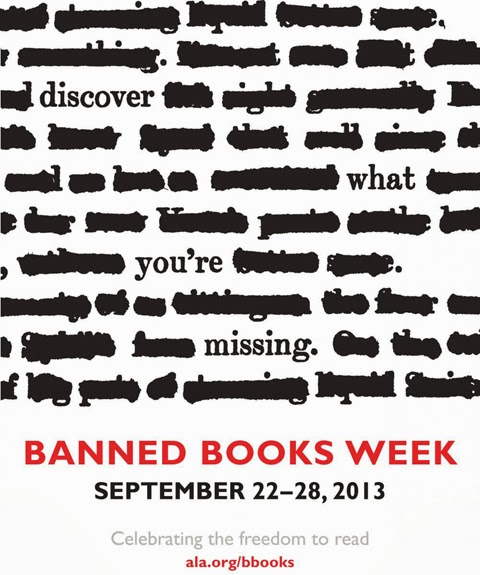
Tuesday, September 24, 2013

Celebrating the Freedom to Read


Banned Books Week is an annual celebration of the freedom to read. It began in 1982 in response to widespread censorship of books, and since that time over 11,000 books have been challenged in communities throughout the United States.

The American Library Association's Office for Intellectual Freedom has been documenting cases of challenged and banned books since 1990, and the ALA's Library Bill of Rights strongly supports free and unfettered access to information and ideas.

An illustration of the extent of the phenomenon is the remarkable fact that of the 88 titles featured in the Library of Congress' 2012 exhibition, Books That Shaped America, 30 have been challenged or banned at one time or another.

Thursday, April 11, 2013

Books over Bloomberg

On April 9, 2013, the Occupy movement scored a victory when a settlement was reached in the case of Occupy Wall Street (OWS), "an unincorporated association," against the City of New York, Mayor Michael Bloomberg, and other city officials and individuals. The suit was filed because of the seizure and destruction of books, library furnishings, and equipment of the People's Library at Zucotti Park in New York City on November 15, 2011. Among other things, the settlement provides for the payment of $47,000 to the OWS Library Working Group and $185,000 in attorneys' fees for the plaintiffs. The full text of the settlement can be read online. Further information about the People's Library and its history can be found at its blog.

Saturday, February 11, 2012

Opposition Grows against ACTA / TTP

As with SOPA and PIPA domestically, opposition is mounting against the international agreements, ACTA (the Anti-Counterfeiting Trade Agreement) and TPP (the Trans-Pacific Partnership Agreement). Both have lacked transparency in the negotiating process and threaten to rewrite intellectual property laws, thereby impacting citizens' rights globally to access content on the Internet and innovate with information technology. The Electronic Frontier Foundation provides further information on ACTA and TPP, and Fight for the Future is sponsoring a petition for people living around the world against the implementation of both.

In Europe, numerous protests are planned for February 11, 2012:

Wednesday, January 18, 2012

Internet Archive Protests SOPA / PIPA

As stated on its blackout page: The Internet Archive believes that it is critical to protest and raise awareness of pending legislation in the United States: House Bill 3261, the Stop Online Piracy Act (SOPA) and S.968, the PROTECT IP Act (PIPA).

We are going dark from 6am to 6pm PST on Wednesday, January 18 (14:00 - 02:00 UTC) to drive a message to Washington. We need your help to do this.

Legislation such as this directly affects libraries (pdf) such as the Internet Archive, which collects, preserves, and offers access to cultural materials. Furthermore, these laws can negatively affect the ecosystem of web publishing that led to the emergence of the Internet Archive.

For United States residents, please take action.

For non-US Residents: Sorry for dragging you into this, and if you are willing please sign a petition to the State Department to express your concern.

Wikipedia Protests SOPA / PIPA

On January 18, 2012, the Wikipedia community is blacking out millions of articles of content in the English version for 24 hours to protest pending US legislation: the Stop Online Piracy Act (SOPA) and the Protect IP Act (PIPA). The decision to withdraw content was made by the global community of Wikipedia editors and is supported by the Wikimedia Foundation, which is the non-profit organization that operates Wikipedia and numerous related projects.

Wikipedia is urging US constituents to contact their elected representatives and voice their opposition to the two acts now under consideration in the House of Representatives and Senate. Wikipedia states further that:

SOPA and PIPA cripple the free and open internet. They put the onus on website owners to police user-contributed material and call for the blocking of entire sites, even if the links are not to infringing material. Small sites will not have the sufficient resources to mount a legal challenge. Without opposition, large media companies may seek to cut off funding sources for small competing foreign sites, even if big media are wrong. Foreign sites will be blacklisted, which means they won't show up in major search engines.

In a post SOPA/PIPA world, Wikipedia --and many other useful informational sites-- cannot survive in a world where politicians regulate the Internet based on the influence of big money in Washington. It represents a framework for future restrictions and suppression. Congress says it's trying to protect the rights of copyright owners, but the "cure" that SOPA and PIPA represent is much more destructive than the disease they are trying to fix.

To learn more about SOPA/PIPA, click here.

Wednesday, November 30, 2011

Destruction of The People's Library


The eviction of Occupy Wall Street protesters from Zuccotti Park in the early morning hours of November 15, 2011 resulted in the destruction and loss of several thousand books as well as irreparable damage to computers, equipment, and personal property that constituted the Occupy Wall Street Library, or People's Library, as it is also known. The video above documents a press conference held on November 23 in response to the destruction and aftermath. Further information about rebuilding efforts and current initiatives by the People's Library can be found at the OWS Library web site.

Tuesday, September 27, 2011

Read Any Banned Books Lately?

Banned Books Week: Celebrating the Freedom to Read (September 24 to October 1, 2011) is an annual event celebrating the freedom to read and the importance of the First Amendment. Held during the last week of September, Banned Books Week highlights the benefits of free and open access to information while drawing attention to the harms of censorship by spotlighting actual or attempted bannings of books across the United States. [read more at the American Library Association site].

Banned Books Week is sponsored by the American Booksellers Association; American Booksellers Foundation for Free Expression; American Library Association; American Society of Journalists and Authors; Association of American Publishers; and National Association of College Stores; and in 2011, the Comic Book Legal Defense Fund; National Coalition Against Censorship; National Council of Teachers of English; and PEN American Center also joined as sponsors. In addition, it is endorsed by the Center for the Book in the Library of Congress.

Note: The World War II poster shown here features a quotation by Franklin Roosevelt and was illustrated by S. Broder. Published in 1942 by the U.S. Government Printing Office, it was distributed by the Division of Public Inquiry within the Office of War Information.

Tuesday, May 31, 2011

Where Is Chinese Artist Ai Weiwei?

Friday, September 24, 2010

Banned Books Week 2010

Banned Books Week: Celebrating the Freedom to Read (September 25 to October 2, 2010) is an annual event celebrating the freedom to read and the importance of the First Amendment. Held during the last week of September, Banned Books Week highlights the benefits of free and open access to information while drawing attention to the harms of censorship by spotlighting actual or attempted bannings of books across the United States.

Banned Books Week is sponsored by the American Booksellers Association; American Booksellers Foundation for Free Expression; the American Library Association; American Society of Journalists and Authors; Association of American Publishers; and the National Association of College Stores. It is endorsed by the Center for the Book in the Library of Congress.

For more information on getting involved with Banned Books Week: Celebrating the Freedom to Read, please see the American Library Association's Calendar of Events and Ideas and Resources. You can also contact the ALA Office for Intellectual Freedom at 1-800-545-2433, ext. 4220, or bbw@ala.org.