Showing posts with label Environment. Show all posts

Friday, January 1, 2021

New Seeds for a New Year

The latest tantalizing annual catalog from Seed Savers Exchange (SSE), featuring heirloom, untreated, non-hybrid, and non-GMO seeds, is now available online; a print copy of the 2021 catalog can also be requested free of charge.

Founded in 1975 by Diane Ott Whealy and Kent Whealy, Seed Savers Exchange is now the largest non-governmental seed bank of its kind in the United States. With over 13,000 members, SSE conserves and maintains heirloom seeds for thousands of vegetables, fruits, herbs, and flowers. Its mission is: 

. . . to save North America's diverse, but endangered, garden heritage for future generations by building a network of people committed to collecting, conserving and sharing heirloom seeds and plants, while educating people about the value of genetic and cultural diversity.
Located on the 890-acre Heritage Farm in Decorah, Iowa, SSE is open to visitors from April to October, and sponsors special events such as seed starting, grafting, and gardening workshops. It also hosts an annual conference and campout. To learn more about Seed Savers Exchange and the benefits of membership, visit its website.

Wednesday, April 22, 2020

After 4.54 Billion Earth Years, 50 Earth Days

Earth Day was first celebrated fifty years ago on April 22, 1970. Founded by former US Senator Gaylord Nelson as an environmental teach-in, Earth Day is now coordinated by Earth Day Network, with extensive programming and events around the world. In 2009, the United Nations also declared April 22 to be International Mother Earth Day, an observance that "recognizes a collective responsibility, as called for in the 1992 Rio Declaration, to promote harmony with nature and the Earth to achieve a just balance among the economic, social and environmental needs of present and future generations of humanity." Look magazine first published the ecology flag shown above on April 21, 1970. The theta symbol on the flag represents the conjoining of "e" for environment and "o" for organism. 

Wednesday, October 9, 2019

Climate Activist Greta Thunberg Comes to Town


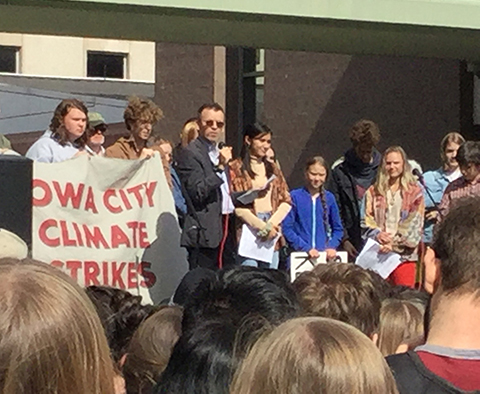
The Swedish climate activist Greta Thunberg led a climate rally attended by several thousand in downtown Iowa City, Iowa on Friday, October 4, 2019. Since beginning her School Strike for the Climate (or Skolstrejk för klimatet) outside the Swedish Parliament in 2018, Thunberg has galvanized millions of youth and adults around the world and become an internationally-recognized leader of the movement to address the environmental crisis caused by fossil fuels.

The video of Thunberg's speech in Iowa City can be seen here; the transcript of her speech is available here. Fellow students from Iowa City, local and state representatives, and others also spoke at the event.

Thunberg has been nominated for this year's Nobel Peace Prize, which will be announced on Friday, October 11. At 16, Thunberg would be the youngest Nobel laureate ever should she win; to date, the youngest winner is Malala Yousafzai, who won the Peace Prize in 2014 at 17. Thunberg is pictured above in a blue jacket.

Tuesday, September 17, 2019

Global #ClimateStrike: September 20 & 27, 2019


Millions worldwide will be joining thousands of youth-led events in over 100 countries to mobilize for effective responses to the environmental consequences of fossil fuels. To learn more and to locate a climate strike near you, visit the Global Climate Strike website.

Of related interest, see the earlier Common Curator posts: Climate of Concern: Shell's 1991 Warning of Global Environmental Damage; James Hansen: Why I Must Speak Out about Climate Change; and Mr. Smith Goes to Washington (Champions of Change for Sustainable and Climate-Smart Agriculture).

Monday, April 22, 2019

Earth Day: 1970 to the Present

Earth Day was first celebrated on April 22, 1970. Founded by former US Senator Gaylord Nelson as an environmental teach-in, Earth Day is now coordinated by Earth Day Network, with extensive programming and events around the world. In 2009, the United Nations also declared April 22 to be International Mother Earth Day, an observance that "recognizes a collective responsibility, as called for in the 1992 Rio Declaration, to promote harmony with nature and the Earth to achieve a just balance among the economic, social and environmental needs of present and future generations of humanity." Look magazine first published the ecology flag shown above on April 21, 1970.

Sunday, April 22, 2018

For Earth Day, Plant a Tree or a Forest

Earth Day was first celebrated on April 22, 1970. Founded by former US Senator Gaylord Nelson as an environmental teach-in, Earth Day is now coordinated by Earth Day Network, with extensive programming and events around the world. In 2009, the United Nations also declared April 22 to be International Mother Earth Day, an observance that "recognizes a collective responsibility, as called for in the 1992 Rio Declaration, to promote harmony with nature and the Earth to achieve a just balance among the economic, social and environmental needs of present and future generations of humanity."

To commemorate both Earth Day and the upcoming Arbor Day, check out The Forest Where Ashley Lives, an educational book about the value and care of urban forests. Written by Mark A. and the eponymous Ashley L. Vitosh, and illustrated by John L. Smith, it is intended for elementary school readers. The book has won an Arbor Day Foundation Education Award, and was published by Iowa State University Extension; a PDF version is available for download from Urban Forestry South.

Wednesday, March 1, 2017

March for Science on Earth Day


The March for Science will be held on Earth Day, April 22, 2017, in Washington, D.C. and at several hundred satellite locations throughout the United States and around the world. Thousands of scientists and scientific-minded individuals will be marching in solidarity to support the work of the scientific community and the critical role it plays in formulating sound, evidence-based public policy, particularly in the realms of public health and environmental protection.

The March for Science "champions robustly funded and publicly communicated science," and its stated goals for the upcoming event are to:
humanize science; partner with the public; advocate for open, inclusive, and accessible science; support scientists; and, affirm science as a democratic value. 
Further information about the movement's goals and principles, as well details about local marches, can be found on the March for Science web site. Be there or be square!

Tuesday, February 28, 2017

Climate of Concern: Shell's 1991 Warning of Global Environmental Damage

In 1991, the multinational oil company Shell released Climate of Concern, an educational video warning of the risks of environmental damage on a global scale due to climate change caused by the increasing consumption of fossil fuels. Confidential reports as early as 1986 document Shell's awareness of the risks of anthropogenic climate change, but the 1991 video has not been widely available (WorldCat shows that it is apparently only held by the Bibliothèque nationale de France). The Correspondent recently acquired a copy, and it can also be viewed at their website.

Monday, February 27, 2017

"Alternative Facts" Are Not Facts


Not only are so-called alternative facts not facts, they are not even alternatives. The Map of the Square and Stationary Earth . . . shown above was published by Prof. Orlando Ferguson of Hot Springs, South Dakota in 1893. He asserts that 400 biblical passages "condemn the Globe Theory, or the Flying Earth, and none sustain it." For 25 cents, Prof. Ferguson offered a book "explaining this square and stationary Earth." He states further that "It knocks the Globe Theory clean out. It will teach you how to foretell eclipses. It is worth its weight in gold."

The Ferguson map was donated to the Geography and Map Division of the Library of Congress in 2011, and is fully described in the Library's online catalog. High-resolution images of the map are also available for download.

Thursday, August 25, 2016

National Park Service Centennial

One hundred years ago on August 25, 1916, President Woodrow Wilson signed legislation to create the National Park Service (NPS), with the mandate "to conserve the scenery and the natural and historic objects and the wild life therein and to provide for the enjoyment of the same in such manner and by such means as will leave them unimpaired for the enjoyment of future generations."

In 2015 alone, more than 300 million people visited the 412 different areas in the park system, which covers over 84 million acres in every state, as well as the District of Columbia, American Samoa, Guam, the Northern Mariana Islands, Puerto Rico, and the Virgin Islands. To help plan future visits, the NPS website provides a Find a Park tool that offers information about the many sites of interest.

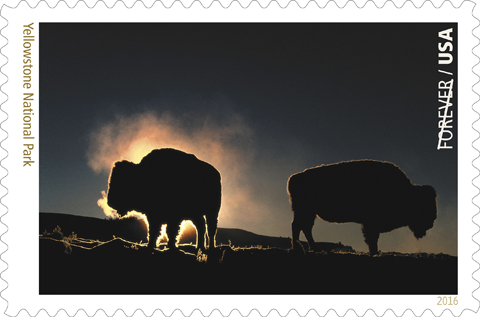
To commemorate the 100th anniversary of the NPS, the U.S. Postal Service issued a set of 16 stamps with images of various well-known parks. The oldest park in the system is Yellowstone National Park, which was created through a bill signed into law by President Ulysses S. Grant on March 1, 1872. The Yellowstone stamp features the silhouettes of two bison, which coincidentally became the national mammal when President Obama signed the National Bison Legacy Act into law on May 9, 2016.

Once numbering in the tens of millions in North America, bison were hunted to near extinction in the nineteenth century. In 1905, Theodore Roosevelt and William Hornaday formed the American Bison Society in an attempt to help save the species. Today, bison herds on public lands managed by the U.S. Department of the Interior support around 10,000 bison; Yellowstone has the largest of these herds, with a population estimated at 4,900 as of last summer.

Sunday, May 29, 2016

Iowa Governor Visits Smith Farm on Conservation Tour


Iowa Governor Terry Branstad visited the Tim Smith Farm on May 4, 2016 as part of on ongoing tour to learn about soil conservation practices and strategies that are being used by environmentally concerned farmers to improve soil health and mitigate the effects of agriculture on water quality in the state. The video above was produced by Joe Murphy of the Iowa Soybean Association (ISA), and includes interviews with Governor Branstad, Kirk Leeds (CEO of ISA), and Smith, as well as scenes of conservation practices on several different farms. The ISA web site also features a recent article on Smith's work.

Previous Common Curator posts about conservation practices on the Smith farm include: Mr. Smith Goes to Washington; Iowa Soil Conservation Farmer of the Year; Cover Crops Reduce Nitrogen Run-Off, Improve Water Quality; and The Boone River Watershed: Why Strip-Till and Cover Crops Matter.

Monday, October 26, 2015

Mr. Smith Goes to Washington

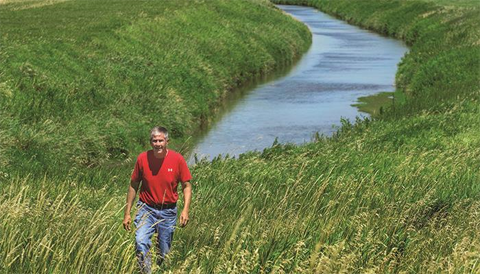
Tim Smith (pictured third from right), the owner-operator of the Smith Farm in north-central Iowa, was recognized in Washington, D.C. on October 26, 2015 as one of twelve White House Champions of Change for Sustainable and Climate-Smart Agriculture. The event in its entirety is viewable via the White House's YouTube channel. As stated in the White House press release:
These individuals were selected by the White House for their achievements and will be honored for exemplary leadership and innovation in agricultural production and education. The Champions have helped implement agricultural practices that promote soil health and energy efficiency, improve water quality, and reduce greenhouse gas emissions. Climate change can no longer be seen as a distant threat. It is already impacting forest, grassland, and cropland systems in the United States, and is threatening agricultural producers and their communities. These Champions understand the challenges our nation is facing from a changing climate and are taking steps to build resilience to the impacts of climate change, which also protects their bottom line. The program will feature remarks by United States Secretary of Agriculture Tom Vilsack.
Smith's accomplishments were described as follows:
Tim Smith is a fourth-generation farmer who raises soybeans, corn and cover crops on his family’s Century Farm in Wright County, Iowa. In addition to raising crops, Tim is focused on strengthening soil health and improving water quality. He has worked with a number of organizations, including the Iowa Soybean Association and the Soil Health Partnership, to implement new farming methods. Tim travels throughout Iowa and the United States advising farmers on how to approach new sustainability efforts. 
The Champions of Change program was created as an opportunity for the White House to feature individuals who are doing extraordinary things to inspire and empower members of their communities. Previous Common Curator posts about conservation practices on the Smith farm include: Iowa Soil Conservation Farmer of the YearCover Crops Reduce Nitrogen Run-Off, Improve Water Quality and The Boone River Watershed: Why Strip-Till and Cover Crops Matter.

Monday, August 10, 2015

Iowa Soil Conservation Farmer of the Year

Tim Smith, the owner-operator of the Smith Farm in north-central Iowa, has received the 2015 Iowa Soil Conservation Farmer of the Year Award, which has been sponsored by the Iowa Farm Bureau (IFB) since 1952.

As cited in the IFB news release:
Smith’s Wright County family farm uses many conservation practices to protect the environment and each brings its own set of measureable improvements and added benefits; strip-till and no-till planting and cover crops boost soil organic matter. Grassy waterways, field borders and a bioreactor serve to slow and filter rainfall. And prairie strips, planted with native grasses and forbs not only prevent runoff, they provide habitat for a variety of bird species. Smith also uses a nutrient management plan for all his fields. 
Smith's contributions to conservation advocacy were also noted, as he given numerous field demonstrations, media interviews, and hosted tours for agricultural representatives from Europe, as well as made presentations to middle school students in Des Moines and graduate students from Iowa State University.

Previous Common Curator posts about conservation practices on the Smith farm include: Cover Crops Reduce Nitrogen Run-Off, Improve Water Quality and The Boone River Watershed: Why Strip-Till and Cover Crops Matter.

Wednesday, December 31, 2014

From Billions to None: The Extinction of the Passenger Pigeon

The last known passenger pigeon, called Martha, after Mrs. Washington, the first First Lady of the United States, died on September 1, 1914 at the Cincinnati Zoo. Although the murmurations depicted in the trailer for the documentary, From Billions to None: The Passenger Pigeon's Flight to Extinction, are not particularly convincing simulations of the long-gone massive flocks, the story of the extinction of a superabundant avian species is nevertheless a fascinating if unfortunate one. It is estimated that the passenger pigeon, once the most common bird in North America, had attained a population of several billion at its peak in the 19th century. Project Passenger Pigeon, organized by scientists, educators, conservationists, and others, seeks to provide "lessons from the past for a sustainable future."

Wednesday, October 9, 2013

Cover Crops Reduce Nitrogen Run-off, Improve Water Quality


This short video features the Smith farm in north-central Iowa, and was produced by the Iowa Farm Bureau, which is working to improve conservation practices among farmers.

For a related post, see The Boone River Watershed: Why Strip-Till and Cover Crops Matter.

Monday, January 21, 2013

The Boone River Watershed: Why Strip-Till and Cover Crops Matter


This short video features the Smith farm in north-central Iowa, and was produced by the Nature Conservancy, which is working to improve conservation practices among farmers. The organization notes that, "For farmers in Iowa's Boone River watershed, the change to strip-till and cover crops can make sense both economically and environmentally."

For further information about the initiatives sponsored by the Nature Conservancy and its partners in Iowa, as well as other recent videos such as "Restoring Ox Bows on the Boone River" and "How Bioreactors Are Making a Difference in the Boone River Watershed," visit the Nature Conservancy's web site. An index of project areas in Iowa can be found here.


Friday, April 27, 2012

For Arbor Day: The Forest Where Ashley Lives


To commemorate Arbor Day, check out the free electronic version of The Forest Where Ashley Lives, an educational book about the value and care of urban forests, written by Mark A. and Ashley L. Vitosh, and illustrated by John L. Smith. Intended for elementary school readers, the text has won an Arbor Day Foundation Education Award.

The book is also available in print and as an interactive CD from the Iowa State University online store. The CD includes the text and illustrations of the book, plus additional features such as audio narration, web links, a glossary, “Did You Know?” facts about forests, and supplemental materials for teachers.

Tuesday, March 27, 2012

Of Cherry Blossoms and Plant Quarantines

The National Cherry Blossom Festival is this year celebrating the 100th anniversary of the planting of cherry trees in Washington, D.C. The trees planted during the spring of 1912, however, were not the first ones imported from Japan for the beautification of the Capitol. Two years earlier, on January 6, 1910, 2,000 flowering cherry trees arrived from Japan and were inspected by the U.S. Bureau of Entomology. Although the Bureau lacked authority to inspect private plant imports, acting chief Charles Marlatt determined that the trees were afflicted with "practically every pest imaginable" and should be destroyed. President Taft subsequently ordered the burning of the entire shipment, which took place at the Washington Monument.

The controversy surrounding the cherry tree incident galvanized the passage of the Plant Quarantine Act of 1912, which established the Federal Horticultural Board and authorized plant quarantines. Prior to this, 39 states had enacted their own legislation regulating plant inspections. While the federal regulatory framework was being built, a second batch of 3,020 cherry trees was ordered from Japan. Fumigated before shipment and declared pest-free upon arrival, the first two trees were finally planted in the Capitol on March 12, 1912 by First Lady Taft and Viscountess Chinda, the Japanese Ambassador's wife.

A full account of this interesting intersection of international diplomacy and domestic horticulture can be read in "Cherry Blossoms, Insects, and Inspections" at the Law Library of Congress' blog, In Custodia Legis. The image above depicts two paired commemorative stamps recently issued by the USPS.

Monday, March 19, 2012

North Carolina Issues Draft Report on Hydraulic Fracturing

The North Carolina Department of Environment and Natural Resources has just issued a draft report on proposed hydraulic fracturing within the state entitled, "North Carolina Oil and Gas Study under Session Law 2011-276." In addition to the full report, the draft Executive Summary and draft Recommendations and Limitations are downloadable separately.

Findings from this draft report will be presented publically in two upcoming meetings, in Sanford on March 20, 2012 and in Chapel Hill on March 27, 2012. Written comments on the draft report will be accepted through April 1, in addition to any feedback received at the two public meetings. Written comments can be sent via email to Shale_gas_comments@ncdenr.gov or through the mail to NCDENR, attn: Trina Ozer, 1601 MSC, Raleigh, NC 27699. Additional resources regarding shale gas can be found at the NCDENR site.

Of related interest is an earlier Common Curator post on an Integrative Workshop on Hydraulic Fracturing held in January 2012 at Duke University.

Wednesday, March 7, 2012

James Hansen: Why I Must Speak Out about Climate Change


TED has just made available a recent talk (filmed in February 2012) by noted climatologist, Dr. James Hansen. An Iowa native, Hansen studied mathematics, physics, and astronomy at the University of Iowa, where Dr. James Van Allen headed up the Department of Physics and Astronomy. Hansen's 1967 doctoral dissertation was entitled, The Atmosphere of Venus: A Dust Insulation Model, and he has since had a long scientific career investigating the basis of global climate change and advocating for the reduction of greenhouse gas emissions into the Earth's atmosphere.