Showing posts with label Music. Show all posts

Monday, April 18, 2022

President Roosevelt, Duke Ellington, Max Roach, and Wu-Tang Clan among 25 Newest Additions to National Recording Registry


N
ow in its twentieth year, the National Recording Registry has grown to 600 entries with Librarian of Congress Carla Hayden having just announced 25 additional sound recordings as the official entries for 2022, stating

The National Recording Registry reflects the diverse music and voices that have shaped our nation’s history and culture through recorded sound. The national library is proud to help preserve these recordings, and we welcome the public’s input. We received about 1,000 public nominations this year for recordings to add to the registry.”

Under the National Recording Preservation Act of 2000, selected recordings must be "culturally, historically, or aesthetically significant" and at least ten years old.


Spanning the years 1921-2010, the selections for this year are as follows:

  1. “Harlem Strut” — James P. Johnson (1921)
  2. Franklin D. Roosevelt: Complete Presidential Speeches (1933-1945)
  3. “Walking the Floor Over You” — Ernest Tubb (1941) (single)
  4. “On a Note of Triumph” (May 8, 1945)
  5. “Jesus Gave Me Water” — The Soul Stirrers (1950) (single)
  6. “Ellington at Newport” — Duke Ellington (1956) (album)
  7. “We Insist!  Max Roach’s Freedom Now Suite” — Max Roach (1960) (album)
  8. “The Christmas Song” — Nat King Cole (1961) (single)
  9. “Tonight’s the Night” — The Shirelles (1961) (album)
  10.  “Moon River” — Andy Williams (1962) (single)
  11.  “In C” — Terry Riley (1968) (album)
  12.  “It’s a Small World” — The Disneyland Boys Choir (1964) (single)
  13.  “Reach Out, I’ll Be There” — The Four Tops (1966) (single)
  14.  Hank Aaron’s 715th Career Home Run (April 8, 1974)
  15.  “Bohemian Rhapsody” — Queen (1975) (single)
  16.  “Don’t Stop Believin’” — Journey (1981) (single)
  17.  “Canciones de Mi Padre” — Linda Ronstadt (1987) (album)
  18.  “Nick of Time” — Bonnie Raitt (1989) (album)
  19.  “The Low End Theory” — A Tribe Called Quest (1991) (album)
  20.  “Enter the Wu-Tang (36 Chambers)” — Wu-Tang Clan (1993) (album)
  21.  “Buena Vista Social Club” (1997) (album)
  22.  “Livin’ La Vida Loca” — Ricky Martin (1999) (single)
  23.  Songs in A Minor” — Alicia Keys (2001) (album)
  24.  WNYC broadcasts for the day of 9/11 (Sept. 11, 2001)
  25.  “WTF with Marc Maron” (Guest: Robin Williams) (April 26, 2010)
The full National Recording Registry can be viewed online here. The Registry solicits nominations annually for inclusion on the registry; further information on the criteria and procedures for making nominations for 2022 is available at the Registry website. Individuals may submit up to 50 nominations per year. 

Thursday, April 1, 2021

Edison, Louis Armstrong, and Odetta among 25 Newest Additions to National Recording Registry

Now in its nineteenth year, the National Recording Registry has grown to 575 entries with Librarian of Congress Carla Hayden having just announced 25 additional sound recordings as the official entries for 2020, stating

“The National Recording Registry will preserve our history through these vibrant recordings of music and voices that have reflected our humanity and shaped our culture from the past 143 years. We received about 900 public nominations this year for recordings to add to the registry, and we welcome the public’s input as the Library of Congress and its partners preserve the diverse sounds of history and culture.”

Under the National Recording Preservation Act of 2000, selected recordings must be "culturally, historically, or aesthetically significant" and at least ten years old.


Spanning the years 1878-2008, the selections for 2020 are as follows:


  1. Edison’s “St. Louis tinfoil” recording (1878)
  2. “Nikolina” — Hjalmar Peterson (1917) (single)
  3. “Smyrneikos Balos” — Marika Papagika (1928) (single)
  4. “When the Saints Go Marching In” — Louis Armstrong & his Orchestra (1938) (single)
  5. Christmas Eve Broadcast--Franklin D. Roosevelt and Winston Churchill (December 24, 1941)
  6. “The Guiding Light” — Nov. 22, 1945
  7. “Odetta Sings Ballads and Blues” — Odetta (1957) (album)
  8. “Lord, Keep Me Day by Day” — Albertina Walker and the Caravans (1959) (single)  
  9. Roger Maris hits his 61st homerun (October 1, 1961)
  10. “Aida” — Leontyne Price, et.al. (1962) (album)
  11. “Once a Day” — Connie Smith (1964) (single)
  12. “Born Under a Bad Sign” — Albert King (1967) (album)
  13. “Free to Be…You & Me” — Marlo Thomas and Friends (1972) (album)
  14. “The Harder They Come” — Jimmy Cliff (1972) (album)
  15. “Lady Marmalade” — Labelle (1974) (single)
  16. “Late for the Sky” — Jackson Browne (1974) (album)
  17. “Bright Size Life” — Pat Metheny (1976) (album)
  18. “The Rainbow Connection” — Kermit the Frog (1979) (single)
  19. “Celebration” — Kool & the Gang (1980) (single)
  20. “Richard Strauss: Four Last Songs” — Jessye Norman (1983) (album)
  21. “Janet Jackson’s Rhythm Nation 1814” — Janet Jackson (1989) (album)
  22. “Partners” — Flaco JimĂ©nez (1992) (album)
  23. “Somewhere Over the Rainbow”/”What A Wonderful World” — Israel Kamakawiwo’ole (1993) (single)
  24. “Illmatic” — Nas (1994) (album)
  25. “This American Life: The Giant Pool of Money” (May 9, 2008)
The full National Recording Registry can be viewed online here. The Registry solicits nominations annually for inclusion on the registry; further information on the criteria and procedures for making nominations for 2021 is available at the Registry website. Individuals may submit up to 50 nominations per year. 

Saturday, March 6, 2021

WFMU Marathon: Freeform Station of the Nation


Love free-form radio? Take the leap and consider supporting independent station WFMU during its annual fundraising Marathon that runs March 6 to March 21, 2021. WFMU first hit the airwaves over sixty years ago on April 24, 1958 at the now-defunct Upsala College and has never looked back. Currently based in Jersey City, New Jersey, WFMU broadcasts at 91.1 Mhz in New York and via a second signal at 90.1 Mhz in the Hudson Valley. WFMU has long been an Internet pioneer, and has multiple online streams, as well as an extensive archive of past shows.

What is free-form radio you might ask? WFMU describes itself as follows: 
WFMU's programming ranges from flat-out uncategorizable strangeness to rock and roll, experimental music, 78 RPM Records, jazz, psychedelia, hip-hop, electronica, hand-cranked wax cylinders, punk rock, gospel, exotica, R&B, radio improvisation, cooking instructions, classic radio airchecks, found sound, dopey call-in shows, interviews with obscure radio personalities and notable science-world luminaries, spoken word collages, Andrew Lloyd Webber soundtracks in languages other than English as well as country and western music. 
And because the station is listener-supported, WFMU DJs have for years maintained complete autonomy and control over their own programming, which is extraordinarily eclectic. Check out the current WFMU audio smorgasbord, and see for yourself. Apps available for both iOS & Android. 


Monday, November 2, 2020

Resistance Revival Chorus: "All You Fascists Bound to Lose"

The Resistance Revival Chorus has just released their debut album, "This Joy," on Righteous Babe Records. The album, available both on vinyl and digitally, features Rhiannon Giddens on Woody Guthrie's 1942 anthem, "All You Fascists Bound To Lose."

Tuesday, April 7, 2020

Happy 100th, Ravi Shankar!

Ravi Shankar [1920-2012] was born 100 years ago, on April 7th. His daughter, Anoushka, who is a master musician and composer in her own right, arranged Ravi's composition, Sandhya Raga, which was performed by a group of his former students as a birthday tribute. Anoushka has been organizing a series of Centenary concerts that unfortunately have been postponed due to the coronavirus pandemic. Meanwhile, enjoy the present sampling of great Indian classical music from Ravi's extensive catalogue!

Thursday, March 26, 2020

New Cohort for National Recording Registry Includes Memphis Minnie, Glen Campbell, Cheap Trick, Selena, Dr. Dre & Colin Currie

Now in its eighteenth year, the National Recording Registry has grown to 550 entries with Librarian of Congress Carla Hayden having just announced 25 additional sound recordings as the official entries for 2019, stating

“The National Recording Registry is the evolving playlist of the American soundscape. It reflects moments in history captured through the voices and sounds of the time. . . . As genres and formats continue to expand, the Library of Congress is committed to working with our many partners to preserve the sounds that have touched our hearts and shaped our culture.”

Under the National Recording Preservation Act of 2000, selected recordings must be "culturally, historically, or aesthetically significant" and at least ten years old.


Spanning the years 1920-2008, the selections for 2019 are as follows:


  1. “Whispering” (single), Paul Whiteman and His Orchestra (1920)
  2. “Protesta per Sacco e Vanzetti,” Compagnia Columbia; “Sacco e Vanzetti,” Raoul Romito
    (1927)
  3. “La Chicharronera” (single), Narciso Martinez and Santiago Almeida (1936)
  4. “Arch Oboler’s Plays” episode “The Bathysphere” (Nov. 18, 1939)
  5. “Me and My Chauffeur Blues” (single), Memphis Minnie (1941)
  6. The 1951 National League Tiebreaker: New York Giants vs. Brooklyn Dodgers — Russ
    Hodges, announcer (Oct. 3, 1951)
  7. Puccini’s “Tosca” (album), Maria Callas, Giuseppe di Stefano, Angelo Mercuriali, Tito Gobbi,
    Melchiorre Luise, Dario Caselli, Victor de Sabata (1953)
  8. “Hello Muddah, Hello Fadduh” (single), Allan Sherman (1963)
  9. WGBH broadcast of the Boston Symphony on the day of the John F. Kennedy Assassination,
    Boston Symphony Orchestra (1963)
  10. “Fiddler on the Roof” (album), original Broadway cast (1964))
  11. “Make the World Go Away” (single), Eddy Arnold (1965)
  12. Hiromi Lorraine Sakata Collection of Afghan Traditional Music (1966-67; 1971-73)
  13. “Wichita Lineman” (single), Glen Campbell (1968)
  14. “Dusty in Memphis” (album), Dusty Springfield (1969)
  15. “Mister Rogers Sings 21 Favorite Songs From ‘Mister Rogers’ Neighborhood’ ” (album), Fred
    Rogers (1973)
  16. “Cheap Trick at Budokan” (album), Cheap Trick (1978)
  17. Holst: Suite No. 1 in E-Flat, Suite No. 2 in F / Handel: Music for the Royal Fireworks / Bach:
    Fantasia in G (special edition audiophile pressing), Frederick Fennell and the Cleveland
    Symphonic Winds (1978)
  18. “Y.M.C.A.” (single), Village People (1978)
  19. “A Feather on the Breath of God” (album), Gothic Voices; Christopher Page, conductor;
    Hildegard von Bingen, composer (1982)
  20. “Private Dancer” (album), Tina Turner (1984)
  21. “Ven Conmigo” (album), Selena (1990)
  22. “The Chronic” (album), Dr. Dre (1992)
  23. “I Will Always Love You” (single), Whitney Houston (1992)
  24. “Concert in the Garden” (album), Maria Schneider Orchestra (2004)
  25. “Percussion Concerto” (album), Colin Currie (2008)
The full National Recording Registry can be viewed online here. The Registry solicits nominations annually for inclusion on the registry; further information on the criteria and procedures for making nominations for 2020 is available at the Registry website. Individuals may submit up to 50 nominations per year. 

Saturday, February 29, 2020

The WFMU Marathon: Support Freeform Radio

Love free-form radio? Take the leap and consider supporting independent station WFMU during its annual fundraising Marathon that runs February 29 to March 15, 2020. WFMU first hit the airwaves over sixty years ago on April 24, 1958 at the now-defunct Upsala College and has never looked back. Currently based in Jersey City, New Jersey, WFMU broadcasts at 91.1 Mhz in New York and via a second signal at 90.1 Mhz in the Hudson Valley. WFMU has long been an Internet pioneer, and has multiple online streams, as well as an extensive archive of past shows.

What is free-form radio you might ask? WFMU describes itself as follows: 
WFMU's programming ranges from flat-out uncategorizable strangeness to rock and roll, experimental music, 78 RPM Records, jazz, psychedelia, hip-hop, electronica, hand-cranked wax cylinders, punk rock, gospel, exotica, R&B, radio improvisation, cooking instructions, classic radio airchecks, found sound, dopey call-in shows, interviews with obscure radio personalities and notable science-world luminaries, spoken word collages, Andrew Lloyd Webber soundtracks in languages other than English as well as country and western music. 
And because the station is listener-supported, WFMU DJs have for years maintained complete autonomy and control over their own programming, which is extraordinarily eclectic. Check out the current WFMU audio smorgasbord, and see for yourself. Apps available for both iOS & Android. 

Thursday, August 15, 2019

The Woodstock Music & Art Fair: Freedom


Fifty years ago, on August 15, 1969, musician Richie Havens [1941-1913] had the honor of opening the Woodstock Festival on Max Yasgur's dairy farm in Bethel, New York. Billed as "An Aquarian Exposition: 3 Days of Peace & Music," the event was unprecedented in both scope and cultural influence, drawing numerous internationally-recognized artists and a crowd estimated at over 400,000. 

The video above shows Havens performing "Freedom," a song he improvised in the moment, and which closed out his set launching the festival. The poster to the right was designed by Arnold Skolnick, who was said to have received about $15 for his efforts. 


Wednesday, August 7, 2019

Public Space One Launches Campaign for New Headquarters


Public Space One (PS1) is creating a permanent home for artistic experimentation and community in downtown Iowa City in two historic houses at 225 & 229 N. Gilbert Street:

—a gallery embedded in a welcoming community space
increased space for the Iowa City Press Co-op, a community-access educational print and book arts studio, with a new dedicated classroom space
a public reading room & archive for The Center for Afrofuturist Studies
a dedicated residency studio for the CAS and Free Studio Residency
light-filled private studios for local artists

an outdoor space for community gatherings and creative events of all kinds 

Please visit PS1's Kickstarter campaign site to learn more about this vibrant community arts organization and how you can help fulfill the vision for their new space. 

Saturday, July 20, 2019

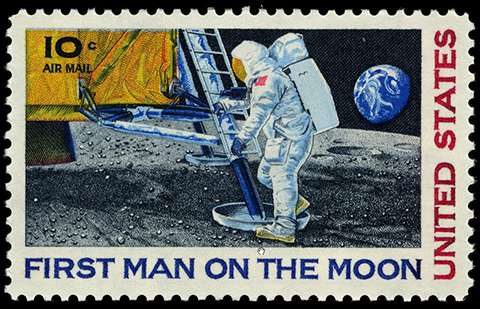
First Humans on the Moon: 07.20.69

Today marks the 50th anniversary of the moon landing of the Apollo 11 Lunar Module Eagle (20:17 UTC, July 20, 1969). Some six hours later (02:56:15 UTC), Neil Armstrong became the first human to set foot on the moon, whereupon he uttered the immortal words: "That's one small step for [a] man, one giant leap for mankind." Edwin "Buzz" Aldrin joined him on the lunar surface a few minutes later, while the third NASA astronaut on the  Apollo 11 mission, Michael Collins, remained in orbit around the moon. A vast archive of the entire spaceflight, including 11,000 hours of Mission Control audio and other original historical documentation, is available at Apollo 11 in Real Time.

The Sixties in America were an especially tumultuous period of social protest by many constituencies, so it is not too surprising that the moon landing itself was also the subject of criticism. Indeed, no less a figure than the highly accomplished space scientist Dr. James Van Allen [1914-2006] of the University of Iowa objected throughout his career to the vast resources that were expended on manned space flight as opposed to other more economical and efficient means of exploration and research.

On the cultural front, poet, musician, and activist Gil Scott-Heron in 1970 composed and recorded the song, "Whitey on the Moon," which contrasts the poverty and medical expenses of the song's protagonist to the fact that astronauts are now going to the moon. The lyrics raise poignant questions about how society allocates limited resources to fundamental needs such as health care. And in what is perhaps a reference to the air mail stamp that was issued in 1969 to commemorate the moon landing (pictured above), the song concludes: "I think I'll send these doctor bills, airmail special (to Whitey on the moon)." Various versions of this song, as well as Scott-Heron's "The Revolution Will Not Be Televised" are available on YouTube.

The last man on the moon (and all twelve NASA astronauts that walked on the moon were male--and white) was Eugene Cernan, who commanded the Apollo 17 mission in December 1972. His parting words as the lunar module left the celestial body closest to Earth were: "We leave as we came and, god willing, as we shall return, with peace, and hope for all mankind."

Thursday, July 4, 2019

We the People Have the Power

Patti Smith and Fred "Sonic" Smith [1948-1994] are shown here performing "People Have the Power," a song they co-wrote and which was included on Patti Smith's 1988 album, Dream of Life. The official music video for the song is viewable here.

Of related interest on the Fourth of July are Mark Twain's Independence Day Peroration and the Declaration of Independence, which is housed at the National Archives in Washington, D.C. The parchment document is thought to have been engrossed by Timothy Matlack, and although it is dated July 4, 1776, it was not signed by members of the Continental Congress until August 2, 1776; additional delegates later signed it, for a total of 56 signatories.

Sunday, May 5, 2019

Pete Seeger on Vellum


Pete Seeger [1919-2014], who would have turned 100 on May 3rd, featured a wise and well-worn calligraphic inscription on his banjo head, also known as a "vellum," for the parchment out which it was made. The credo, "This machine surrounds hate and forces it to surrender," parallels one that fellow traveller Woody Guthrie displayed prominently on his guitar, namely, "This machine kills fascists."

To mark his birthday centennial, Smithsonian Folkways has just released "Pete Seeger: The Smithsonian Folkways Collection," a career-spanning anthology that contains 137 tracks on 6 CDs (including 20 previously unreleased), as well as a book of essays and other documentation. Seeger himself once offered some curatorial advice to the archivists and production staff at Smithsonian Folkways, recommending that they "find the homemade honesty of great folk music in every country of the world."

Sunday, March 24, 2019

Ritchie Valens, Dexter Gordon & Nina Simone among Artists Added to the National Recording Registry

Now in its seventeenth year, the National Recording Registry has grown to 525 entries with Librarian of Congress Carla Hayden having just announced 25 additional sound recordings as the official entries for 2018, stating: “The National Recording Registry honors the music that enriches our souls, the voices that tell our stories and the sounds that mirror our lives. The influence of recorded sound over its nearly 160-year history has been profound and technology has increased its reach and significance exponentially. The Library of Congress and its many collaborators are working to preserve these sounds and moments in time, which reflect our past, present and future.”

Under the National Recording Preservation Act of 2000, selected recordings must be "culturally, historically, or aesthetically significant" and at least ten years old.


Spanning the years 1901-2001, the selections for 2018 are as follows:


  1. Yiddish Cylinders from the Standard Phonograph Company of New York and the Thomas Lambert Company (c. 1901-1905)
  2. “Memphis Blues” (single), Victor Military Band (1914)
  3. Melville Jacobs Collection of Native Americans of the American Northwest (1929-1939)
  4. “Minnie the Moocher” (single), Cab Calloway (1931)
  5. “Bach Six Cello Suites” (album), Pablo Casals (c. 1939)
  6. “They Look Like Men of War” (single), Deep River Boys (1941)
  7. “Gunsmoke” — Episode: “The Cabin” (Dec. 27, 1952)
  8. Ruth Draper: Complete recorded monologues, Ruth Draper (1954-1956)
  9. “La Bamba” (single), Ritchie Valens (1958)
  10. “Long Black Veil” (single), Lefty Frizzell (1959)
  11. “Stan Freberg Presents the United States of America, Vol. 1: The Early Years” (album), Stan Freberg (1961)
  12. “GO” (album), Dexter Gordon (1962)
  13. “War Requiem” (album), Benjamin Britten (1963)
  14. “Mississippi Goddam” (single), Nina Simone (1964)
  15. “Soul Man” (single), Sam & Dave (1967)
  16. “Hair” (original Broadway cast recording) (1968)
  17. Speech on the Death of Dr. Martin Luther King, Jr., Robert F. Kennedy (April 4, 1968)
  18. “Sweet Caroline” (single), Neil Diamond (1969)
  19. “Superfly” (album), Curtis Mayfield (1972)
  20. “Ola Belle Reed” (album), Ola Belle Reed (1973)
  21. “September” (single), Earth, Wind & Fire (1978)
  22. “You Make Me Feel (Mighty Real)” (single), Sylvester (1978)
  23. “She’s So Unusual” (album), Cyndi Lauper (1983)
  24. “Schoolhouse Rock!: The Box Set” (1996)
  25. “The Blueprint” (album), Jay-Z (2001)
The full National Recording Registry can be viewed online here. The Registry solicits nominations annually for inclusion on the registry; further information on the criteria and procedures for making nominations for 2019 is available at the Registry website.

Sunday, February 3, 2019

The Day the Music Died, 1959

Buddy Holly, Ritchie Valens, and J.P. "The Big Bopper" Richardson all played their last concert, which was part of the Winter Dance Party Tour, at the Surf Ballroom in Clear Lake, Iowa. Headed out to their next gig after the show, a plane crash killed all three and the pilot, Roger Peterson, shortly after takeoff at around 1am on February 3, 1959--60 years ago today.

Musician Don McLean released the song, "American Pie," which references the tragedy, on the American Pie album in 1971. In 2017, the song was selected for the National Recording Registry at the Library of Congress. The above video depicts a live performance at the BBC in 1972.

Thursday, October 11, 2018

Quiet Pride: The Elizabeth Catlett Project

Jazz bassist and composer Rufus Reid will be performing "Quiet Pride: The Elizabeth Catlett Project" along with his large jazz ensemble at Hancher Auditorium on Saturday, October 13, 2018. Reid's composition was inspired by the sculptural work of artist Elizabeth Catlett [1915-2012], an African American woman who in 1940 was among the first three students to earn a Master of Fine Arts degree from the University of Iowa. Catlett's thesis advisor was Grant Wood. A video interview with Catlett conducted toward the end of her life can be viewed at the National Visionary Leadership Project.

Reid is currently undertaking a short residency at the University of Iowa as an Ida Cordelia Beam Distinguished Visiting Professor.