Since 2006, the Society of American Archivists (SAA) has designated May 1st as MayDay, or a day of action for both individuals and organizations such as archives, libraries, museums, and historical societies to improve their capacities to deal with emergencies that can threaten or destroy historical collections. The ravages of natural disasters such as the tornadoes and hurricanes of recent years are just some of the physical risks facing cultural heritage institutions.
Although the landmark study, A Public Trust at Risk: The Heritage Health Index Report on the State of America's Collections (2005), systematically documented that most institutions lack an adequate disaster preparedness plan, the SAA has worked to mitigate these deficiencies. The SAA web site provides recommendations for MayDay activities, as well as a compilation of resources, including technical literature and tools, disaster plan templates and examples, tutorials and courses, bibliographies, and other resources.
In recent years, the State Historical Society of Iowa (SHSI) has undergone severe cuts to both collections and services, which are documented in detail in a White Paper produced by the Save Iowa History Alliance. Leading historians on both a state and national level have addressed their concerns directly to the Iowa Governor and to the Director of the Iowa Department of Cultural Affairs, which oversees the SHSI.
Further details on these efforts, as well as contact information for key decision-makers, is available in the previous Common Curator posts: Save Iowa History and Save Iowa History 3. The complete White Paper on the State Historical of Iowa can be downloaded as a PDF.
Showing posts with label Museums. Show all posts
Wednesday, May 1, 2019
Monday, August 6, 2018
Happy Birthday, Andy Warhol!
Today is the 90th anniversary of the birth of artist Andy Warhol [1928-1987]. The eponymous Andy Warhol Museum is said to be the largest in the United States dedicated to the work of a single artist, and houses the largest collection of Warhol art and archives in the world.
Among the Museum's holdings is Warhol's experimentation in 1985 with digital art using an Amiga 1000 computer supplied to him by Commodore International. Using ProPaint software, Warhol executed a portrait of singer Debbie Harry of Blondie during a live product launch. Warhol later made several other electronic images, including a version of one of his notorious Campbell's Soup paintings, a series of 32 varieties first exhibited in 1962.
Labels:
Archives,
Art,
Common Curator,
Images,
Museums,
Preservation
Sunday, May 13, 2018
"Whistler's Mother" Rearranged
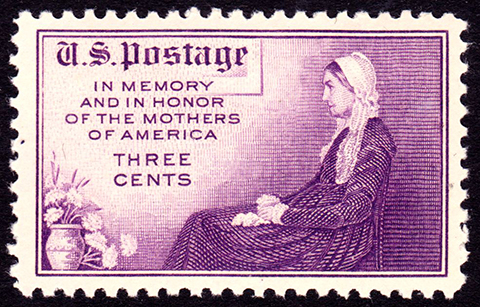
President Franklin D. Roosevelt, himself an avid philatelist, took a strong interest in stamps as a means to communicate. He had a close working relationship with the Postmaster General James A. Farley, and contributed several design ideas for stamps issued during his time in office (1933-1945).
Among these was Roosevelt's suggestion that "Arrangement in Grey and Black No. 1," the iconic painting by James Abbott McNeill Whistler, be used as the basis for a stamp commemorating Mother's Day. Also known as "Portrait of the Artist's Mother," or simply, "Whistler's Mother," the subject of the painting was prominently featured on a 3-cent stamp that was issued in 1934, just 20 years after Mother's Day became an official national holiday.
Though a seemingly faithful representation, the stamp drew criticism both for the manner in which the painting was cropped and for the addition of a vase of flowers. The American Artists Professional League went so far as to telegram the Postmaster General, stating the stamp was "a mutilation of the artist's original picture, robbing it of much of its charm." The painting is currently held by the Musée d'Orsay in Paris, and today's viewers can make their own aesthetic judgement.
More of Roosevelt's stamp designs can be seen as part of the National Postal Museum's online exhibition, Delivering Hope: FDR & Stamps of the Great Depression.
Labels:
Art,
Common Curator,
Design,
Event,
Images,
Museums,
Smithsonian
Tuesday, May 1, 2018
MayDay 2018: Saving Our History
Since 2006, the Society of American Archivists (SAA) has designated May 1st as MayDay, or a day of action for both individuals and organizations such as archives, libraries, museums, and historical societies to improve their capacities to deal with emergencies that can threaten or destroy historical collections. The ravages of natural disasters such as the tornadoes and hurricanes of recent years are just some of the physical risks facing cultural heritage institutions.
Although the landmark study, A Public Trust at Risk: The Heritage Health Index Report on the State of America's Collections (2005), systematically documented that most institutions lack an adequate disaster preparedness plan, the SAA has worked to mitigate these deficiencies. The SAA web site provides recommendations for MayDay activities, as well as a compilation of resources, including technical literature and tools, disaster plan templates and examples, tutorials and courses, bibliographies, and other resources.
In recent years, the State Historical Society of Iowa (SHSI) has undergone severe cuts to both collections and services, which are documented in detail in a recent White Paper produced by the Save Iowa History Alliance. Leading historians on both a state and national level have addressed their concerns directly to Governor Branstad and to Mary Cownie, Director of the Iowa Department of Cultural Affairs, which oversees the SHSI.
Further details on these efforts, as well as contact information for key decision-makers, is available in the previous Common Curator posts: Save Iowa History and Save Iowa History 3. The complete White Paper on the State Historical of Iowa can be downloaded as a PDF.
Although the landmark study, A Public Trust at Risk: The Heritage Health Index Report on the State of America's Collections (2005), systematically documented that most institutions lack an adequate disaster preparedness plan, the SAA has worked to mitigate these deficiencies. The SAA web site provides recommendations for MayDay activities, as well as a compilation of resources, including technical literature and tools, disaster plan templates and examples, tutorials and courses, bibliographies, and other resources.
In recent years, the State Historical Society of Iowa (SHSI) has undergone severe cuts to both collections and services, which are documented in detail in a recent White Paper produced by the Save Iowa History Alliance. Leading historians on both a state and national level have addressed their concerns directly to Governor Branstad and to Mary Cownie, Director of the Iowa Department of Cultural Affairs, which oversees the SHSI.
Further details on these efforts, as well as contact information for key decision-makers, is available in the previous Common Curator posts: Save Iowa History and Save Iowa History 3. The complete White Paper on the State Historical of Iowa can be downloaded as a PDF.
Labels:
Archives,
Common Curator,
History,
Iowa,
Libraries,
Museums,
Preservation,
SAA
Thursday, February 22, 2018
#FundLibraries #FundMuseums #FundArchives
The American Library Association's President Jim Neal has issued the following statement in response to the Trump administration's proposed elimination of the Institute for Library and Museum Services (IMLS) and the gutting of $183 million dollars for the Library Services Technology Act (LSTA):
“The administration’s FY2019 budget is out of touch with the real needs of Americans and the priorities of leaders in Congress who represent them. The president miscalculates the value of more than 120,000 libraries across America, just as he did in his FY2018 budget proposal.
“There is bipartisan support for libraries in Congress, where decision-makers know that to cut funding for libraries is to undercut opportunity for their constituents.
“Thanks to its Grants to States program, IMLS funding provides services that benefit everyone in our communities, including:
- Veterans in California who receive assistance claiming well-earned benefits to further their education, get medical treatment, start a business and transition to civilian life.
- Students in Arkansas who prepare for today’s competitive job market by participating in coding classes taught by trained school and public librarians.
- Entrepreneurs in rural North Carolina who received business development assistance from an IMLS-funded business and technology outreach librarian.
- Adults in Kansas who take GED courses and use otherwise cost-prohibitive exam preparation tools to advance their education and improve career prospects.
“Withholding federal support for libraries means withholding services that foster achievement, develop the workforce, and contribute to local economies. ALA members will continue to highlight the value of libraries to our elected leaders in every US congressional district. And we are confident that our congressional leaders will continue to protect the federal programs that invest in our communities.”
Wednesday, February 14, 2018
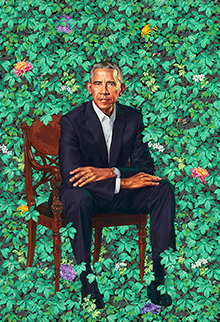
Portraits of President Obama and First Lady Unveiled at Smithsonian National Portrait Gallery
The collections of the Smithsonian's National Portrait Gallery, which holds the nation's only complete set of presidential portraits outside the White House, were recently augmented as newly-commissioned portraits of the 44th president, Barack Obama, and former First Lady Michelle Obama, were unveiled on February 12, 2018 at a ceremony presided over by Smithsonian Secretary David Skorton and National Portrait Gallery Director Kim Sajet. The President's portrait was painted by artist Kehinde Wiley, and the First Lady's portrait by artist Amy Sherald.
National Portrait Gallery Director Sajet observed:
As a museum of history and art, we have learned over the past half-century that the best portraiture has the power to bring world leaders into dialogue with everyday Americans. These two paintings fall into that category, and we believe they will serve as an inspiration for generations to come.Wiley and Sherald are the first African American artists that have ever been commissioned for official portraits of a President or First Lady.
Labels:
Art,
Black History,
Common Curator,
Event,
Exhibition,
Museums,
Smithsonian
Thursday, October 12, 2017
UNESCO Statement on the Withdrawal of the United States from Membership
Irina Bokova, Director-General of UNESCO, delivered on October 12, 2017 a statement of "profound regret" on the decision of the United States to withdraw from the United Nations Educational, Scientific and Cultural Organization effective December 31, 2018. Bakova stated that "Universality is critical to UNESCO’s mission to strengthen international peace and security in the face of hatred and violence, to defend human rights and dignity," and delineated numerous initiatives, collaborations, and projects that have involved the United States, which was one of the original signers of the Constitution of UNESCO on November 16, 1945.
One notable UNESCO program achievement, in 2008, was the designation of Iowa City, Iowa as a UNESCO City of Literature. It was just the third city in the world to be accorded such recognition, and to date is the only such city in the United States. Iowa City UNESCO City of Literature Executive Director John Kenyon, in an article in the Iowa City Press-Citizen, observed that he was personally very disappointed by the withdrawal, and noted that "This decision has not made things better for UNESCO." He also remarked that "UNESCO's ability to better the world was compromised" when the United States ceased paying membership contributions in 2011 under the Obama administration.
A press statement by the U.S. Department of State earlier today indicates that UNESCO was informed, despite the withdrawal, of the United States' ongoing:
It is worth recalling that the Preamble to the Constitution of UNESCO begins with the assertion "that since wars begin in the minds of men, it is in the minds of men that the defences of peace must be constructed." And today that must include the minds of everyone.
One notable UNESCO program achievement, in 2008, was the designation of Iowa City, Iowa as a UNESCO City of Literature. It was just the third city in the world to be accorded such recognition, and to date is the only such city in the United States. Iowa City UNESCO City of Literature Executive Director John Kenyon, in an article in the Iowa City Press-Citizen, observed that he was personally very disappointed by the withdrawal, and noted that "This decision has not made things better for UNESCO." He also remarked that "UNESCO's ability to better the world was compromised" when the United States ceased paying membership contributions in 2011 under the Obama administration.
A press statement by the U.S. Department of State earlier today indicates that UNESCO was informed, despite the withdrawal, of the United States' ongoing:
. . . desire to remain engaged with UNESCO as a non-member observer state in order to contribute U.S. views, perspectives and expertise on some of the important issues undertaken by the organization, including the protection of world heritage, advocating for press freedoms, and promoting scientific collaboration and education.Meanwhile, the Iowa City Book Festival continues this week with its full slate of activities, including events celebrating the 50th anniversary of the International Writing Program. Festival highlights for today also include the bestowal of the Paul Engle Prize to this year's recipient, Alexander Chee.
It is worth recalling that the Preamble to the Constitution of UNESCO begins with the assertion "that since wars begin in the minds of men, it is in the minds of men that the defences of peace must be constructed." And today that must include the minds of everyone.
Labels:
Archives,
Art,
Common Curator,
Education,
Event,
History,
Human Rights,
Iowa,
Libraries,
Literacy,
Literature,
Museums,
Science,
UNESCO,
United Nations,
Video
Monday, May 1, 2017
MayDay 2017: Saving Our Heritage
Since 2006, the Society of American Archivists (SAA) has designated May 1st as MayDay, or a day of action for both individuals and organizations such as archives, libraries, museums, and historical societies to improve their capacities to deal with emergencies that can threaten or destroy historical collections. The ravages of natural disasters such as the tornadoes and hurricanes of recent years are just some of the physical risks facing cultural heritage institutions.
Although the landmark study, A Public Trust at Risk: The Heritage Health Index Report on the State of America's Collections (2005), systematically documented that most institutions lack an adequate disaster preparedness plan, the SAA has worked to mitigate these deficiencies. The SAA web site provides recommendations for MayDay activities, as well as a compilation of resources, including technical literature and tools, disaster plan templates and examples, tutorials and courses, bibliographies, and other resources.
In recent years, the State Historical Society of Iowa (SHSI) has undergone severe cuts to both collections and services, which are documented in detail in a recent White Paper produced by the Save Iowa History Alliance. Leading historians on both a state and national level have addressed their concerns directly to Governor Branstad and to Mary Cownie, Director of the Iowa Department of Cultural Affairs, which oversees the SHSI.
Further details on these efforts, as well as contact information for key decision-makers, is available in the previous Common Curator posts: Save Iowa History and Save Iowa History 3. The complete White Paper on the State Historical of Iowa can be downloaded as a PDF.
Although the landmark study, A Public Trust at Risk: The Heritage Health Index Report on the State of America's Collections (2005), systematically documented that most institutions lack an adequate disaster preparedness plan, the SAA has worked to mitigate these deficiencies. The SAA web site provides recommendations for MayDay activities, as well as a compilation of resources, including technical literature and tools, disaster plan templates and examples, tutorials and courses, bibliographies, and other resources.
In recent years, the State Historical Society of Iowa (SHSI) has undergone severe cuts to both collections and services, which are documented in detail in a recent White Paper produced by the Save Iowa History Alliance. Leading historians on both a state and national level have addressed their concerns directly to Governor Branstad and to Mary Cownie, Director of the Iowa Department of Cultural Affairs, which oversees the SHSI.
Further details on these efforts, as well as contact information for key decision-makers, is available in the previous Common Curator posts: Save Iowa History and Save Iowa History 3. The complete White Paper on the State Historical of Iowa can be downloaded as a PDF.
Labels:
Archives,
Common Curator,
Iowa,
Libraries,
Museums,
Preservation,
SAA
Thursday, April 13, 2017
Fight for Libraries; Fight for Museums; Save the Institute of Museum & Library Services (IMLS)
For this year's National Library Week (April 9-15, 2017), the American Library Association (ALA) has designated April 13 as Take Action for Libraries Day as part of an ongoing advocacy campaign to counter the Administration's proposed draconian budget cuts, which include the elimination of the Institute of Museum and Library Services (IMLS), the leading federal agency supporting the work of museums and libraries nationwide.
Specifically, the ALA is calling on Congress to preserve funding levels for the Library Services and Technology Act (LSTA), as well as the Innovative Approaches to Literacy (IAL) program. For those wishing to engage directly in the effort to support libraries and museums of all types, the ALA offers an array of advocacy resources online.
The stated mission of the IMLS is "to inspire libraries and museums to advance innovation, lifelong learning, and cultural and civic engagement," by providing "leadership through research, policy making, and grant making." The Common Curator can attest firsthand to the vital importance of the IMLS mission, having worked on two major IMLS digitization grants to help create two substantial and significant digital collections that are freely accessible online.
As Project Director, the Common Curator received a $120,300 grant to build the North Carolina History of Health Digital Collection, which makes available some 350,000 pages of core health-related journal literature from 1849 to the present. Earlier, as Digital Production Editor & Metadata Coordinator, he helped build American Journeys: A Digital Library and Learning Center, which features eyewitness accounts of early American exploration and settlement from around 1500 to 1850. It, too, has been heavily utilized since its launch, attracting hundreds of thousands of users annually.
It is estimated there are 123,000 libraries and 35,000 museums in the U.S. Moreover, it is estimated that 169 million people over 14 are library users (69% of the population), while 148 million people over 18 visit a museum annually. Clearly, there is a critical demand and need for memory institutions, which is consistent with the IMLS vision, namely, "A democratic society where communities and individuals thrive with broad public access to knowledge, cultural heritage, and lifelong learning."
Labels:
ALA,
Archives,
Common Curator,
Education,
IMLS,
Libraries,
Museums,
Public Policy
Saturday, February 13, 2016
Grant Wood at 125
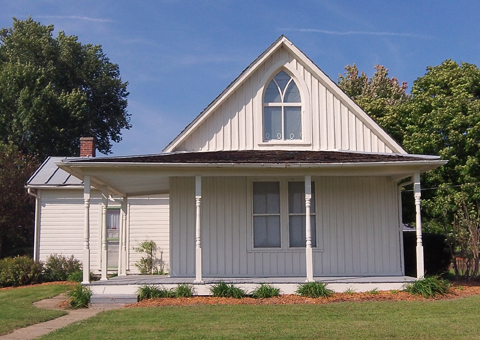
Today is the 125th anniversary of the birth of artist Grant Wood [1891-1942]. Pictured above is the house in Eldon, Iowa that is portrayed in the background of his most famous painting, American Gothic. An iconic work that has been parodied countless times since its execution in 1930, Wood based the taciturn farm couple on his own sister and dentist. The painting won a bronze medal in a competition sponsored by the Art Institute of Chicago, where it has remained as part of their permanent collection.
Further information on Grant Wood can be found in previous Common Curator posts: Grant Wood Sketchbook Returns to Figge Art Museum and 120th Anniversary of Grant Wood's Birth.
Labels:
Art,
Common Curator,
Exhibition,
Grant Wood,
Images,
Iowa,
Museums
Wednesday, June 17, 2015
Save Iowa History 3
The President and Executive Director of the American Historical Association (AHA), the leading professional organization of historians in the United States, sent the above letter on June 16, 2015 to Iowa Governor Terry Branstad and the leadership of the Iowa Department of Cultural Affairs to protest further cuts in funding for staff, services, and research collections at the State Historical Society of Iowa.
For further information, see earlier Common Curator posts: Save Iowa History (with petition and contact information) and Save Iowa History 2 (with survey).
Labels:
Archives,
Common Curator,
Iowa,
Libraries,
Museums,
Preservation
Wednesday, June 3, 2015
Save Iowa History 2
The State Historical Society of Iowa is presently soliciting public input about its collections and services via an online survey, as described below:
WHAT: The State Historical Society of Iowa (SHSI) wants your input about what and how you use our historical collections to conduct research.
WHO: The survey is open to the public. We encourage all Iowans interested in history and other researchers to participate - from students to scholarly to general interest.
WHEN: The survey will be open through Tuesday, June 30, 2015. You may complete it only once.
HOW: Take the survey here. It will take approximately 10 minutes or less to complete.
WHY: This survey is an important step in the SHSI Collections Planning process currently underway. It will help SHSI plan for how Iowa's history is best managed, preserved, and accessed by Iowans and researchers.
Your input is valuable as SHSI sets priorities for future care of its historical collections. We will continue to serve those already invested in Iowa history--and want to inspire new generations of historians across Iowa's 99 counties.
NEXT STEPS: To receive news about SHSI, please sign up for the Iowa Historian, the Society's newsletter.
More information about the Society's resources and activities can be found at the SHSI website.
WHAT: The State Historical Society of Iowa (SHSI) wants your input about what and how you use our historical collections to conduct research.
WHO: The survey is open to the public. We encourage all Iowans interested in history and other researchers to participate - from students to scholarly to general interest.
WHEN: The survey will be open through Tuesday, June 30, 2015. You may complete it only once.
HOW: Take the survey here. It will take approximately 10 minutes or less to complete.
WHY: This survey is an important step in the SHSI Collections Planning process currently underway. It will help SHSI plan for how Iowa's history is best managed, preserved, and accessed by Iowans and researchers.
Your input is valuable as SHSI sets priorities for future care of its historical collections. We will continue to serve those already invested in Iowa history--and want to inspire new generations of historians across Iowa's 99 counties.
NEXT STEPS: To receive news about SHSI, please sign up for the Iowa Historian, the Society's newsletter.
More information about the Society's resources and activities can be found at the SHSI website.
Labels:
Archives,
Common Curator,
Iowa,
Libraries,
Museums
Sunday, November 30, 2014
Library at UK's Imperial War Museum Facing Elimination
The Imperial War Museum (IWM) in the UK is facing substantial cuts to collections and services, particularly its Library. Founded in 1917, the IWM maintains significant research collections related to "all aspects of twentieth- and twenty-first century conflict involving Britain, the Commonwealth and other former empire countries." Over 11,000 supporters have so far signed an online petition urging a reversal of the proposed closure of the Library, reduction of educational programs, and job losses.
Labels:
Archives,
Common Curator,
Libraries,
Military,
Museums
Tuesday, September 30, 2014
Grant Wood Sketchbook Returns to Figge Art Museum

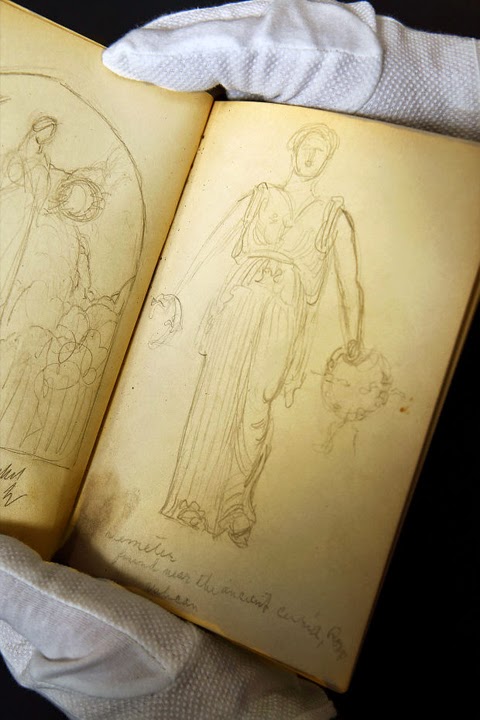
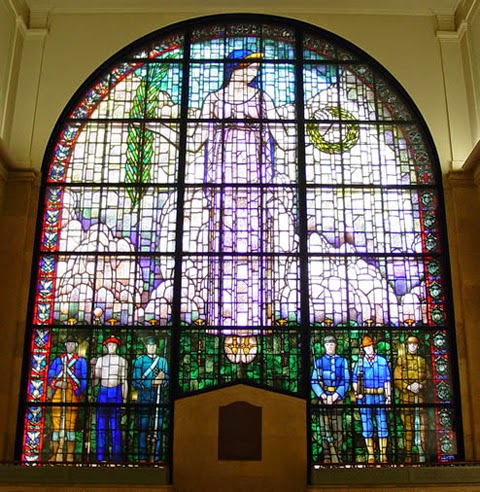
Missing for several decades, a sketchbook by world-renowned Iowa artist Grant Wood [1891-1942] was recently reclaimed by the Figge Art Museum in Davenport, Iowa. Part of a collection acquired in 1965 from Wood's sister, Nan Wood Graham, the sketchbook contains notes and plans for the stained glass window he designed for the Veterans Memorial Building in Cedar Rapids in 1928.
The window depicts soldiers in privates' uniforms from the six major U.S. wars up to that time: the Revolutionary War, the War of 1812, the Mexican War, the Civil War, the Spanish-American
War, and the First World War; the soldiers are surmounted by a large female figure said to represent the Republic. To oversee the fabrication of the window directly, Wood travelled to Munich, Germany, one of several trips to Europe he made early in his career.
The recovered sketchbook is thought to have been stolen shortly after its acquisition by the Davenport Municipal Art Gallery, the Figge's predecessor. Andrew Wallace, the Figge's current Manager of Collections and Exhibitions, was instrumental in researching the loss of the sketchbook and in negotiating its return after it was slated for auction. More information on this fortunate turn of events can be found in an article in the Quad-City Times.
Much of Grant Wood's personal archive has been digitized. The University of Iowa hosts the Figge Art Museum Grant Wood Digital Collection and several dozen images have been digitized by the Archives of American Art in their Grant Wood Collection, 1930-1983.
The Cedar Rapids Museum of Art is home to the world's largest collection of Grant Wood artwork, and features the Grant Wood Gallery. Curious individuals can discover more about Wood's life and times by visiting stops along Iowa's Grant Wood Trail. American Gothic, Wood's iconic masterpiece painted in 1930, is housed in the Art Institute of Chicago.
Note: Top image is from the Quad-City Times; bottom image is from the Veterans Memorial Building. A previous Common Curator post of related interest is the 120th Anniversary of Grant Wood's Birth.
Labels:
Art,
Common Curator,
Grant Wood,
Images,
Iowa,
Military,
Museums
Thursday, May 1, 2014
MayDay 2014: Saving Our History
Although the landmark study, A Public Trust at Risk: The Heritage Health Index Report on the State of America's Collections (2005), systematically documented that most institutions lack an adequate disaster preparedness plan, the SAA has worked to mitigate these deficiencies. The SAA web site provides recommendations for MayDay activities, as well as a compilation of resources, including technical literature and tools, disaster plan templates and examples, tutorials and courses, bibliographies, and other resources.
May 1st, of course, is also International Workers' Day, which serves to commemorate the anniversary of the Haymarket Affair in Chicago. The eight-hour workday was a central demand of the Chicago labor movement in the 1860s, and a week-long, city-wide strike began on May 1, 1867. The strike collapsed, but the issue remained, with the Federation of Organized Trades and Labor Unions in 1884 calling for workers to take direct action and begin observing the eight-hour day on May 1, 1886. More on IWD can be found in the Common Curator post, the 125th Anniversary of the Haymarket Affair.
Labels:
Archives,
Common Curator,
Event,
History,
Images,
Labor,
Libraries,
Museums,
Preservation,
SAA
Sunday, April 27, 2014
Kickstarting the Morbid Anatomy Museum
Spearheaded by Joanna Ebenstein, creator of the Morbid Anatomy blog in 2007, the Kickstarter campaign for the new Morbid Anatomy Museum located in Brooklyn, New York has just surpassed its goal of $60,000. There is, however, still another five days to contribute to this worthwhile project, which will:
. . . feature permanent and temporary exhibitions, a café/bar, a gift shop, an expanded library and more ambitious programming. It will be a beautiful and inspiring space to foster our unique international community of supporters, friends, artists, rogue scholars and like-minded enthusiasts; a place which enshrines that which we hold dear, a place to study, to delight; a place to “meet the others.”To learn more about this ambitious undertaking, visit the Morbid Anatomy Museum project page on Kickstarter. Ebenstein, along with co-editor Colin Dickey, recently concluded another highly successful Kickstarter project with the publication of The Morbid Anatomy Anthology, a well-illustrated and handsomely-produced volume of essays on a number of fascinating topics.
Labels:
Anatomy,
Common Curator,
Kickstarter,
Museums,
Video
Tuesday, May 31, 2011
Scarabocchio Art Museum Reopening

The Scarabocchio Art Museum (SAM), a joint venture of the University of Wisconsin--Stevens Point (UWSP) and the City of Stevens Point, is reopening May 31, 2011. Located in downtown Stevens Point, the gallery's reopening will coincide with the reception for Monoprint 2011: A Gathering of Artists, a weeklong workshop featuring 12 printmakers from the U.S. and abroad in residence at the University.
SAM was founded by Dr. David Smith, an emeritus faculty member in the Department of Art & Design at UWSP, and the reopening will have on display a retrospective of Smith's scarabocchio-style originals dating from 1973 to 2009. The Museum's current mission is to continue to serve as a venue for Smith's work, while providing opportunities for performing and fine arts activities and art-related education and programming through collaborative efforts. SAM hopes to provide a setting for events that enhance the cultural and intellectual growth of the community. The Curator of SAM is Brian Borchardt.
Note: Scarabocchio is Italian for scribble or doodle, and the term has been used by Professor Smith to describe his style of drawings, as shown in the image above, executed in 2009.
Labels:
Art,
Common Curator,
Event,
Exhibition,
Images,
Museums
Wednesday, October 6, 2010
Chapel Hill Museum To Auction Memorabilia
The Chapel Hill Museum (North Carolina), which closed over the summer due to economic difficulties, will be holding an auction on Friday, October 8, 2010. Doors open at 6pm for registration and preview, with the auction commencing at 7pm. Chapel Hill memorabilia to be sold includes vintage photos and historic displays, items related to notable Chapel Hill residents, as well as vintage collectibles, oriental carpets, etc. Absentee bids will also be accepted in person on Thursday, October 7th from 10am to 2pm. Further information on the closing of the Museum, which was in operation since 1996, can be found on its web site.
Labels:
Common Curator,
Event,
In the News,
Museums,
North Carolina
Wednesday, September 1, 2010
Ask a Curator Day
September 1, 2010 is "Ask a Curator Day," a one-time worldwide Question & Answer event on Twitter. Modelled on the successful Follow a Museum event on February 1, 2010, users of Twitter can post questions to participating curators of art, history, science, and other collections at #askacurator. A list of individuals and institutions from over 20 countries available for questions can be viewed here.
Labels:
Archives,
Common Curator,
Event,
Museums,
Social Media,
Twitter
Tuesday, March 24, 2009
Military Medical Photographs Online
The National Museum of Health and Medicine has mounted a growing collection of archival photographic images on Flickr. Grouped at present into 30 different sets, the online images are just a small portion of the Museum’s collection of several hundred-thousand images. More information on the collection is available in a recent Wired Magazine blog posting.The Museum began as the Army Medical Museum during the Civil War in 1862 and assumed its present name in 1989. It is an element of the Armed Forces Institute of Pathology, and its holdings are divided into five main areas: Historical Collections; Anatomical Collections; Otis Historical Archives; Human Developmental Anatomy Center; and the Neuroanatomical Collections.
Located on the campus of the Walter Reed Army Medical Center in Washington, D.C., the Museum has an active exhibition program and sponsors various events. The Museum also publishes a newsletter, Flesh and Bones, which is available online. A group of Museum employees maintains an unofficial blog, A Repository of Bottled Monsters, with news of Museum activities.
The image above, depicting US Army Nurses serving at the 1st Reserve Hospital in Manila, the Philippines, was obtained from the Museum's Spanish-American War set on Flickr.
Labels:
Anatomy,
Blog,
Carolina Curator,
Digital Resource,
Images,
Museums
Subscribe to:
Posts (Atom)