Showing posts with label Women's History. Show all posts

Tuesday, May 21, 2019

The Path to Women's Suffrage: The 19th Amendment to the U.S. Constitution


House Joint Resolution 1 (H. J. Res. 1), proposing an amendment to the Constitution extending the right of suffrage to women, was introduced in the House of Representatives on May 19, 1919, and passed on May 21, 1919--100 years ago today. The resolution was soon approved by the Senate, on June 4, 1919, and over the course of the next 14-1/2 months was ratified by three-fourths of the states (with Tennessee becoming the 36th and last state necessary for ratification on August 18, 1920). On August 26, 1920, U.S. Secretary of State Bainbridge Colby certified H. J. Res. 1 as the 19th Amendment to the Constitution, the text of which reads: "The right of citizens of the United States to vote shall not be denied or abridged by the United States or by any State on account of sex. Congress shall have power to enforce this article by appropriate legislation."

Friday, March 8, 2019

International Women's Day: #ThinkEqual


March 8th marks the 108th anniversary of International Women's Day. The United Nations' theme for International Women's Day 2019 is "Think Equal, Build Smart, Innovate for Change." The video above features remarks by UN Women Executive Director Phumzile Mlambo-Ngcuka as well as the UN Secretary-General António Guterres and other UN leaders.

First celebrated on March 19, 1911 by more than one million people in Austria, Denmark, Germany, and Switzerland after a proposal by Clara Zetkin [1857-1933] in 1910 at the second International Conference of Working Women in Copenhagen, International Women's Day is now observed in many nations throughout the world.

The United Nations first began celebrating March 8 as International Women's Day during International Women's Year in 1975, and in 1977 approved a resolution proclaiming a United Nations Day for Women's Rights and International Peace for member states.

Tuesday, November 20, 2018

Corita Kent: Artist Extraordinaire at 100

Corita Kent [1918-1986] was born 100 years today, on November 20, 1918, in Fort Dodge, Iowa, and subsequently became world renowned for her work as a serigrapher (or screen printer), as well as for commissioned works both large (the Rainbow Swash on a massive gas storage tank outside of Boston) and small (the 1985 U.S.P.S. Love stamp, of which more than 700 million were sold).

As a Catholic nun, Sister Corita headed for several years the Art Department at the Immaculate Heart College in Los Angeles, California, where she instilled her artistic values of close observation, imagination, and social justice in her many students. A creative iconoclast in her own work, she famously formulated what could be considered "Corita's Decalogue," otherwise known as the "Immaculate Heart College Art Department Rules," of which Rule 7 is: "The only rule is work. If you work it will lead to something. It's the people who do all of the work all of the time who eventually catch on to things." Although she plainly cites artist John Cage in Rule 10, the ten rules are frequently misattributed to Cage rather than Corita herself.

Corita eventually left the order of the Sisters of the Immaculate Heart of Mary, and reentered secular life in 1968. She continued her prolific artistic output, which rivalled or surpassed many other artists of the era, including fellow screen printer, Andy Warhol. Corita was posthumously awarded an AIGA medal in 2016, and her legacy is sustained today by the Corita Art Center, which offers her original prints as well as ongoing programming. A recent major exhibition catalogue, Someday Is Now: The Art of Corita Kent, features much of her artwork and serves as an excellent introduction to her life and philosophy.

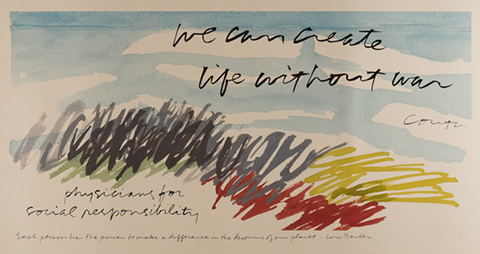
Corita died on September 18, 1986 at age 67, and her obituary in the Los Angeles Times can be read here. The video above, "Become a Microscope: 90 Statements on Sister Corita," is a short documentary produced by Aaron Rose to celebrate the 90th anniversary of her birthday. Below is one example of Corita's work, "We Can Create Life Without War," a poster commissioned in 1983 by the organization, Physicians for Social Responsibility. An illustrated chronology of Corita's life can be viewed at the Corita Art Center website.


Thursday, October 11, 2018

Quiet Pride: The Elizabeth Catlett Project

Jazz bassist and composer Rufus Reid will be performing "Quiet Pride: The Elizabeth Catlett Project" along with his large jazz ensemble at Hancher Auditorium on Saturday, October 13, 2018. Reid's composition was inspired by the sculptural work of artist Elizabeth Catlett [1915-2012], an African American woman who in 1940 was among the first three students to earn a Master of Fine Arts degree from the University of Iowa. Catlett's thesis advisor was Grant Wood. A video interview with Catlett conducted toward the end of her life can be viewed at the National Visionary Leadership Project.

Reid is currently undertaking a short residency at the University of Iowa as an Ida Cordelia Beam Distinguished Visiting Professor.

Wednesday, March 7, 2018

International Women's Day: #TimeIsNow

March 8th marks the 107th anniversary of International Women's Day. The United Nations' theme for International Women's Day 2018 is "Time Is Now: Rural and Urban Activists Transforming Women's Lives." The video above features remarks by UN Women Executive Director Phumzile Mlambo-Ngcuka.

First celebrated on March 19, 1911 by more than one million people in Austria, Denmark, Germany, and Switzerland after a proposal by Clara Zetkin [1857-1933] in 1910 at the second International Conference of Working Women in Copenhagen, International Women's Day is now observed in many nations throughout the world.

The United Nations first began celebrating March 8 as International Women's Day during International Women's Year in 1975, and in 1977 approved a resolution proclaiming a United Nations Day for Women's Rights and International Peace for member states.

Wednesday, March 8, 2017

International Women's Day: #BeBoldForChange


March 8th marks the 106th anniversary of International Women's Day. The United Nations' theme for International Women's Day 2017 is "Women in the Changing World of World: Planet 50-50 by 2030." The video above features remarks by UN Women Executive Director Phumzile Mlambo-Ngcuka.

First celebrated on March 19, 1911 by more than one million people in Austria, Denmark, Germany, and Switzerland after a proposal by Clara Zetkin [1857-1933] in 1910 at the second International Conference of Working Women in Copenhagen, International Women's Day is now observed in many nations throughout the world.

The United Nations first began celebrating March 8 as International Women's Day during International Women's Year in 1975, and in 1977 approved a resolution proclaiming a United Nations Day for Women's Rights and International Peace for member states.

Thursday, September 15, 2016

Dr. Carla Hayden Sworn in as Librarian of Congress

Dr. Carla Hayden was sworn in as the 14th Librarian of Congress by Chief Justice John G. Roberts, Jr. on September 14, 2016. Nominated by President Obama on February 24, 2016, Dr. Hayden was confirmed by the U.S. Senate after her confirmation hearing on April 20, 2016. She is both the first woman and first African American to serve as Librarian of Congress since the Library was established in 1800.

Wednesday, June 29, 2016

The Equal Rights Amendment: Yesterday and Today


There have been more than 11,000 attempts since 1787 to amend the U.S. Constitution, with only 27 successes. The Equal Rights Amendment (ERA) was introduced into every session of Congress between 1923 and 1972, when it was finally passed by Congress. Ultimately, however, it failed to be ratified by the required three-fourths of the states to be become part of the Constitution. Written in 1921, the proposed text reads:
Section 1. Equality of rights under the law shall not be denied or abridged by the United States or by any State on account of sex.
Section 2. The Congress shall have the power to enforce, by appropriate legislation, the provisions of this article.
Section 3. This amendment shall take effect two years after the date of ratification.
The video above features a panel discussion, The Equal Rights Amendment: Yesterday and Today [note that the speakers begin at 5:12], that was sponsored by the National Archives in partnership with the National Woman's Party. Held at the Belmont-Paul Women's Equality National Monument on June 16, 2016, the event was part of the programming that is accompanying the exhibition, Amending America, which runs through September 4, 2017 at the National Archives Museum.

For further historical information on the constitutional amendment process, see the dataset created by the National Archives: Amending America: Proposed Amendments to the United States Constitution, 1787 to 2014.

Wednesday, April 20, 2016

Librarian of Congress Confirmation Hearing

Dr. Carla Hayden is shown here on April 20, 2016 delivering her opening statement at the Senate confirmation hearing on her nomination to become Librarian of Congress. The entirety of the hearing can be viewed via C-Span. Hayden was nominated to become the 14th Librarian of Congress by President Obama on February 24, 2016.

Tuesday, March 8, 2016

International Women's Day: Step It Up for Gender Equality


March 8th marks the 105th anniversary of International Women's Day. The United Nations' theme for International Women's Day 2016 is "Planet 50-50 by 2030: Step It Up for Gender Equality." The video above features remarks by UN Women Executive Director Phumzile Mlambo-Ngcuka.

First celebrated on March 19, 1911 by more than one million people in Austria, Denmark, Germany, and Switzerland after a proposal by Clara Zetkin [1857-1933] in 1910 at the second International Conference of Working Women in Copenhagen, International Women's Day is now observed in many nations throughout the world.

The United Nations first began celebrating March 8 as International Women's Day during International Women's Year in 1975, and in 1977 approved a resolution proclaiming a United Nations Day for Women's Rights and International Peace for member states.

Saturday, March 8, 2014

International Women's Day 2014

 
March 8, 2014 marks the 103st anniversary of International Women's Day. The United Nations' theme for International Women's Day 2014 is "Equality for Women Is Progress for All."  The video above features remarks by UN Women Executive Director Phumzile Mlambo-Ngcuka.

First celebrated on March 19, 1911 by more than one million people in Austria, Denmark, Germany, and Switzerland after a proposal by Clara Zetkin [1857-1933] in 1910 at the second International Conference of Working Women in Copenhagen, International Women's Day is now observed in many nations throughout the world.

The United Nations first began celebrating March 8 as International Women's Day during International Women's Year in 1975, and in 1977 approved a resolution proclaiming a United Nations Day for Women's Rights and International Peace for member states.

Friday, March 8, 2013

A Song for International Women's Day 2013


Launching on International Women's Day, celebrated annually on March 8th, "One Woman" is "a rallying cry that inspires listeners to join the drive for women's rights and gender equality." The song was written for UN Women, the United Nations Entity for Gender Equality and the Empowerment of Women.

The theme for this year's International Women’s Day is "A promise is a promise: Time for action to end violence against women." Violence against women is "a gross human rights violation that affects up to 7 in 10 women and a top priority for UN Women." For further information and a schedule of events sponsored by UN Women, including a live webcast, visit the IWD 2013 website.

Wednesday, March 7, 2012

International Women's Day 2012


March 8, 2012
marks the 101st anniversary of International Women's Day. First celebrated on March 19, 1911 by more than one million people in Austria, Denmark, Germany, and Switzerland after a proposal by Clara Zetkin [1857-1933] in 1910 at the second International Conference of Working Women in Copenhagen, International Women's Day is now observed in many nations throughout the world.

The United Nations first began celebrating March 8 as International Women's Day during International Women's Year in 1975, and in 1977 approved a resolution proclaiming a United Nations Day for Women's Rights and International Peace for member states.

The UN's theme for International Women's Day 2012 is "Empower Rural Women--End Hunger and Poverty." The video above, produced by UN Women, is entitled, "Columbia: Wayuu Gold, Fighting for Access to Fresh Water," and details the campaign led by Griselda Polanco to obtain a secure water supply for her village. In 2006, Griselda's sister, Orsinia Polanco, was the first indigenous woman elected to the Columbian Congress, and she has worked tirelessly to make access to water a fundamental right for all Columbians, including the Wayuu and other indigenous peoples.

Thursday, January 12, 2012

North Carolina Eugenics Task Force Recommends $50,000 Reparations for Survivors

In North Carolina over 7,600 people were sterilized between 1929 and 1974 under the state’s Eugenics Sterilization Program. Indiana was the first state to implement such a program, and eventually over 30 states followed suit, including North Carolina in 1929. The Eugenics Board of North Carolina reviewed petitions for sterilizations and authorized sterilizations in over 90% of cases. Of those sterilized, approximately 38% were black and 84% were female; moreover, 71% were classified as “feebleminded.” While most states’ sterilization programs diminished in scope after World War II, almost 80% of North Carolina’s cases occurred after 1945. By the late 1960’s over 60% of those sterilized in North Carolina were black and 99% were female.

In 1972 the Eugenics Board became the Eugenics Commission, and was finally abolished in 1977. In 2002, the state of North Carolina formally apologized to the victims of sterilization, and in 2003 the General Assembly repealed the law that authorized involuntary sterilization.

On March 8, 2011, Governor Beverly Perdue issued Executive Order 83 to create the Governor's Task Force to Determine the Method of Compensation for Victims of North Carolina's Eugenics Board, which functions with the support of the North Carolina Justice for Sterilization Victims Foundation. After months of investigation and public hearings, the Task Force issued a preliminary report on August 1, 2011 and three additional reports on December 6, 2011.

At its most recent meeting on January 10, 2012, the Task Force voted on its final recommendations, which included the recommendation that the state pay $50,000 to each surviving victim. In response, Governor Perdue issued the following statement:
Thank you to the devoted members of this task force for months of diligent, careful and thoughtful work to address one of the most difficult and emotionally wrenching issues in our state’s history.

While no amount of money will ever make up for the fact that government officials deprived North Carolinians, mostly women, of the possibility of having children—and officials did so, in most cases, without the victims’ consent or against their will—we must do something. I support the task force’s compensation proposal. I also agree that we should establish a permanent exhibit so that this shameful period is never forgotten. I look forward to reviewing the details of the task force’s recommendations.
Although it is unknown at present how many survivors there are, it is estimated that there may be as many as 1500 to 2000. The North Carolina Justice for Sterilization Victims Foundation strongly encourages anyone believing he or she was sterilized under the authority of the Eugenics Board of North Carolina to contact them for assistance in documenting a potential claim.

Readers interested in learning more about the historical background of eugenics can check out Eugenics in North Carolina at the State Library of North Carolina web site, as well as the Winston-Salem Journal's project, Against Their Will: North Carolina’s Sterilization Program.

In addition, the North Carolina History of Health Digital Collection, a grant project initiated and directed by the Common Curator, contains all volumes of the Biennial Report of the Eugenics Board of North Carolina [1934-1966], and the survey report, Eugenical Sterilization in North Carolina [1935].

Of related interest are an archival finding aid for Eugenics Commission documents and previous Common Curator posts: North Carolina Dedicates Eugenics Historical Marker and The History of Eugenics in North Carolina.

Tuesday, July 5, 2011

First Annual Ladies of Letterpress Conference

Ladies of Letterpress (LoLP), a trade organization for letterpress printers and aficionados of fine printing everywhere, will be holding its inaugural conference August 5-7, 2011 in Asheville, North Carolina. The schedule is loaded with events, including:

Panel Discussions:


--Letterpress As a Business
--Running and Starting a Community Print Shop
--Artist Books + Fine Press
--The Future of Letterpress!
--Teaching Letterpress in a University Settting
--Printing Collaborations for Community
--Lead Tweets: Or, How to Use Social Media to Promote Your Business

Demonstrations:


--The World of Handmade Paper
--Vandercook Care and Maintenance
--Making the Dead Feminist Broadside Series
--Getting to Know Your Tabletop Press
--Wood Engraving
--Catherine Realce of visualchemist

Speakers and demonstrators from leading small presses around the country will be on hand, with the keynote presentation to be delivered by Judith Berliner of Full Circle Press. In addition, a Printer's Fair and Trade Fair will run during the conference. A reduced rate for registration will be available through July 12, 2011.

The co-founders of Ladies of Letterpress are Jessica White, of Heroes and Criminals Press, and Kseniya Thomas, of Thomas-Printers. Further information about the organization and the conference can be found on the LoLP and conference web sites. (Note: The shirt pictured above was designed by Todd Thyberg of Angel Bomb Design, and can be ordered online.)

Monday, March 7, 2011

Centennial of International Women's Day


March 8, 2011
marks the 100th anniversary of International Women's Day (IWD). First celebrated on March 19, 1911 by more than one million people in Austria, Denmark, Germany, and Switzerland after a proposal by Clara Zetkin [1857-1933] in 1910 at the second International Conference of Working Women in Copenhagen, IWD is now observed in many nations throughout the world.

The United Nations first began celebrating March 8 as IWD during International Women's Year in 1975, and in 1977 approved a resolution proclaiming a United Nations Day for Women's Rights and International Peace for member states. 2011 will also be the first IWD for UN Women, a new UN entity established in 2010 for gender equality and the empowerment of women.

Featured in the video above is Michelle Bachelet, Executive Director of UN Women. The UN's theme for IWD 2011 is "Equal Access to Education, Training, and Science and Technology: Pathway to Decent Work for Women."

Tuesday, June 1, 2010

Winner of 2010 McLendon-Thomas Award in the History of Medicine

Chailee Mann-Stadt, a third-year MD student in the UNC School of Medicine, is the winner of the third annual McLendon-Thomas Award in the History of Medicine. Sponsored by the Bullitt History of Medicine Club, the essay competition carries a $500 prize that is funded by UNC alumni S. Gregory Boyd (MD '03, JD '04) and Laura Boyd (JD '02). The award honors Dr. William McLendon and Dr. Colin Thomas, Jr. and recognizes scholarly excellence in the history of the health sciences.

Chailee's winning essay was entitled, "Drs. Dewey and Milligan: Early Women in American Medicine," and she will be delivering a presentation to the Bullitt Club during the lecture series for 2010-11.

The essay competition is open to all UNC-Chapel Hill students in the health sciences: medicine, pharmacy, public health, dentistry, nursing, and allied health sciences. The next deadline for submissions is April 1, 2011; for further information, please see the competition guidelines.

:: Greg and Laura Boyd live in New York City, where he is an attorney with Davis & Gilbert LLP and she is professional photographer. Greg considers the history of medicine to be one of the most important aspects of his medical education and Drs. McClendon and Thomas among the best role models possible. They both strongly believe that the history of medicine represents a critical perspective and focus on the art of medicine that are necessary for training the best possible physicians, health care executives, and policy makers.

:: Dr. William W. McLendon served from 1973-1995 at UNC as Director of the Hospital Clinical Laboratories and as Professor and Vice-Chair of Pathology. Since his retirement in 1995 he has been Professor Emeritus of Pathology and Laboratory Medicine. An MD graduate of UNC in 1956, he and Bob Whitlock (MD '57) were the student co-founders in 1954 of the Bullitt History of Medicine Club. Dr. McLendon is the co-author, along with the late Drs. William Blythe and Floyd Denny, of the recently published Bettering the Health of the People: W. Reece Berryhill, the UNC School of Medicine, and the North Carolina Good Health Movement.

:: Dr. Colin G. Thomas, Jr. joined the faculty of the UNC School of Medicine in 1952, and is currently Byah Thomason-Sanford Doxey Professor of Surgery. From 1966-1984 he served as Chair of the Department of Surgery, and from 1984-1989 as Chief of the Division of General Surgery. Dr. Thomas was one of the early faculty members of the Bullitt History of Medicine Club, and is the co-author, along with Mary Jane Kagarise, of the 1997 history, Legends and Legacies: A Look Inside: Four Decades of Surgery at the University of North Carolina at Chapel Hill, 1952-1993.

:: For more information on the Bullitt Club and mp3 recordings of past lectures, please visit the Bullitt Club website.

Monday, May 10, 2010

National Women's Health Week, May 9-15, 2010

Dr. Regina M. Benjamin, Surgeon General, has made the following statement on the importance of celebrating National Women’s Health Week and empowering women to make their health a top priority:
Mother’s Day, May 9, marks the start of National Women’s Health Week, a weeklong observance coordinated by the U.S. Department of Health and Human Services’ Office on Women’s Health. With the theme “It’s Your Time,” the goal of National Women’s Health Week is to empower women to make their own health a top priority and encourage them to take small, manageable steps to improve their health and reduce their risk for many diseases. On Mother's Day, women across the country will celebrate with family and friends. This year, I also encourage women to celebrate themselves by focusing on their own health and well-being.

The most important steps women can take to improve their health include eating a well balanced, nutritious diet; getting regular physical activity; avoiding unhealthy behaviors, like smoking; and paying attention to mental health. In addition, women should get regular checkups and preventive screenings. May 10 is National Women’s Checkup Day, and I urge all women to make an appointment with their health care professional.

In honor of National Women’s Health Week and National Women’s Checkup Day, more than one thousand events will take place across the country. To find an event near you, visit the National Women's Health Week web site.

During National Women’s Health Week it is important to tell our wives, mothers, grandmothers, daughters, sisters, aunts, and girlfriends to make the time to improve their health, prevent disease, and live longer, healthier, and happier lives. After all, when women take even simple steps to improve their health, the results can be significant and everyone benefits.

Note: The text of President Obama's proclamation of National Women's Health Week is available via the White House web site.

Tuesday, April 6, 2010

Bullitt Club Lecture on History of Oral Contraception

The last meeting of the Bullitt History of Medicine Club for 2009-10 will be Thursday, April 22, 2010 at the UNC Health Sciences Library in the 5th Floor Conference Room (527). Please join us from 12-1pm for light refreshments and lecture. Meetings are free and open to the public.

Dr. Carol Otey, Associate Professor of Cell and and Molecular Biology at UNC, will be presenting a lecture entitled, "Oral Contraception: From Ancient Plant Extracts to the Birth of the Pill."

The evolution of contraceptive practices from ancient times to the present will be discussed, within the context of the legal and social forces at work in human populations during different historical periods. The emphasis will be on plant-based contraception, including ancient herbal medicines, the development of rubber-based barrier methods (starting from raw plant sap), and the genesis of birth control pills in plant-based organic compounds.

Dr. Otey earned degrees in cell biology at Trinity University (BS) and UCLA (PhD), before pursuing post-doctoral work at UNC. She worked as Assistant Professor at the University of Virginia from 1993-1998, and joined the UNC faculty in 1998.

For further information about the Bullitt Club, including mp3 recordings of past lectures, please visit the organization's web site.

Thursday, March 18, 2010

Women's History Month 2010

Women's History Month is celebrated every March, and International Women's Day every March 8th. In 1987, the National Women's History Project (NWHP) successfully petitioned Congress to expand Women's History Week to Women's History Month. The NWHP is celebrating its 30th anniversary this year with the theme Writing Women Back into History. The Library of Congress, National Archives and Records Administration, National Endowment for the Humanities, National Gallery of Art, National Park Service, Smithsonian Institution, and the United States Holocaust Memorial Museum have used this theme to jointly create an online project to highlight the many individual and collective contributions of women to history.

Below are some additional resources that focus on the achievements of women in medicine and science, as well as the women's suffrage movement in North Carolina and nationally. The UNC online catalog also offers up many library resources related to women's history, both electronic and print; see, for example, subject searches for Women Physicians; Women Scientists; Women's Rights; and Women's History.

Among many examples of prominent women represented in Special Collections at the Health Sciences Library are the medical pioneers Florence Nightingale and Susan Dimock:

:: Florence Nightingale [1820-1910], known as the “Lady with the Lamp” for her service during the Crimean War, was a pioneering nurse, statistician, author, and educator. In 1860 she opened the Nightingale Training School for Nurses in London, for which her book, Notes on Nursing (1859), served as the cornerstone of the curriculum. Several of her handwritten letters from Special Collections have been digitized and are available online; many of her published works are also available in the library.

:: Susan Dimock [1847-1875] of Washington, North Carolina, was a pioneer among women physicians in America. Denied access to medical education, she pursued her studies abroad, graduating from the University of Zurich in 1871; her dissertation on puerperal fever, written in German, is available online as part of the International Theses Collection at HSL. In 1872, Dr. Dimock was appointed the resident physician of the New England Hospital of Women and Children, and played a key role in developing a formal training program for nurses. This same year she was granted honorary membership in the Medical Society of the State of North Carolina--it's first female member.

See also related entries on Women's History on the Carolina Curator blog.

:: Women Nobel Laureates (Nobel Foundation)
The Nobel Prize and Prize in Economic Sciences have been awarded to women 41 times between 1901 and 2009. Only one woman, Marie Curie, has been honoured twice, with the 1903 Nobel Prize in Physics and the 1911 Nobel Prize in Chemistry. This means that 40 women in total have been awarded the Nobel Prize between 1901 and 2009.

Ten women have won the Nobel Prize in Physiology or Medicine, the first being Gerty Theresa Cori in 1947 for her contribution to the "discovery of the course of the catalytic conversion of glycogen," and the most recent being Elizabeth H. Blackburn and Carol W. Greider in 2009, for their work on "the discovery of how chromosomes are protected by telomeres and the enzyme telomerase."

:: Profiles in Science (National Library of Medicine)
This site celebrates twentieth-century leaders in biomedical research and public health. It makes the archival collections of prominent scientists, physicians, and others who have advanced the scientific enterprise available to the public through modern digital technology.

Rosalind Franklin [1920-1958] -- A British chemist and crystallographer who is best known for her role in the discovery of the structure of DNA.

Barbara McClintock [1902-1992] -- An American geneticist who won the 1983 Nobel Prize in Physiology or Medicine for her discovery of genetic transposition, or the ability of genes to change position on the chromosome.

Florence Rena Sabin [1871-1953] -- An American anatomist and medical researcher. Her excellent and innovative work on the origins of the lymphatic system, blood cells, and immune system cells, and on the pathology of tuberculosis was well-recognized during her lifetime.

Maxine Singer [b. 1931] -- A leading molecular biologist and science advocate. She has made important contributions to the deciphering of the genetic code and to our understanding of RNA and DNA, the chemical elements of heredity.

Virginia Apgar [ 1909-1974] -- An American physician who is best known for the Apgar Score, a simple, rapid method for assessing newborn viability.

Mary Lasker [1900-1994] -- Medical philanthropist, political strategist, and health activist. Lasker acted as the catalyst for the rapid growth of the biomedical research enterprise in the United States after World War II.

:: Online Exhibitions (National Library of Medicine)

Changing the Face of Medicine: Celebrating America's Women Physicians

"That Girl There Is Doctor in Medicine": Elizabeth Blackwell, America's First Woman M.D.

:: Women's History in North Carolina (UNC's Documenting the American South)
North Carolina women have proven themselves to be pioneering, revolutionary, and industrious. From the Edenton Tea Party to the Civil War to World War I fundraisers, and beyond, they have agitated relentlessly for social improvement and against injustice.

:: North Carolina and the Struggle for Women's Suffrage (UNC's Documenting the American South)
The flyers, speeches, and documents summarized here, dated from approximately 1915 to 1920, represent the controversy surrounding the final push for women's suffrage in the United States. Proceedings of the Second Annual Convention of the Equal Suffrage Association, a publication of the Equal Suffrage Association of North Carolina, illustrates in detail the goals and operation of the suffrage group.

:: The HerStory Scrapbook (New York Times)
The right to vote is a fundamental principle of democracy. From 1917 to 1920, the New York Times published over 3,000 articles, editorials, and letters about the women who were fighting for, and against, suffrage. The HerStory Scrapbook includes more than 900 of the most interesting pieces from that period. It is the equivalent of having had someone save articles from the Times in a scrapbook for prosperity.