
Showing posts with label NARA. Show all posts
Showing posts with label NARA. Show all posts
Saturday, July 4, 2026
Monday, May 25, 2020
Memorial Day 2020

Of related interest, see the earlier Memorial Day post, A Living Service Flag, which features a large-scale formation (or living) photograph depicting the service flag of the U.S. Armed Forces. The photograph was produced circa 1918 by Arthur Mole and John Thomas, and entailed the complex staging of thousands of soldiers at Camp Funston in Fort Riley, Kansas.

Wednesday, April 1, 2020
Census Day: Be Counted

No, it's not an April Fools' Day joke . . . it's mandated in the U.S. Constitution. The 2020 decennial questionnaire only takes a few minutes to complete online. The long, fascinating history of the U.S. Census is also documented online. Although there are now multiple ways by which to submit census information, the first printed forms were introduced for the 1830 Census:
From 1790 to 1820, the U.S. Marshals conducting the census only received instructions about what to ask. Each marshal supplied his own paper and used whatever method he chose to divide the paper into the columns needed to collect the required information. The method for recording the data was not standardized until 1830 when marshals received uniform printed schedules.

Article 1, Section 2 of the Constitution spells out how the enumeration and political apportionment will operate on the body politic . . . hence the categories for free white persons, slaves, and free colored persons on the 1830 forms shown above and to the right (larger versions):
Representatives and direct Taxes shall be apportioned among the several States which may be included within this Union, according to their respective Numbers, which shall be determined by adding to the whole Number of free Persons, including those bound to Service for a Term of Years, and excluding Indians not taxed, three fifths of all other Persons. The actual Enumeration shall be made within three Years after the first Meeting of the Congress of the United States, and within every subsequent Term of ten Years, in such Manner as they shall by Law direct.
The 14th Amendment, passed by Congress just after the Civil War, changed this equation substantially.
Historical census records are maintained by the National Archives and Records Administration rather than the Census Bureau itself. Exemplars of past decennial questionnaires (also called schedules or simply forms) can be viewed here.
Wednesday, April 4, 2018
The 50th Anniversary of the Assassination of Martin Luther King, Jr.
Civil rights leader Dr. Martin Luther King, Jr. was fatally shot on April 4, 1968 in Memphis, Tennessee, 50 years ago today. The day after his assassination, President Lyndon B. Johnson issued Presidential Proclamation 3839 declaring a national day of mourning for April 7, 1968 and that flags were to be flown at half-mast at governmental and military facilities both within the United States and abroad until King's internment. Johnson begins the Proclamation by stating: "The heart of America grieves today. A leader of his people--a teacher of all people--has fallen."
For previous Common Curator posts related to King's life and work, see: The March on Washington for Jobs and Freedom; Beyond Vietnam: A Time to Break Silence; The Quest for Peace and Justice; and Martin Luther King, Jr. Day. The New York Times has also recently republished its original obituary for King, which was first published April 5, 1968.


For previous Common Curator posts related to King's life and work, see: The March on Washington for Jobs and Freedom; Beyond Vietnam: A Time to Break Silence; The Quest for Peace and Justice; and Martin Luther King, Jr. Day. The New York Times has also recently republished its original obituary for King, which was first published April 5, 1968.
Monday, January 15, 2018
The March on Washington for Jobs and Freedom
Martin Luther King, Jr. [1929-1968] would have turned 89 today. It was during the March on Washington, held on August 28, 1963, that Dr. King delivered his famous "I Have a Dream Speech." The speech galvanized the civil rights movement, and in 1964, James Blue released the film, "The March," which documented the events of the March as well as King's speech.
The film was produced for the Motion Picture Service unit of the United States Information Agency, and was intended for foreign audiences. In 2008, the documentary was inducted into the National Film Registry maintained by the Library of Congress. A full digital restoration of the original negatives was later undertaken by the Motion Picture Preservation Lab to coincide with the March's 50th anniversary in 2013; details of this painstaking process are available at the National Archives website.
The National Archives has many other resources related to King and to African American history, and there are several prior Common Curator posts regarding King's legacy as well.
The film was produced for the Motion Picture Service unit of the United States Information Agency, and was intended for foreign audiences. In 2008, the documentary was inducted into the National Film Registry maintained by the Library of Congress. A full digital restoration of the original negatives was later undertaken by the Motion Picture Preservation Lab to coincide with the March's 50th anniversary in 2013; details of this painstaking process are available at the National Archives website.
The National Archives has many other resources related to King and to African American history, and there are several prior Common Curator posts regarding King's legacy as well.
Wednesday, August 2, 2017
The Sussex Declaration of Independence

The Declaration of Independence was signed in 1776, but there has long been disagreement on which day (or days) it was actually signed. Although the evidence is not clear-cut, some historians consider August 2 rather than July 4 to be the day the document was signed by all (or most) of the delegates to the Second Congressional Congress. What is not in dispute, however, is that ultimately 56 signatures were affixed, and that these are grouped by state, with the exception of Congress President John Hancock, whose iconic signature appears at the head of the others. This founding document was engrossed on parchment and is permanently housed in the Rotunda for the Charters of Freedom at the National Archives Museum in Washington, D.C.
The original Declaration (also known as the Matlack Declaration) is now complemented by the Sussex Declaration, which is the only other known manuscript copy of the Declaration on parchment from the late 1700s. Danielle Allen and Emily Sneff, researchers at Harvard's Declaration Resources Project, first came across the document in August 2015; it derives its moniker from the West Sussex Record Office in Chichester, U.K., the repository where it is located.
The Sussex copy is the same size as the Matlack Declaration, but is oriented horizontally. More notably, some of the signers' names are misspelled, and the names are not grouped by states. Allen and Sneff believe that James Wilson, a signer of both the Declaration of Independence and the U.S. Constitution, is the person who likely commissioned the Sussex Declaration. They discuss many of their findings in Discovering the Sussex Declaration, a lecture delivered at the National Archives on July 6, 2017.
Monday, July 4, 2016
The Declaration of Independence

Thursday, June 19, 2014
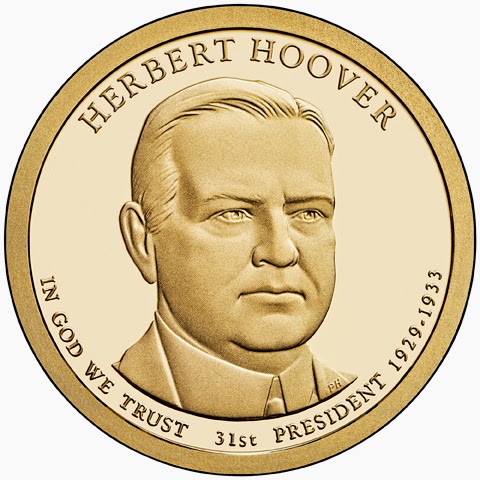
The Buck Starts Here
Thursday, December 5, 2013
Spike Like Ike!

Other of Eisenhower's favorite recipes, for such dishes as Old-Fashioned Beef Stew, Chili Con Carne, and 1868 Venison, can be downloaded here. Further historical information is available on the Dwight D. Eisenhower Presidential Library, Museum, and Boyhood Home website.
Monday, March 4, 2013
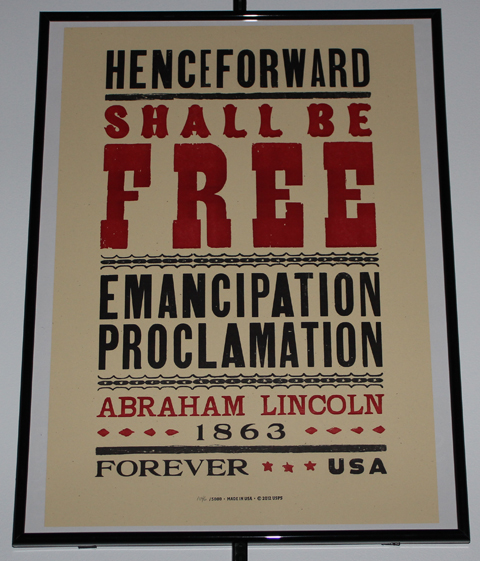
The Emancipation Proclamation at 150

Saturday, April 30, 2011
April Is the Coolest Month
It is fitting that the National Archives and Records Administration (NARA) announced during Poetry Month that Kenneth Price, professor at the University of Nebraska--Lincoln and co-editor of the Walt Whitman Archive, had conclusively identified nearly 3,000 documents as the work--at least in part--of Walt Whitman. Whitman lived in Washington, D.C. from 1863 to 1873, and was employed variously as a government clerk, copyist, and scribe in offices of the Army Paymaster, the Bureau of Indian Affairs, and the Attorney General. The exact nature of Whitman's intellectual contributions to these documents will require further study and elaboration, but the documents nonetheless represent an important new archival facet in the life of one of America's greatest poets.
Further resources on Whitman are available at the Walt Whitman Archive, and at the Library of Congress, which has the largest Whitman archives in the world (a guide is available online). A portrait of Whitman as an older man, as well as a link to an online version of his Leaves of Grass (1855), can be found at an earlier Common Curator posting.
Monday, January 17, 2011
Fifty Years after Ike's Farewell
 Fifty years ago today, on January 17, 1961, President Dwight D. Eisenhower delivered a televised Farewell Address to the nation, one that is recalled significantly for its introduction into political discourse of the phrase, "the military-industrial complex."
The Dwight D. Eisenhower Presidential Library and Museum provides online access to the entire address (including an audio recording), and to many additional documents that are related to its preparation and to its subsequent reception over a period lasting to the present era.
On January 19, 1966, for instance, a statement was entered into the Congressional Record that was entitled, "Statement on Fifth Anniversary of President Eisenhower's Farewell Address by Special Committee on the Military-Industrial Complex of the American Veterans Committee [PDF]." The speech, it is noted, was "wholeheartedly" endorsed by the Committee, who intended "to use its energy and resources to study the military-industrial complex in its many manifestations for the Nation."
Image source: Farewell address by President Dwight D. Eisenhower, January 17, 1961; Final TV Talk 1/17/61 (Page 15), Box 38, Speech Series, Papers of Dwight D. Eisenhower as President, 1953-61, Eisenhower Library; National Archives and Records Administration.
Saturday, January 15, 2011
National Archives Offers "Today's Document" as Mobile App


The National Archives and Records Administration (NARA) is now offering a mobile version of Today's Document, which is featured on the NARA web site. The application provides access to 365 documents and photographs, with background information available for each, among other functionalities.
The document for today happens to be a portrait of Dr. Martin Luther King, Jr., who was born on January 15, 1929. Created by Betsy G. Reyneau, the painting is part of NARA's donated collections, Record Group 200.
Tuesday, February 9, 2010
National Archives Solicits Input on Open Government Plan
The Open Government Directive of December 8, 2009 was issued to promote new lines of communication and cooperation between the Federal government and the American people. To meet the goals of Open Government, each Federal agency is creating an Open Government Plan. The National Records and Archives Administration (NARA) is soliciting public input on how it can promote transparency, participation, and collaboration.
Comments can be made via the following forums by March 19, 2010:
:: Open Government Idea Forum
:: NARAtions Blog
:: E-mail: opengov@nara.gov
NARA's Open Government Plan will be released on April 6, 2010 and made available online.
Comments can be made via the following forums by March 19, 2010:
:: Open Government Idea Forum
:: NARAtions Blog
:: E-mail: opengov@nara.gov
NARA's Open Government Plan will be released on April 6, 2010 and made available online.
Subscribe to:
Posts (Atom)