The broadside above was letterpress printed by the Common Curator at the Iowa City Press Co-op.
Showing posts with label Military. Show all posts
Sunday, May 1, 2022
War Is a Racket, 2022
Major General Smedley D. Butler [1881-1940], who at his death was the most highly decorated U.S. Marine in history, published the anti-war essay, "War Is a Racket," in 1935. Though the examples and expenditures he cites have been far surpassed in the intervening decades, his fundamental points remain salient yet today. The essay can be read online via the Internet Archive.
Monday, May 25, 2020
Memorial Day 2020
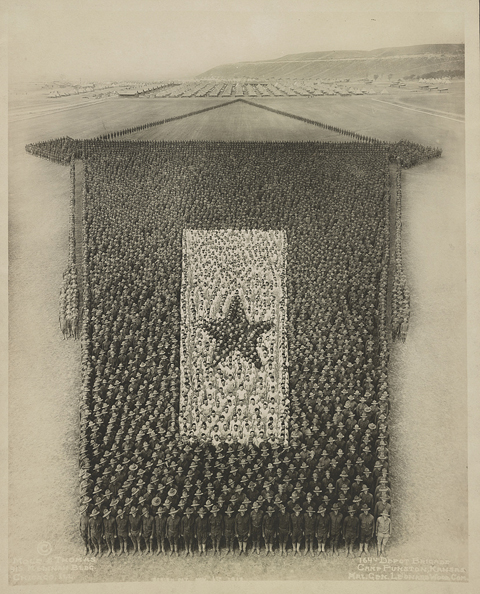
Of related interest, see the earlier Memorial Day post, A Living Service Flag, which features a large-scale formation (or living) photograph depicting the service flag of the U.S. Armed Forces. The photograph was produced circa 1918 by Arthur Mole and John Thomas, and entailed the complex staging of thousands of soldiers at Camp Funston in Fort Riley, Kansas.
Sunday, November 11, 2018
The Eleventh Hour of the Eleventh Day of the Eleventh Month 1918: Armistice!
Chronicling America, the Library of Congress' historic newspaper database, includes a selection of around 90 newspapers that on November 11, 1918 hailed the news of the Armistice which brought World War I to an end.
A number of foreign language newspapers published in the United States also carried the momentous news, such as La Prensa (Spanish, San Antonio, TX); Tägliche Omaha Tribüne (German, Omaha, NE); Svět (Czech, Cleveland, OH); America (Romanian, Cleveland, OH); Draugas (Lithuanian, Chicago, IL); and Dziennik Chicagoski (Polish, Chicago, IL). The full issue of the The Washington Times shown above can be viewed here.
Labels:
Archives,
Common Curator,
Event,
Images,
Library of Congress,
Military,
War
Monday, April 16, 2018
The Peace Sign at Sixty
Monday, May 29, 2017
Celebrating the JFK Centennial: A Strategy of Peace
John F. Kennedy, the 35th president of the U.S., was born 100 years ago today on May 29, 1917. The video above is an excerpt from Kennedy's speech, "A Strategy of Peace," delivered at American University in Washington, D.C. on June 10, 1963 [transcript]. In his address, Kennedy exhorts:
Let us examine our attitude toward peace itself. Too many of us think it is impossible. Too many think it unreal. But that is a dangerous, defeatist belief. It leads to the conclusion that war is inevitable--that mankind is doomed--that we are gripped by forces we cannot control.
We need not accept that view. Our problems are manmade--therefore, they can be solved by man. And man can be as big as he wants. No problem of human destiny is beyond human beings. Man's reason and spirit have often solved the seemingly unsolvable--and we believe they can do it again.Kennedy further observes:
So, let us not be blind to our differences--but let us also direct attention to our common interests and to the means by which those differences can be resolved. And if we cannot end now our differences, at least we can help make the world safe for diversity. For, in the final analysis, our most basic common link is that we all inhabit this small planet. We all breathe the same air. We all cherish our children's future. And we are all mortal.The John F. Kennedy Presidential Library and Museum offers countless resources related to Kennedy's life and legacy. The JFK Centennial website provides additional information on events and programming related to the 100th anniversary of Kennedy's birth.
Labels:
Common Curator,
History,
Military,
Peace,
Video
Wednesday, April 5, 2017
Beyond Vietnam: A Time to Break Silence . . . MLK, Jr. after Fifty Years
Fifty years ago on April 4, 1967 (exactly one year before his assassination), Dr. Martin Luther King, Jr., delivered a major speech at Riverside Church in New York City which articulated his reasoning for his opposition to the Vietnam War, and how the conflict was intertwined with racism and other pressing social issues facing the nation. Entitled "Beyond Vietnam: A Time to Break Silence," King traces the evolution of his thought on the war, and argues for a "radical revolution of values," stating:
. . . [W]e must rapidly begin the shift from a thing-oriented society to a person-oriented society. When machines and computers, profit motives and property rights, are considered more important than people, the giant triplets of racism, extreme materialism, and militarism are incapable of being conquered.Towards the conclusion of his speech, King posits a fundamental question:
We still have a choice today: nonviolent coexistence or violent coannihilation. We must move past indecision to action. We must find new ways to speak for peace in Vietnam and justice throughout the developing world, a world that borders on our doors. If we do not act, we shall surely be dragged down the long, dark, and shameful corridors of time reserved for those who possess power without compassion, might without morality, and strength without sight.Wise words still today, fifty years hence. The full transcript of King's speech can be read here; the YouTube video above contains audio only.
Labels:
Black History,
Civil Rights,
Common Curator,
Human Rights,
Lecture,
Military,
Video,
War
Monday, May 30, 2016
A Living Service Flag
In honor of Memorial Day, above is shown a living (or formation) photograph circa 1918 depicting the service flag of the U.S. Armed Forces. It was produced by Arthur Mole and John Thomas with the assistance of hundreds if not thousands of troops of the 164th Depot Brigade stationed at Camp Funston in Fort Riley, Kansas. Technically complex to stage, the pair created around 30 such photographs on patriotic themes at various military camps during World War I.
As defined in the U.S. Code at 36 USC § 901:
A service flag approved by the Secretary of Defense may be displayed in a window of the place of residence of individuals who are members of the immediate family of an individual serving in the Armed Forces of the United States during any period of war or hostilities in which the Armed Forces of the United States are engaged.Service flags are also known as service banners, and Blue Star Service Banners depict a blue star for each family member who is serving during war or hostilities. Gold Star Service Banners depict a gold star (with a thin blue border) for each family member killed during wartime service.
Further information on the work of Mole & Thomas and other photographers who created similar large-scale images can be found at the Library of Congress' Picture This blog in the post: Formation Photographs: Lining Up to Salute the Flag. The original photograph above is held in the Library of Congress' Prints & Photographs Division.
Sunday, August 9, 2015
The Advent of Atomic Weaponry: Hiroshima and Nagasaki
A Day That Shook the World, a short British Pathé film from 1945, briefly describes the dropping of "Little Boy," the first atom bomb to be used as a weapon, on the city of Hiroshima at 8:15am on August 6, 1945 (Japan time). It was quickly followed by the dropping of "Fat Man" on Nagasaki on August 9, 1945. Both caused unprecedented death and destruction.
A previous Common Curator post, The Legacy of Hiroshima and Nagasaki, discusses, among other matters, Tsutomu Yamaguchi [1916-2010], who at the time of his death was the only nijyuu hibakusha, or "twice-bombed person," officially recognized by the Japanese government. Other resources of interest are Democracy Now's interview with Japanese Nobel Laureate Kenzaburo Oe and the National Archives' photographs and sound recordings documenting the Hiroshima bombing.
Sunday, November 30, 2014
Library at UK's Imperial War Museum Facing Elimination
The Imperial War Museum (IWM) in the UK is facing substantial cuts to collections and services, particularly its Library. Founded in 1917, the IWM maintains significant research collections related to "all aspects of twentieth- and twenty-first century conflict involving Britain, the Commonwealth and other former empire countries." Over 11,000 supporters have so far signed an online petition urging a reversal of the proposed closure of the Library, reduction of educational programs, and job losses.
Labels:
Archives,
Common Curator,
Libraries,
Military,
Museums
Tuesday, September 30, 2014
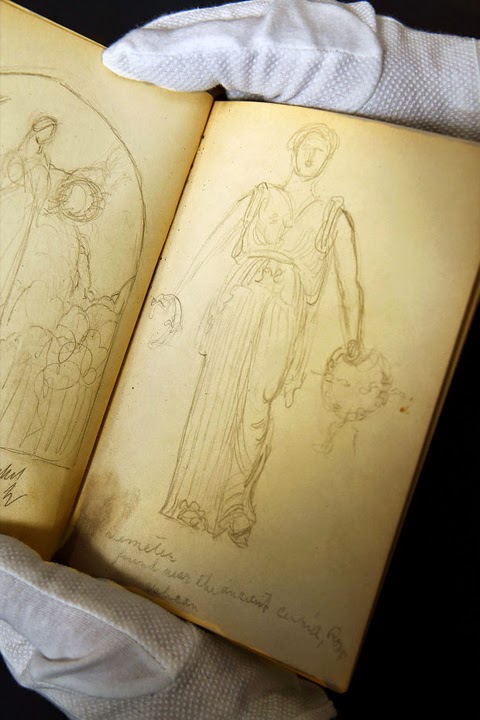
Grant Wood Sketchbook Returns to Figge Art Museum

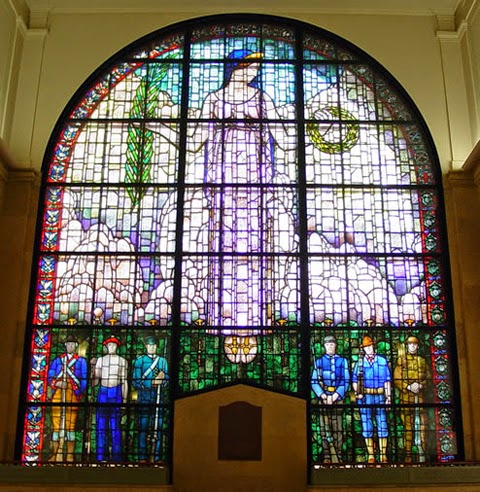
Missing for several decades, a sketchbook by world-renowned Iowa artist Grant Wood [1891-1942] was recently reclaimed by the Figge Art Museum in Davenport, Iowa. Part of a collection acquired in 1965 from Wood's sister, Nan Wood Graham, the sketchbook contains notes and plans for the stained glass window he designed for the Veterans Memorial Building in Cedar Rapids in 1928.
The window depicts soldiers in privates' uniforms from the six major U.S. wars up to that time: the Revolutionary War, the War of 1812, the Mexican War, the Civil War, the Spanish-American
War, and the First World War; the soldiers are surmounted by a large female figure said to represent the Republic. To oversee the fabrication of the window directly, Wood travelled to Munich, Germany, one of several trips to Europe he made early in his career.
The recovered sketchbook is thought to have been stolen shortly after its acquisition by the Davenport Municipal Art Gallery, the Figge's predecessor. Andrew Wallace, the Figge's current Manager of Collections and Exhibitions, was instrumental in researching the loss of the sketchbook and in negotiating its return after it was slated for auction. More information on this fortunate turn of events can be found in an article in the Quad-City Times.
Much of Grant Wood's personal archive has been digitized. The University of Iowa hosts the Figge Art Museum Grant Wood Digital Collection and several dozen images have been digitized by the Archives of American Art in their Grant Wood Collection, 1930-1983.
The Cedar Rapids Museum of Art is home to the world's largest collection of Grant Wood artwork, and features the Grant Wood Gallery. Curious individuals can discover more about Wood's life and times by visiting stops along Iowa's Grant Wood Trail. American Gothic, Wood's iconic masterpiece painted in 1930, is housed in the Art Institute of Chicago.
Note: Top image is from the Quad-City Times; bottom image is from the Veterans Memorial Building. A previous Common Curator post of related interest is the 120th Anniversary of Grant Wood's Birth.
Labels:
Art,
Common Curator,
Grant Wood,
Images,
Iowa,
Military,
Museums
Sunday, August 24, 2014
The British "Light Up" the Library of Congress
Two hundred years ago today, on August 24, 1814, British troops burned the U.S. Capitol, which then housed the books of the Library of Congress. Rear Admiral George Cockburn is said to have asked his men, "Shall this harbor of Yankee democracy be burned? All for it shall say 'Aye'". The resulting fire destroyed the Library's entire collection of some 3,000 volumes, but Thomas Jefferson soon thereafter offered his own substantial library for sale to Congress, writing:
"I have been fifty years in making it, and have spared no pains, opportunity or expense, to make it what it now is. While residing in Paris I devoted every afternoon . . . in examining all the principal bookstores, turning over every book with my own hands, and putting by everything which related to America . . . ."Jefferson's 6,487 volumes, which constituted the largest personal library in the country at the time, were appraised at $23,950, and on October 10, 1814, the Senate unanimously approved its purchase. Some in the House of Representatives expressed strong opposition, however, noting that the library contained many titles in foreign languages, as well as philosophical works by such authors as Voltaire, Locke, and Rousseau. Daniel Webster suggested buying the whole collection, but then returning to Jefferson "all books of an atheistical, irreligious, and immoral tendency." The measure eventually passed by a 10-vote margin, and the library was purchased intact, thus seeding the rebirth of the Library of Congress.
A catalog of Jefferson's library arranged alphabetically by title was issued by the Library of Congress in 1815. At Jefferson's request, Nicholas Trist in 1823 restored the intellectual classification scheme that Jefferson had used to arrange his collection at Monticello. Thomas Jefferson's Library: A Catalog with the Entries in His Own Order, edited by James Gilreath and Douglas L. Wilson, can be viewed online. Although unaffiliated with the Library of Congress, LibraryThing also offers an online "Legacy Library" devoted to Jefferson's various collections.
The history of Jefferson's library is further complicated by another fire in the U.S. Capitol in 1851, which destroyed two-thirds of his former books. In 1998, Mark Dimunation, Chief of the Rare Book and Special Collections Division at the Library of Congress, commenced an effort to restore the lost books through the purchase or donation of identical editions. Today the Library of Congress ranks as the world's largest, and owes much to the breadth and depth of Jefferson's intellectual pursuits.
Note: The image above is from "The Library of Congress," an article by Ben Perley Poore in Harper's New Monthly Magazine, vol. XLVI, no. CCLXXI, December 1872, pp. 41-50, at p. 44.
Labels:
Common Curator,
Images,
Libraries,
Library of Congress,
Military
Saturday, April 26, 2014
#NotABugSplat
The above image is an on-site installation in Pakistan. Produced by an artist collective, the large scale of the portrait is intended to put a visible human face on potential targets of drone missiles, which are sometimes referred to by drone operators as "bug splats." More information on the project is available at the #NotaBugSplat website.
Labels:
Art,
Common Curator,
Human Rights,
Images,
In the News,
Military,
Public Policy,
War
Subscribe to:
Posts (Atom)