Showing posts with label Civil Rights. Show all posts

Tuesday, May 21, 2019

The Path to Women's Suffrage: The 19th Amendment to the U.S. Constitution


House Joint Resolution 1 (H. J. Res. 1), proposing an amendment to the Constitution extending the right of suffrage to women, was introduced in the House of Representatives on May 19, 1919, and passed on May 21, 1919--100 years ago today. The resolution was soon approved by the Senate, on June 4, 1919, and over the course of the next 14-1/2 months was ratified by three-fourths of the states (with Tennessee becoming the 36th and last state necessary for ratification on August 18, 1920). On August 26, 1920, U.S. Secretary of State Bainbridge Colby certified H. J. Res. 1 as the 19th Amendment to the Constitution, the text of which reads: "The right of citizens of the United States to vote shall not be denied or abridged by the United States or by any State on account of sex. Congress shall have power to enforce this article by appropriate legislation."

Friday, March 8, 2019

International Women's Day: #ThinkEqual


March 8th marks the 108th anniversary of International Women's Day. The United Nations' theme for International Women's Day 2019 is "Think Equal, Build Smart, Innovate for Change." The video above features remarks by UN Women Executive Director Phumzile Mlambo-Ngcuka as well as the UN Secretary-General António Guterres and other UN leaders.

First celebrated on March 19, 1911 by more than one million people in Austria, Denmark, Germany, and Switzerland after a proposal by Clara Zetkin [1857-1933] in 1910 at the second International Conference of Working Women in Copenhagen, International Women's Day is now observed in many nations throughout the world.

The United Nations first began celebrating March 8 as International Women's Day during International Women's Year in 1975, and in 1977 approved a resolution proclaiming a United Nations Day for Women's Rights and International Peace for member states.

Sunday, February 24, 2019

A Student Free Speech Landmark: Tinker v. Des Moines Independent School District (1969)


Fifty years ago today, on February 24, 1969, the U.S. Supreme Court in a landmark decision held that First Amendment free speech rights applied to students in public schools. The case, Tinker et al. v. Des Moines Independent School District et al., 393 U.S. 503 (1969), was decided by a 7-2 vote, with Justice Abe Fortas delivering the majority opinion of the Court; Justices Hugo Black and John M. Harlan II each wrote dissenting opinions.

At issue was the right of several students to wear black armbands in protest against the Vietnam War and to support the Christmas truce called for by Senator Robert F. Kennedy in December 1965. The students included four members of the Tinker family (John, 15; Mary Beth, 13; Hope, 11; and Paul, 8) and Christopher Eckhardt, 16, who wore black armbands at their respective schools in the Des Moines Independent School District. Mary Beth Tinker and Eckhardt were suspended on December 16, and John Tinker on December 17. The controversy lead the Iowa Civil Liberties Union and the American Civil Liberties Union to support the suspended students, and after losing in U.S. District Court, the case was appealed to the U.S. Court of Appeals for the 8th Circuit, and eventually the U.S. Supreme Court, where attorney Dan L. Johnston argued for the petitioners on November 12, 1968.

In his opinion, Justice Fortas observed that:
"First Amendment rights, applied in light of the special characteristics of the school environment, are available to teachers and students. It can hardly be argued that either students or teachers shed their constitutional rights to freedom of speech or expression at the schoolhouse gate. This has been the unmistakable holding of this Court for almost 50 years."
Fortas articulated further that:
"In order for the State in the person of school officials to justify prohibition of a particular expression of opinion, it must be able to show that its action was caused by something more than a mere desire to avoid the discomfort and unpleasantness that always accompany an unpopular viewpoint. Certainly where there is no finding and no showing that engaging in the forbidden conduct would 'materially and substantially interfere with the requirements of appropriate discipline in the operation of the school,' the prohibition cannot be sustained."
The standard of material and substantial disruption has subsequently become known as the Tinker Test in determining free speech rights for students.

Pictured to the right are Mary Beth and John with armbands, circa March 4, 1968, when the U.S. Supreme Court agreed to hear their case. The armbands originally worn in protest were simple strips of black cloth, unadorned with peace symbols, as shown below by Mary Beth in a photo from December 1965.

The Tinkers have ever since remained strong advocates for free speech and civil liberties, particularly for the young. Mary Beth and John, along with other Tinker family members, guests, and students, are featured in the video above that commemorates the 50th anniversary of their landmark case. The event was held at the State Historical Museum in Des Moines on February 22, 2019, and aired on Iowa Public Television.

Monday, December 10, 2018

The Univeral Declaration of Human Rights at 70

Human Rights Day is celebrated annually on December 10 to mark the anniversary of the Universal Declaration of Human Rights (UDHR). This year's campaign theme is Stand Up 4 Human Rights. At the recent UN event, "Good Human Rights Stories," Secretary-General António Guterres observed:
"As we mark the 70th anniversary of the Universal Declaration of Human Rights, we should never forget the profound progress that has been made over the decades--and, indeed, that is happening as we speak. The good stories deserve to be shared--not only to celebrate the achievements of those who made it happen. But to serve as an example and inspiration for others around the world. Just as the denial of human rights is part of the problem, the active promotion of human rights is part of the solution. So, too, is spreading the stories and the lessons of doors opened, rights secured, and victories won."
The Declaration was proclaimed on December 10, 1948 through United Nations General Assembly Resolution 217 A (III):
. . . as a common standard of achievement for all peoples and all nations, to the end that every individual and every organ of society, keeping this Declaration constantly in mind, shall strive by teaching and education to promote respect for these rights and freedoms and by progressive measures, national and international, to secure their universal and effective recognition and observance, both among the peoples of Member States themselves and among the peoples of territories under their jurisdiction.
Although not itself a binding legal document, it has "inspired more than more than 60 human rights instruments which together constitute an international standard of human rights." 

The Declaration has been translated into more than 500 languages and dialects, from Abkhaz to Zulu. The English version is available here, while other versions are available via an online database. A guide to UN Human Rights documentation as well as various related UN databases are also accessible on the UN Human Rights website. A showcase of UDHR-related materials from around the world is available here.

Tuesday, November 20, 2018

Corita Kent: Artist Extraordinaire at 100

Corita Kent [1918-1986] was born 100 years today, on November 20, 1918, in Fort Dodge, Iowa, and subsequently became world renowned for her work as a serigrapher (or screen printer), as well as for commissioned works both large (the Rainbow Swash on a massive gas storage tank outside of Boston) and small (the 1985 U.S.P.S. Love stamp, of which more than 700 million were sold).

As a Catholic nun, Sister Corita headed for several years the Art Department at the Immaculate Heart College in Los Angeles, California, where she instilled her artistic values of close observation, imagination, and social justice in her many students. A creative iconoclast in her own work, she famously formulated what could be considered "Corita's Decalogue," otherwise known as the "Immaculate Heart College Art Department Rules," of which Rule 7 is: "The only rule is work. If you work it will lead to something. It's the people who do all of the work all of the time who eventually catch on to things." Although she plainly cites artist John Cage in Rule 10, the ten rules are frequently misattributed to Cage rather than Corita herself.

Corita eventually left the order of the Sisters of the Immaculate Heart of Mary, and reentered secular life in 1968. She continued her prolific artistic output, which rivalled or surpassed many other artists of the era, including fellow screen printer, Andy Warhol. Corita was posthumously awarded an AIGA medal in 2016, and her legacy is sustained today by the Corita Art Center, which offers her original prints as well as ongoing programming. A recent major exhibition catalogue, Someday Is Now: The Art of Corita Kent, features much of her artwork and serves as an excellent introduction to her life and philosophy.

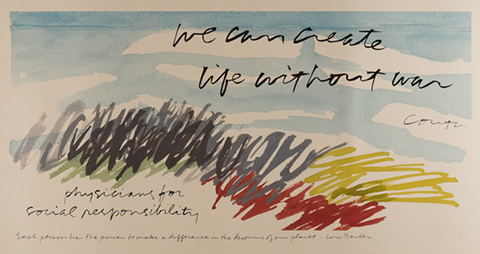
Corita died on September 18, 1986 at age 67, and her obituary in the Los Angeles Times can be read here. The video above, "Become a Microscope: 90 Statements on Sister Corita," is a short documentary produced by Aaron Rose to celebrate the 90th anniversary of her birthday. Below is one example of Corita's work, "We Can Create Life Without War," a poster commissioned in 1983 by the organization, Physicians for Social Responsibility. An illustrated chronology of Corita's life can be viewed at the Corita Art Center website.


Wednesday, April 4, 2018

The 50th Anniversary of the Assassination of Martin Luther King, Jr.

Civil rights leader Dr. Martin Luther King, Jr. was fatally shot on April 4, 1968 in Memphis, Tennessee, 50 years ago today. The day after his assassination, President Lyndon B. Johnson issued Presidential Proclamation 3839 declaring a national day of mourning for April 7, 1968 and that flags were to be flown at half-mast at governmental and military facilities both within the United States and abroad until King's internment. Johnson begins the Proclamation by stating: "The heart of America grieves today. A leader of his people--a teacher of all people--has fallen."

For previous Common Curator posts related to King's life and work, see: The March on Washington for Jobs and Freedom; Beyond Vietnam: A Time to Break Silence; The Quest for Peace and Justice; and Martin Luther King, Jr. Day. The New York Times has also recently republished its original obituary for King, which was first published April 5, 1968.

Wednesday, March 7, 2018

International Women's Day: #TimeIsNow

March 8th marks the 107th anniversary of International Women's Day. The United Nations' theme for International Women's Day 2018 is "Time Is Now: Rural and Urban Activists Transforming Women's Lives." The video above features remarks by UN Women Executive Director Phumzile Mlambo-Ngcuka.

First celebrated on March 19, 1911 by more than one million people in Austria, Denmark, Germany, and Switzerland after a proposal by Clara Zetkin [1857-1933] in 1910 at the second International Conference of Working Women in Copenhagen, International Women's Day is now observed in many nations throughout the world.

The United Nations first began celebrating March 8 as International Women's Day during International Women's Year in 1975, and in 1977 approved a resolution proclaiming a United Nations Day for Women's Rights and International Peace for member states.

Wednesday, February 28, 2018

Against Amnesia: Archives, Evidence, and Social Justice


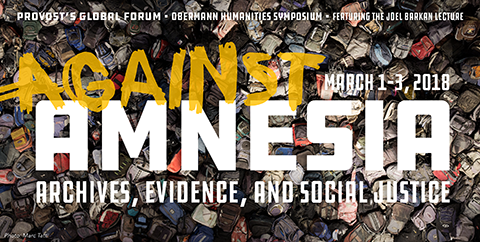
Against Amnesia: Archives, Evidence, and Social Justice is this year's Obermann Humanities Symposium at the University of Iowa, and will be held at campus and downtown Iowa City venues on March 1-3, 2018. The symposium is an initiative of the Provost's Global Forum, and will offer a full schedule of lectures, panels, film screenings, and exhibitions.

The organizers note that "practicing archivists, engaged scholars, and interdisciplinary artists will share projects from creating 'data refuges' of climate date to mining corporate records for evidence of organized violence." Experimental filmmaker, Bill Morrison, honored as an Ida Cordelia Beam Distinguished Visiting Professor, will be delivering a talk, "Consider the Source," and presenting his most recent film, "Dawson City: Frozen Time (2016)."

Further information can be found at the symposium website, which includes biographies of speakers, resources on archives and activism, and a listing of numerous, diverse archives in the area.

Tuesday, February 27, 2018

The Sesquicentennial of W.E.B. Du Bois' Birth


Civil rights advocate, scholar, educator, and global activist, William Edward Burghardt Du Bois was born 150 years ago on February 23, 1868, and died August 27, 1963.

Among his many outstanding contributions were his roles in founding, in 1905, the Niagara Movement, an African American group of scholars and professionals that challenged racial discrimination, and in 1909, the National Association for the Advancement of Colored People (NAACP). He was also the founder and editor of The Crisis, which was the NAACP's monthly magazine.

Du Bois earned his doctorate from Harvard in 1895, the first African American to ever do so. His dissertation, "The Suppression of the African Slave Trade to the United States of America, 1638-1870," was the inaugural publication of the Harvard Historical Series. In 1899, he published a major sociological work called The Philadelphia Negro: A Social Study. Du Bois authored many other works over the course of his career, notable among them, The Souls of Black Folk: Essays and Sketches (1903) and Black Reconstruction in America, 1860-1880 (1935).

As a global citizen, Du Bois was long committed to Pan-Africanism. He attended the First Pan-African Conference in London in 1900, and later organized a series of Pan-African congresses around the world. In 1961, at the invitation of its president, Du Bois received citizenship in Ghana, where he worked as director of the new Encyclopedia Africana, which was devoted to the African diaspora; he died in Ghana in 1963 at the age of 95.

For additional information on the life and work of Du Bois, check out the online guide to resources held by the Library of Congress. The University of Massachusetts at Amherst has a very substantial collection, the W.E.B. Du Bois Papers, 1803-1999, containing nearly 100,000 digital items. Other resources include the W.E.B. Du Bois National Historic Site in Great Barrington, Massachusetts, where Du Bois was born and raised, and the Harpers Ferry National Historical Park, where an instrumental meeting of the Niagara Movement took place at Storer College in 1906.

Note: The photograph above was taken by Cornelius Marion Battey on May 31, 1919, and is in the collections of the Library of Congress.

Thursday, February 22, 2018

Wednesday, February 14, 2018

The Bicentennial of Frederick Douglass' Birth


Born into slavery 200 years ago, on February 14, 1818, Frederick Douglass represents one of the most consequential figures in American history. His life's work as an abolitionist, social reformer, orator, author, publisher, and statesman are without parallel.

To learn more about Douglass, there are a number of significant research collections to explore. The Frederick Douglass Papers at the Library of Congress contains approximately 7,400 items, with the bulk of the material dating from 1862 to 1865. Many of Douglass' early writings were destroyed when his house in Rochester, New York, burned in 1872.

Indiana University-Purdue University Indianapolis (IUPUI) has created a digital edition of the Frederick Douglass Papers, and at the University of Rochester, the Frederick Douglass Institute, in conjunction with the Dept. of Rare Books and Special Collections, is seeking to digitize all of the Douglass-related materials at the University Library. The National Archives has deep collections in African American history generally.

The National Park Service maintains the Frederick Douglass National Historic Site, which preserves and interprets Cedar Hill, where Douglass lived from 1877 till his death in 1895 at age 77. The Frederick Douglass Bicentennial Community has a number of online resources that are also of interest.

Note: The photograph above was taken by George Francis Schreiber on April 26, 1870, and is in the collections of the Library of Congress.

Monday, January 15, 2018

The March on Washington for Jobs and Freedom

Martin Luther King, Jr. [1929-1968] would have turned 89 today. It was during the March on Washington, held on August 28, 1963, that Dr. King delivered his famous "I Have a Dream Speech." The speech galvanized the civil rights movement, and in 1964, James Blue released the film, "The March," which documented the events of the March as well as King's speech.

The film was produced for the Motion Picture Service unit of the United States Information Agency, and was intended for foreign audiences. In 2008, the documentary was inducted into the National Film Registry maintained by the Library of Congress. A full digital restoration of the original negatives was later undertaken by the Motion Picture Preservation Lab to coincide with the March's 50th anniversary in 2013; details of this painstaking process are available at the National Archives website.

The National Archives has many other resources related to King and to African American history, and there are several prior Common Curator posts regarding King's legacy as well.

Saturday, December 2, 2017

Net Neutrality Is Being Upended


Net neutrality is the principle that all data or content should be treated equally, without discrimination, by every Internet Service Provider (ISP). Net neutrality thus ensures that all stakeholders share an equitable platform for communication, commerce, and other purposes.

The Federal Communications Commission (FCC) will be voting on December 14, 2017 to approve or reject Chairman Ajit Pai's draft order to undermine the current framework as articulated in the FCC's 2015 Open Internet Order. Organizations such as the Electronic Frontier Foundation (EFF) and the American Civil Liberties Union (ACLU), among many others, are partners in the Battle for the Net coalition, which is actively advocating for the complete rejection of Chairman Pai's new order.

To learn about what you can do to make your voice heard, visit the Battle for the Net website, which provides links to an online petition, information about upcoming protests around the United States, and details about contacting your elected officials as well as communicating your views directly to the FCC.

Saturday, September 23, 2017

Banned Books Week: Challenge Censorship

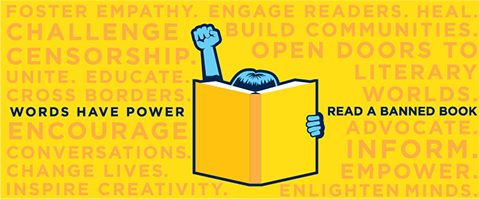
Sponsored by the American Library Association and allied organizations, Banned Books Week (September 24-30, 2017) is an annual celebration of the freedom to read. It began in 1982 in response to widespread censorship of books, and since that time over 11,000 books have been challenged in communities throughout the United States.

The American Library Association's Office for Intellectual Freedom has been documenting cases of challenged and banned books since 1990, and the ALA's Library Bill of Rights strongly supports free and unfettered access to information and ideas. Internationally, the Index on Censorship is an organization that promotes and defends the right to freedom of expression.

Wednesday, April 5, 2017

Beyond Vietnam: A Time to Break Silence . . . MLK, Jr. after Fifty Years


Fifty years ago on April 4, 1967 (exactly one year before his assassination), Dr. Martin Luther King, Jr., delivered a major speech at Riverside Church in New York City which articulated his reasoning for his opposition to the Vietnam War, and how the conflict was intertwined with racism and other pressing social issues facing the nation. Entitled "Beyond Vietnam: A Time to Break Silence," King traces the evolution of his thought on the war, and argues for a "radical revolution of values," stating:
. . . [W]e must rapidly begin the shift from a thing-oriented society to a person-oriented society. When machines and computers, profit motives and property rights, are considered more important than people, the giant triplets of racism, extreme materialism, and militarism are incapable of being conquered.
Towards the conclusion of his speech, King posits a fundamental question:
We still have a choice today: nonviolent coexistence or violent coannihilation. We must move past indecision to action. We must find new ways to speak for peace in Vietnam and justice throughout the developing world, a world that borders on our doors. If we do not act, we shall surely be dragged down the long, dark, and shameful corridors of time reserved for those who possess power without compassion, might without morality, and strength without sight. 
Wise words still today, fifty years hence. The full transcript of King's speech can be read here; the YouTube video above contains audio only.

Wednesday, March 8, 2017

International Women's Day: #BeBoldForChange


March 8th marks the 106th anniversary of International Women's Day. The United Nations' theme for International Women's Day 2017 is "Women in the Changing World of World: Planet 50-50 by 2030." The video above features remarks by UN Women Executive Director Phumzile Mlambo-Ngcuka.

First celebrated on March 19, 1911 by more than one million people in Austria, Denmark, Germany, and Switzerland after a proposal by Clara Zetkin [1857-1933] in 1910 at the second International Conference of Working Women in Copenhagen, International Women's Day is now observed in many nations throughout the world.

The United Nations first began celebrating March 8 as International Women's Day during International Women's Year in 1975, and in 1977 approved a resolution proclaiming a United Nations Day for Women's Rights and International Peace for member states.

Tuesday, January 31, 2017

ALA Opposes New Administration Polices That Contradict Core Values

American Library Association (ALA) President Julie B. Todaro on January 30, 2017 released the following statement on behalf of the ALA that reasserts the association's commitment to core values concerning access to information, intellectual freedom, diversity, social responsibility, and other issues:

“We are shocked and dismayed by recent executive orders and other actions by the new administration, which stand in stark contrast to the core values of the American Library Association. Our core values include access to information; confidentiality/privacy; democracy; equity, diversity and inclusion; intellectual freedom; and social responsibility.

“The American Library Association strongly opposes any actions that limit free access to information, undermine privacy, or discriminate on any basis. This includes the temporary suspension of visas and entrance to the US based on anyone’s nationality or religion as well as the increased scrutiny of any individual’s communication such as mobile phone and/or social media activity.

“Our nation’s 120,000 public, academic, school, and special libraries serve all community members, including people of color, immigrants, people with disabilities and the most vulnerable in our communities, offering services and educational resources that transform communities, open minds, and promote inclusion and diversity.

“ALA believes that the struggle against racism, prejudice, stereotyping, and discrimination is central to our mission. We will continue to speak out and support efforts to abolish intolerance and cultural invisibility, stand up for all the members of the communities we serve, and promote understanding and inclusion through our work.

“We will continue to speak out and support our members as they work tirelessly for access to library and information resources on behalf of all of their community members, while advocating for privacy, intellectual freedom, critical global research, information literacy, ongoing access to scientific research, and fair and equitable treatment for everyone.

“As our strategic plan states, ‘ALA recognizes the critical need for access to library and information resources, services, and technologies by all people, especially those who may experience language or literacy-related barriers; economic distress; cultural or social isolation; physical or attitudinal barriers; racism; discrimination on the basis of appearance, ethnicity, immigrant status, housing status, religious background, sexual orientation, gender identity, gender expression; or barriers to equal education, employment and housing.’

“We encourage our members to continue to speak out and show their support for and work on behalf of our core values, in their communities as well as with their local, state, and national elected and appointed officials. Additionally, ALA has tools and resources online to help you advocate for our core values:
“ALA is committed to using its national platform for speaking up and speaking out for its members and constituents in these chaotic, unprecedented, and challenging times. We appreciate the library community’s continued support.”

Mother of Exiles: Send These, the Homeless, Tempest-tost to Me

The New Colossus

Not like the brazen giant of Greek fame,
With conquering limbs astride from land to land;

Here at our sea-washed, sunset gates shall stand
A mighty woman with a torch, whose flame
Is the imprisoned lightning, and her name
Mother of Exiles. From her beacon-hand
Glows world-wide welcome; her mild eyes command
The air-bridged harbor that twin cities frame.
"Keep ancient lands, your storied pomp!" cries she
With silent lips. "Give me your tired, your poor,
Your huddled masses yearning to breathe free,
The wretched refuse of your teeming shore.
Send these, the homeless, tempest-tost to me,
I lift my lamp beside the golden door!"

Emma Lazarus [1849-1887] wrote "The New Colossus" on November 2, 1883, and donated it for use by the Art Loan Fund Exhibition in Aid of the Bartholdi Pedestal Fund for the Statue of Liberty. A source of inspiration to countless new immigrants and Americans alike, it was inscribed on a plaque on the pedestal of the Statue of Liberty in 1903. Then as now, however, Nativists and others have opposed immigration on various grounds, as the political cartoon to the right, captioned "The Proposed Emigrant Dumping Site," reveals (Judge, March 22, 1890).
 
The Statue of Liberty Enlightening the World was a gift from the people of France to the United States. Dedicated on October 28, 1886, it was designated as a National Monument in 1924, and has been maintained by the National Park Service since 1933.

Note: The image at the top first appeared in Frank Leslie's Illustrated Newspaper on July 2, 1887 at pp. 324-325; it was entitled "New York -- Welcome to the Land of Freedom -- An Ocean Steamer Passing the Statue of Liberty: Scene on the Steerage Deck [of the "Germanic"] / from a sketch by a staff artist." Further information on this item is available via the Library of Congress' Prints and Photographs Online Catalog. 

Saturday, December 10, 2016

Human Rights Day 2016

Human Rights Day is celebrated annually on December 10 to mark the anniversary of the Universal Declaration of Human Rights (UDHR). This year's campaign is Stand Up for Someone's Rights, for which United Nations Secretary-General Ban Ki-Moon observes: "At a time multiplying conflicts, intensifying humanitarian needs and rising hate speech, the Universal Declaration of Human Rights reminds us that recognition of the 'equal and inalienable rights of all members of the human family is the foundation of freedom, justice and peace in the world.'"

The Declaration was proclaimed on December 10, 1948 through United Nations General Assembly Resolution 217 A (III):
. . . as a common standard of achievement for all peoples and all nations, to the end that every individual and every organ of society, keeping this Declaration constantly in mind, shall strive by teaching and education to promote respect for these rights and freedoms and by progressive measures, national and international, to secure their universal and effective recognition and observance, both among the peoples of Member States themselves and among the peoples of territories under their jurisdiction.
Although not itself a binding legal document, it has "inspired more than more than 60 human rights instruments which together constitute an international standard of human rights." 

The Declaration has been translated into more than 300 languages and dialects, from Abkhaz to Zulu. The English version is available here, while other versions are available via an online database. A guide to UN Human Rights documentation as well as various related UN databases are also accessible on the UN Human Rights website. A showcase of UDHR-related materials from around the world is available here.

Saturday, October 1, 2016

Banned Books Week: Celebrating the Freedom to Read

Sponsored by the American Library Association and allied organizations, Banned Books Week is an annual celebration of the freedom to read. It began in 1982 in response to widespread censorship of books, and since that time over 11,000 books have been challenged in communities throughout the United States.

The American Library Association's Office for Intellectual Freedom has been documenting cases of challenged and banned books since 1990, and the ALA's Library Bill of Rights strongly supports free and unfettered access to information and ideas. Internationally, the Index on Censorship is an organization that promotes and defends the right to freedom of expression.