Showing posts with label Human Rights. Show all posts

Tuesday, May 24, 2022

The Unburnable Book

To support free expression and fight censorship, author Margaret Atwood has joined forces with Penguin Random House and others to produce an unburnable version of The Handmaid's Tale, which is now being auctioned by Sotheby's. All proceeds go to benefit PEN America. The current bid is $42,000, and the auction closes June 7, 2022. 

Here are the technical specifications for the highly engineered edition of one: 

8vo. Printed on black-and-white-coated aluminum Cinefoils, used in film production to wrap hot lights, which are stable to 660°C/1220°F, textblock hand-sewn with nickel wire, often used in electrical components, which is stable to 1400°C/2,600°F, head and tail bands are woven stainless steel, used in aerospace manufacturing, which are stable up to 1530°C/2790°F. Boards 3mm phenolic sheets, used in electronics manufacturing, which are stable to 540°F/282°C, opaque white and CMYK printing produced on an OKI five-colour digital press, with inks stable to 1200°C/2200°F. 

In the video above, Atwood is demonstrating proof of concept. Of related interest are earlier Common Curator posts on censorship, including Books Are Weapons in the War of Ideas. 

Monday, November 2, 2020

Make America Trumpless Again


Make Iowa Kingless Again


Resistance Revival Chorus: "All You Fascists Bound to Lose"

The Resistance Revival Chorus has just released their debut album, "This Joy," on Righteous Babe Records. The album, available both on vinyl and digitally, features Rhiannon Giddens on Woody Guthrie's 1942 anthem, "All You Fascists Bound To Lose."

Tuesday, September 17, 2019

Global #ClimateStrike: September 20 & 27, 2019


Millions worldwide will be joining thousands of youth-led events in over 100 countries to mobilize for effective responses to the environmental consequences of fossil fuels. To learn more and to locate a climate strike near you, visit the Global Climate Strike website.

Of related interest, see the earlier Common Curator posts: Climate of Concern: Shell's 1991 Warning of Global Environmental Damage; James Hansen: Why I Must Speak Out about Climate Change; and Mr. Smith Goes to Washington (Champions of Change for Sustainable and Climate-Smart Agriculture).

Tuesday, June 4, 2019

1989 Democracy Movement at Tiananmen Square: 八九民运在天安門廣場


Friday, March 8, 2019

International Women's Day: #ThinkEqual


March 8th marks the 108th anniversary of International Women's Day. The United Nations' theme for International Women's Day 2019 is "Think Equal, Build Smart, Innovate for Change." The video above features remarks by UN Women Executive Director Phumzile Mlambo-Ngcuka as well as the UN Secretary-General António Guterres and other UN leaders.

First celebrated on March 19, 1911 by more than one million people in Austria, Denmark, Germany, and Switzerland after a proposal by Clara Zetkin [1857-1933] in 1910 at the second International Conference of Working Women in Copenhagen, International Women's Day is now observed in many nations throughout the world.

The United Nations first began celebrating March 8 as International Women's Day during International Women's Year in 1975, and in 1977 approved a resolution proclaiming a United Nations Day for Women's Rights and International Peace for member states.

Monday, December 10, 2018

The Univeral Declaration of Human Rights at 70

Human Rights Day is celebrated annually on December 10 to mark the anniversary of the Universal Declaration of Human Rights (UDHR). This year's campaign theme is Stand Up 4 Human Rights. At the recent UN event, "Good Human Rights Stories," Secretary-General António Guterres observed:
"As we mark the 70th anniversary of the Universal Declaration of Human Rights, we should never forget the profound progress that has been made over the decades--and, indeed, that is happening as we speak. The good stories deserve to be shared--not only to celebrate the achievements of those who made it happen. But to serve as an example and inspiration for others around the world. Just as the denial of human rights is part of the problem, the active promotion of human rights is part of the solution. So, too, is spreading the stories and the lessons of doors opened, rights secured, and victories won."
The Declaration was proclaimed on December 10, 1948 through United Nations General Assembly Resolution 217 A (III):
. . . as a common standard of achievement for all peoples and all nations, to the end that every individual and every organ of society, keeping this Declaration constantly in mind, shall strive by teaching and education to promote respect for these rights and freedoms and by progressive measures, national and international, to secure their universal and effective recognition and observance, both among the peoples of Member States themselves and among the peoples of territories under their jurisdiction.
Although not itself a binding legal document, it has "inspired more than more than 60 human rights instruments which together constitute an international standard of human rights." 

The Declaration has been translated into more than 500 languages and dialects, from Abkhaz to Zulu. The English version is available here, while other versions are available via an online database. A guide to UN Human Rights documentation as well as various related UN databases are also accessible on the UN Human Rights website. A showcase of UDHR-related materials from around the world is available here.

Tuesday, November 20, 2018

Corita Kent: Artist Extraordinaire at 100

Corita Kent [1918-1986] was born 100 years today, on November 20, 1918, in Fort Dodge, Iowa, and subsequently became world renowned for her work as a serigrapher (or screen printer), as well as for commissioned works both large (the Rainbow Swash on a massive gas storage tank outside of Boston) and small (the 1985 U.S.P.S. Love stamp, of which more than 700 million were sold).

As a Catholic nun, Sister Corita headed for several years the Art Department at the Immaculate Heart College in Los Angeles, California, where she instilled her artistic values of close observation, imagination, and social justice in her many students. A creative iconoclast in her own work, she famously formulated what could be considered "Corita's Decalogue," otherwise known as the "Immaculate Heart College Art Department Rules," of which Rule 7 is: "The only rule is work. If you work it will lead to something. It's the people who do all of the work all of the time who eventually catch on to things." Although she plainly cites artist John Cage in Rule 10, the ten rules are frequently misattributed to Cage rather than Corita herself.

Corita eventually left the order of the Sisters of the Immaculate Heart of Mary, and reentered secular life in 1968. She continued her prolific artistic output, which rivalled or surpassed many other artists of the era, including fellow screen printer, Andy Warhol. Corita was posthumously awarded an AIGA medal in 2016, and her legacy is sustained today by the Corita Art Center, which offers her original prints as well as ongoing programming. A recent major exhibition catalogue, Someday Is Now: The Art of Corita Kent, features much of her artwork and serves as an excellent introduction to her life and philosophy.

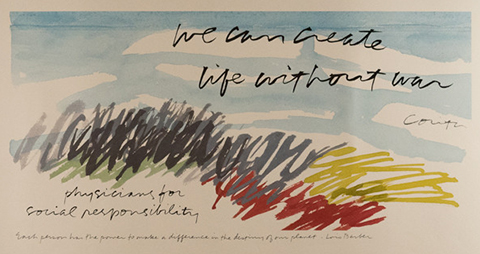
Corita died on September 18, 1986 at age 67, and her obituary in the Los Angeles Times can be read here. The video above, "Become a Microscope: 90 Statements on Sister Corita," is a short documentary produced by Aaron Rose to celebrate the 90th anniversary of her birthday. Below is one example of Corita's work, "We Can Create Life Without War," a poster commissioned in 1983 by the organization, Physicians for Social Responsibility. An illustrated chronology of Corita's life can be viewed at the Corita Art Center website.


Wednesday, April 4, 2018

The 50th Anniversary of the Assassination of Martin Luther King, Jr.

Civil rights leader Dr. Martin Luther King, Jr. was fatally shot on April 4, 1968 in Memphis, Tennessee, 50 years ago today. The day after his assassination, President Lyndon B. Johnson issued Presidential Proclamation 3839 declaring a national day of mourning for April 7, 1968 and that flags were to be flown at half-mast at governmental and military facilities both within the United States and abroad until King's internment. Johnson begins the Proclamation by stating: "The heart of America grieves today. A leader of his people--a teacher of all people--has fallen."

For previous Common Curator posts related to King's life and work, see: The March on Washington for Jobs and Freedom; Beyond Vietnam: A Time to Break Silence; The Quest for Peace and Justice; and Martin Luther King, Jr. Day. The New York Times has also recently republished its original obituary for King, which was first published April 5, 1968.

Wednesday, March 7, 2018

International Women's Day: #TimeIsNow

March 8th marks the 107th anniversary of International Women's Day. The United Nations' theme for International Women's Day 2018 is "Time Is Now: Rural and Urban Activists Transforming Women's Lives." The video above features remarks by UN Women Executive Director Phumzile Mlambo-Ngcuka.

First celebrated on March 19, 1911 by more than one million people in Austria, Denmark, Germany, and Switzerland after a proposal by Clara Zetkin [1857-1933] in 1910 at the second International Conference of Working Women in Copenhagen, International Women's Day is now observed in many nations throughout the world.

The United Nations first began celebrating March 8 as International Women's Day during International Women's Year in 1975, and in 1977 approved a resolution proclaiming a United Nations Day for Women's Rights and International Peace for member states.

Wednesday, February 28, 2018

Against Amnesia: Archives, Evidence, and Social Justice


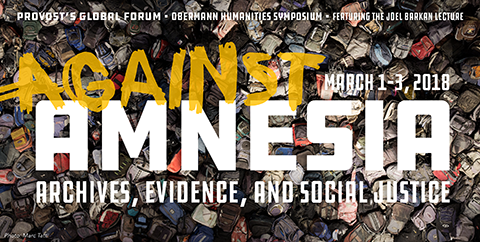
Against Amnesia: Archives, Evidence, and Social Justice is this year's Obermann Humanities Symposium at the University of Iowa, and will be held at campus and downtown Iowa City venues on March 1-3, 2018. The symposium is an initiative of the Provost's Global Forum, and will offer a full schedule of lectures, panels, film screenings, and exhibitions.

The organizers note that "practicing archivists, engaged scholars, and interdisciplinary artists will share projects from creating 'data refuges' of climate date to mining corporate records for evidence of organized violence." Experimental filmmaker, Bill Morrison, honored as an Ida Cordelia Beam Distinguished Visiting Professor, will be delivering a talk, "Consider the Source," and presenting his most recent film, "Dawson City: Frozen Time (2016)."

Further information can be found at the symposium website, which includes biographies of speakers, resources on archives and activism, and a listing of numerous, diverse archives in the area.

Tuesday, February 27, 2018

The Sesquicentennial of W.E.B. Du Bois' Birth


Civil rights advocate, scholar, educator, and global activist, William Edward Burghardt Du Bois was born 150 years ago on February 23, 1868, and died August 27, 1963.

Among his many outstanding contributions were his roles in founding, in 1905, the Niagara Movement, an African American group of scholars and professionals that challenged racial discrimination, and in 1909, the National Association for the Advancement of Colored People (NAACP). He was also the founder and editor of The Crisis, which was the NAACP's monthly magazine.

Du Bois earned his doctorate from Harvard in 1895, the first African American to ever do so. His dissertation, "The Suppression of the African Slave Trade to the United States of America, 1638-1870," was the inaugural publication of the Harvard Historical Series. In 1899, he published a major sociological work called The Philadelphia Negro: A Social Study. Du Bois authored many other works over the course of his career, notable among them, The Souls of Black Folk: Essays and Sketches (1903) and Black Reconstruction in America, 1860-1880 (1935).

As a global citizen, Du Bois was long committed to Pan-Africanism. He attended the First Pan-African Conference in London in 1900, and later organized a series of Pan-African congresses around the world. In 1961, at the invitation of its president, Du Bois received citizenship in Ghana, where he worked as director of the new Encyclopedia Africana, which was devoted to the African diaspora; he died in Ghana in 1963 at the age of 95.

For additional information on the life and work of Du Bois, check out the online guide to resources held by the Library of Congress. The University of Massachusetts at Amherst has a very substantial collection, the W.E.B. Du Bois Papers, 1803-1999, containing nearly 100,000 digital items. Other resources include the W.E.B. Du Bois National Historic Site in Great Barrington, Massachusetts, where Du Bois was born and raised, and the Harpers Ferry National Historical Park, where an instrumental meeting of the Niagara Movement took place at Storer College in 1906.

Note: The photograph above was taken by Cornelius Marion Battey on May 31, 1919, and is in the collections of the Library of Congress.

Thursday, February 22, 2018

Wednesday, February 14, 2018

The Bicentennial of Frederick Douglass' Birth


Born into slavery 200 years ago, on February 14, 1818, Frederick Douglass represents one of the most consequential figures in American history. His life's work as an abolitionist, social reformer, orator, author, publisher, and statesman are without parallel.

To learn more about Douglass, there are a number of significant research collections to explore. The Frederick Douglass Papers at the Library of Congress contains approximately 7,400 items, with the bulk of the material dating from 1862 to 1865. Many of Douglass' early writings were destroyed when his house in Rochester, New York, burned in 1872.

Indiana University-Purdue University Indianapolis (IUPUI) has created a digital edition of the Frederick Douglass Papers, and at the University of Rochester, the Frederick Douglass Institute, in conjunction with the Dept. of Rare Books and Special Collections, is seeking to digitize all of the Douglass-related materials at the University Library. The National Archives has deep collections in African American history generally.

The National Park Service maintains the Frederick Douglass National Historic Site, which preserves and interprets Cedar Hill, where Douglass lived from 1877 till his death in 1895 at age 77. The Frederick Douglass Bicentennial Community has a number of online resources that are also of interest.

Note: The photograph above was taken by George Francis Schreiber on April 26, 1870, and is in the collections of the Library of Congress.

Monday, January 15, 2018

The March on Washington for Jobs and Freedom

Martin Luther King, Jr. [1929-1968] would have turned 89 today. It was during the March on Washington, held on August 28, 1963, that Dr. King delivered his famous "I Have a Dream Speech." The speech galvanized the civil rights movement, and in 1964, James Blue released the film, "The March," which documented the events of the March as well as King's speech.

The film was produced for the Motion Picture Service unit of the United States Information Agency, and was intended for foreign audiences. In 2008, the documentary was inducted into the National Film Registry maintained by the Library of Congress. A full digital restoration of the original negatives was later undertaken by the Motion Picture Preservation Lab to coincide with the March's 50th anniversary in 2013; details of this painstaking process are available at the National Archives website.

The National Archives has many other resources related to King and to African American history, and there are several prior Common Curator posts regarding King's legacy as well.

Thursday, October 12, 2017

UNESCO Statement on the Withdrawal of the United States from Membership

Irina Bokova, Director-General of UNESCO, delivered on October 12, 2017 a statement of "profound regret" on the decision of the United States to withdraw from the United Nations Educational, Scientific and Cultural Organization effective December 31, 2018. Bakova stated that "Universality is critical to UNESCO’s mission to strengthen international peace and security in the face of hatred and violence, to defend human rights and dignity," and delineated numerous initiatives, collaborations, and projects that have involved the United States, which was one of the original signers of the Constitution of UNESCO on November 16, 1945.

One notable UNESCO program achievement, in 2008, was the designation of Iowa City, Iowa as a UNESCO City of Literature. It was just the third city in the world to be accorded such recognition, and to date is the only such city in the United States. Iowa City UNESCO City of Literature Executive Director John Kenyon, in an article in the Iowa City Press-Citizen, observed that he was personally very disappointed by the withdrawal, and noted that "This decision has not made things better for UNESCO." He also remarked that "UNESCO's ability to better the world was compromised" when the United States ceased paying membership contributions in 2011 under the Obama administration.

A press statement by the U.S. Department of State earlier today indicates that UNESCO was informed, despite the withdrawal, of the United States' ongoing:
. . . desire to remain engaged with UNESCO as a non-member observer state in order to contribute U.S. views, perspectives and expertise on some of the important issues undertaken by the organization, including the protection of world heritage, advocating for press freedoms, and promoting scientific collaboration and education.
Meanwhile, the Iowa City Book Festival continues this week with its full slate of activities, including events celebrating the 50th anniversary of the International Writing Program. Festival highlights for today also include the bestowal of the Paul Engle Prize to this year's recipient, Alexander Chee.

It is worth recalling that the Preamble to the Constitution of UNESCO begins with the assertion "that since wars begin in the minds of men, it is in the minds of men that the defences of peace must be constructed." And today that must include the minds of everyone.

Wednesday, April 5, 2017

Beyond Vietnam: A Time to Break Silence . . . MLK, Jr. after Fifty Years


Fifty years ago on April 4, 1967 (exactly one year before his assassination), Dr. Martin Luther King, Jr., delivered a major speech at Riverside Church in New York City which articulated his reasoning for his opposition to the Vietnam War, and how the conflict was intertwined with racism and other pressing social issues facing the nation. Entitled "Beyond Vietnam: A Time to Break Silence," King traces the evolution of his thought on the war, and argues for a "radical revolution of values," stating:
. . . [W]e must rapidly begin the shift from a thing-oriented society to a person-oriented society. When machines and computers, profit motives and property rights, are considered more important than people, the giant triplets of racism, extreme materialism, and militarism are incapable of being conquered.
Towards the conclusion of his speech, King posits a fundamental question:
We still have a choice today: nonviolent coexistence or violent coannihilation. We must move past indecision to action. We must find new ways to speak for peace in Vietnam and justice throughout the developing world, a world that borders on our doors. If we do not act, we shall surely be dragged down the long, dark, and shameful corridors of time reserved for those who possess power without compassion, might without morality, and strength without sight. 
Wise words still today, fifty years hence. The full transcript of King's speech can be read here; the YouTube video above contains audio only.

Wednesday, March 8, 2017

International Women's Day: #BeBoldForChange


March 8th marks the 106th anniversary of International Women's Day. The United Nations' theme for International Women's Day 2017 is "Women in the Changing World of World: Planet 50-50 by 2030." The video above features remarks by UN Women Executive Director Phumzile Mlambo-Ngcuka.

First celebrated on March 19, 1911 by more than one million people in Austria, Denmark, Germany, and Switzerland after a proposal by Clara Zetkin [1857-1933] in 1910 at the second International Conference of Working Women in Copenhagen, International Women's Day is now observed in many nations throughout the world.

The United Nations first began celebrating March 8 as International Women's Day during International Women's Year in 1975, and in 1977 approved a resolution proclaiming a United Nations Day for Women's Rights and International Peace for member states.

Tuesday, January 31, 2017

ALA Opposes New Administration Polices That Contradict Core Values

American Library Association (ALA) President Julie B. Todaro on January 30, 2017 released the following statement on behalf of the ALA that reasserts the association's commitment to core values concerning access to information, intellectual freedom, diversity, social responsibility, and other issues:

“We are shocked and dismayed by recent executive orders and other actions by the new administration, which stand in stark contrast to the core values of the American Library Association. Our core values include access to information; confidentiality/privacy; democracy; equity, diversity and inclusion; intellectual freedom; and social responsibility.

“The American Library Association strongly opposes any actions that limit free access to information, undermine privacy, or discriminate on any basis. This includes the temporary suspension of visas and entrance to the US based on anyone’s nationality or religion as well as the increased scrutiny of any individual’s communication such as mobile phone and/or social media activity.

“Our nation’s 120,000 public, academic, school, and special libraries serve all community members, including people of color, immigrants, people with disabilities and the most vulnerable in our communities, offering services and educational resources that transform communities, open minds, and promote inclusion and diversity.

“ALA believes that the struggle against racism, prejudice, stereotyping, and discrimination is central to our mission. We will continue to speak out and support efforts to abolish intolerance and cultural invisibility, stand up for all the members of the communities we serve, and promote understanding and inclusion through our work.

“We will continue to speak out and support our members as they work tirelessly for access to library and information resources on behalf of all of their community members, while advocating for privacy, intellectual freedom, critical global research, information literacy, ongoing access to scientific research, and fair and equitable treatment for everyone.

“As our strategic plan states, ‘ALA recognizes the critical need for access to library and information resources, services, and technologies by all people, especially those who may experience language or literacy-related barriers; economic distress; cultural or social isolation; physical or attitudinal barriers; racism; discrimination on the basis of appearance, ethnicity, immigrant status, housing status, religious background, sexual orientation, gender identity, gender expression; or barriers to equal education, employment and housing.’

“We encourage our members to continue to speak out and show their support for and work on behalf of our core values, in their communities as well as with their local, state, and national elected and appointed officials. Additionally, ALA has tools and resources online to help you advocate for our core values:
“ALA is committed to using its national platform for speaking up and speaking out for its members and constituents in these chaotic, unprecedented, and challenging times. We appreciate the library community’s continued support.”