Showing posts with label Photography. Show all posts
Showing posts with label Photography. Show all posts
Friday, July 19, 2019
Moon Hoax Not
Moon Hoax Not by S.G. Collins of Postwar Media is a short video describing the technical implausibilities and impossibilities that would have been involved in any attempt to fabricate the visual documentation of NASA's moon shot in 1969. Extensive original documentation of the actual mission to the moon is available at Apollo 11 in Real Time.

Wednesday, April 10, 2019
The First Observed Black Hole
Scientists with the National Science Foundation (NSF) and the Event Horizon Telescope (EHT) announced on April 10, 2019 that they have obtained the first visual record of a supermassive black hole and its shadow. Utilizing an international network of eight ground-based radio telescopes, a collaborative team of more than 200 researchers captured images of the black hole at the center of Messier 87, a massive galaxy in the Virgo galaxy cluster. The black hole is some 55 million light years from Earth and has a mass 6.5 billion times that of the Sun. The results of the years-long effort were published in a series of six papers in The Astrophysical Journal Letters, and were announced in a joint NSF/EHT press conference.
Monday, December 24, 2018
Earthrise, 12.24.68
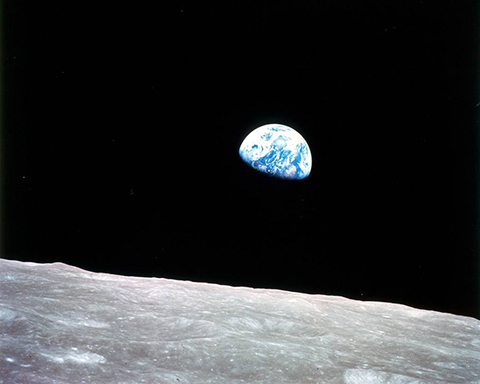
Fifty years ago today, on December 24, 1968, NASA astronaut William Anders, a member of the three-person Apollo 8 crew then orbiting the moon, took the photograph above, which later came to be known as "Earthrise." It was the first time such a view of Earth had been documented by humans in space. As Anders later recounted:
"And up came the Earth. We had had no discussion on the ground, no briefing, no instructions on what to do. I jokingly said, 'well it's not on the flight plan,' and the other two guys were yelling at me to give them cameras. I had the only color camera with a long lens. So I floated a black and white over to [Frank] Borman. I can't remember what [James] Lovell got. They were all yelling for cameras, and we started snapping away."The iconic photo is available from NASA's website; NASA has also just released a new video describing the world's first mission to orbit the moon: "Apollo 8: Around the Moon and Back."
Sunday, April 8, 2018
The Republication of Edward S. Curtis' The North American Indian
Edward S. Curtis [1868-1952] published The North American Indian [Being a Series of Volumes Picturing and Describing the Indians of the United States and Alaska] during the period 1907-1930. It comprised 20 volumes of narrative text accompanied by 20 portfolios of photogravures; the text tallied over 5,000 pages, and the photographic images numbered over 2,200. Less than half of the projected 500 sets were ultimately produced.
The original prospectus described this project as "The most gigantic undertaking in the making of books since the King James edition of the Bible . . . ." Curtis both authored the text and photographed the images, and was supported in his field work by the patronage of J. Pierpont Morgan. Frederick Webb Hodge, who worked at the Bureau of American Ethnology from 1905 to 1918 and later at the Museum of the American Indian, Heye Foundation, served as the editor for the series. Theodore Roosevelt contributed a brief foreword.
In the course of his research, Curtis took over 40,000 photographic images of some 80 tribes, recorded over 10,000 wax cylinders of Native American languages and music, and observed and described many aspects of Indian traditions, customs, and ways of life. As valuable as Curtis' documentation is--and in many cases, it is the only such historical information available--it also reflects certain attitudes and mindsets no longer current among scholars and historians. Among other criticisms, the staging of some photographs raises important questions of representation and interpretation in Curtis' work.
To mark the sesquicentennial of Curtis' birth, Christopher Cardozo Fine Art is republishing Curtis' magnum opus in its entirety, with meticulous attention to reproducing the quality of the original set. The video above gives a brief overview of the process and rationale for the undertaking. Further details as well as ordering information is available at the publisher's website.
An online edition of The North American Indian is also available as part of Northwestern University's Digital Library Collections. The digitization of the set was largely funded by the Institute for Museum and Library Services. The Library of Congress holds more than 2,400 silver-gelatin photographic prints by Curtis that were acquired through copyright deposit from about 1900 to 1930; of these, 1,608 were not included in The North American Indian. Over 1,000 prints in the Curtis Collection have been digitized and individually described.
Monday, May 30, 2016
A Living Service Flag
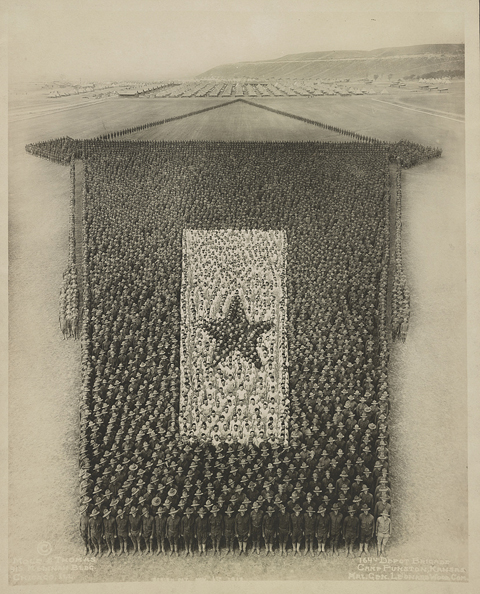
In honor of Memorial Day, above is shown a living (or formation) photograph circa 1918 depicting the service flag of the U.S. Armed Forces. It was produced by Arthur Mole and John Thomas with the assistance of hundreds if not thousands of troops of the 164th Depot Brigade stationed at Camp Funston in Fort Riley, Kansas. Technically complex to stage, the pair created around 30 such photographs on patriotic themes at various military camps during World War I.
As defined in the U.S. Code at 36 USC § 901:
A service flag approved by the Secretary of Defense may be displayed in a window of the place of residence of individuals who are members of the immediate family of an individual serving in the Armed Forces of the United States during any period of war or hostilities in which the Armed Forces of the United States are engaged.Service flags are also known as service banners, and Blue Star Service Banners depict a blue star for each family member who is serving during war or hostilities. Gold Star Service Banners depict a gold star (with a thin blue border) for each family member killed during wartime service.
Further information on the work of Mole & Thomas and other photographers who created similar large-scale images can be found at the Library of Congress' Picture This blog in the post: Formation Photographs: Lining Up to Salute the Flag. The original photograph above is held in the Library of Congress' Prints & Photographs Division.
Sunday, July 28, 2013
Scenes from Heritage Farm at Seed Savers Exchange


From the top: View from the Trial and Diversity Gardens; View of the Main Stage, with Lillian Goldman Visitors Center; Barn, with Diane's Garden; Livestock Warning Sign; Detail of a Life-sized Painting by Valerie Miller of Steel Cow Studio; and Painted Tongue flowers.
Monday, April 1, 2013
Moon Hoax Not
Moon Hoax Not by S.G. Collins is a quick-paced video describing the technical implausibilities and impossibilities that would have been involved in any attempt to fabricate the visual documentation of NASA's moon shot in 1969. The Common Curator also has these earlier offerings for All Fools' Day, including its putative origin and other notorious hoaxes.
Wednesday, September 5, 2012
"my eyes are not shut"

Thursday, December 30, 2010
The End of an Era for Kodachrome Film
 Dwayne's Photo in Parsons, Kansas will be processing the last roll of Kodachrome film today, December 30, 2010. Eastman Kodak manufactured Kodachrome film in a variety of formats for still and motion picture cameras from 1935 until 2009, when it announced that further production would cease due to diminished demand. Countless photographers greatly valued Kodachrome, which offered significant archival stability among other positive qualities. Dwayne's Photo was the last certified facility to continue developing the film--until today's deadline. The shirt pictured here commemorates a few highlights from Kodachrome's long history: Paul Simon recorded the song, "Kodachrome" in 1973, and the Kodachrome Basin State Park adopted its name after a photoessay of the Utah park appeared in the September 1949 issue of National Geographic.
Subscribe to:
Posts (Atom)