Showing posts with label Space. Show all posts

Saturday, July 20, 2019

First Humans on the Moon: 07.20.69

Today marks the 50th anniversary of the moon landing of the Apollo 11 Lunar Module Eagle (20:17 UTC, July 20, 1969). Some six hours later (02:56:15 UTC), Neil Armstrong became the first human to set foot on the moon, whereupon he uttered the immortal words: "That's one small step for [a] man, one giant leap for mankind." Edwin "Buzz" Aldrin joined him on the lunar surface a few minutes later, while the third NASA astronaut on the  Apollo 11 mission, Michael Collins, remained in orbit around the moon. A vast archive of the entire spaceflight, including 11,000 hours of Mission Control audio and other original historical documentation, is available at Apollo 11 in Real Time.

The Sixties in America were an especially tumultuous period of social protest by many constituencies, so it is not too surprising that the moon landing itself was also the subject of criticism. Indeed, no less a figure than the highly accomplished space scientist Dr. James Van Allen [1914-2006] of the University of Iowa objected throughout his career to the vast resources that were expended on manned space flight as opposed to other more economical and efficient means of exploration and research.

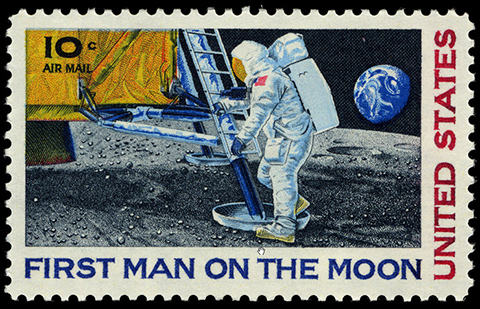
On the cultural front, poet, musician, and activist Gil Scott-Heron in 1970 composed and recorded the song, "Whitey on the Moon," which contrasts the poverty and medical expenses of the song's protagonist to the fact that astronauts are now going to the moon. The lyrics raise poignant questions about how society allocates limited resources to fundamental needs such as health care. And in what is perhaps a reference to the air mail stamp that was issued in 1969 to commemorate the moon landing (pictured above), the song concludes: "I think I'll send these doctor bills, airmail special (to Whitey on the moon)." Various versions of this song, as well as Scott-Heron's "The Revolution Will Not Be Televised" are available on YouTube.

The last man on the moon (and all twelve NASA astronauts that walked on the moon were male--and white) was Eugene Cernan, who commanded the Apollo 17 mission in December 1972. His parting words as the lunar module left the celestial body closest to Earth were: "We leave as we came and, god willing, as we shall return, with peace, and hope for all mankind."

Friday, July 19, 2019

Moon Hoax Not


Moon Hoax Not by S.G. Collins of Postwar Media is a short video describing the technical implausibilities and impossibilities that would have been involved in any attempt to fabricate the visual documentation of NASA's moon shot in 1969. Extensive original documentation of the actual mission to the moon is available at Apollo 11 in Real Time.

Wednesday, April 10, 2019

The First Observed Black Hole

Scientists with the National Science Foundation (NSF) and the Event Horizon Telescope (EHT) announced on April 10, 2019 that they have obtained the first visual record of a supermassive black hole and its shadow. Utilizing an international network of eight ground-based radio telescopes, a collaborative team of more than 200 researchers captured images of the black hole at the center of Messier 87, a massive galaxy in the Virgo galaxy cluster. The black hole is some 55 million light years from Earth and has a mass 6.5 billion times that of the Sun. The results of the years-long effort were published in a series of six papers in The Astrophysical Journal Letters, and were announced in a joint NSF/EHT press conference.

Monday, December 24, 2018

Earthrise, 12.24.68


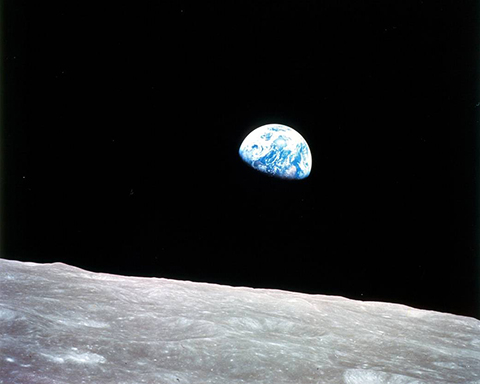
Fifty years ago today, on December 24, 1968, NASA astronaut William Anders, a member of the three-person Apollo 8 crew then orbiting the moon, took the photograph above, which later came to be known as "Earthrise." It was the first time such a view of Earth had been documented by humans in space. As Anders later recounted: 
"And up came the Earth. We had had no discussion on the ground, no briefing, no instructions on what to do. I jokingly said, 'well it's not on the flight plan,' and the other two guys were yelling at me to give them cameras. I had the only color camera with a long lens. So I floated a black and white over to [Frank] Borman. I can't remember what [James] Lovell got. They were all yelling for cameras, and we started snapping away."
The iconic photo is available from NASA's website; NASA has also just released a new video describing the world's first mission to orbit the moon: "Apollo 8: Around the Moon and Back."

Monday, October 1, 2018

NASA Turns Sixty


The National Aeronautics and Space Administration (NASA) began operations on October 1, 1958, and was created by the National Aeronautics and Space Act which was signed by President Eisenhower on July 29, 1958. NASA supplanted the National Advisory Committee for Aeronautics (NACA), and T. Keith Glennan served as its first administrator. On October 11, 1958, NASA launched its first mission, the Pioneer 1 satellite (note that the first U.S. satellite overall was Explorer 1, launched January 31, 1958). A timeline of NASA's rich and illustrious history can be found at NASA's 60th anniversary website.

Wednesday, October 4, 2017

Sputnik I Launches the Space Age 60 Years Ago

Euronews recounts in its Legends of Space series the story of the first artificial satellite to orbit the Earth, Sputnik I (Спутник-1), which was launched by the Soviet Union on October 4, 1957.

Wednesday, August 12, 2015

Tossed in Space


NASA astronauts aboard the International Space Station (ISS) have grown and consumed produce in space for the first time, a small crop of red romaine lettuce. Further information on the Veggie greenhouse system used on ISS is available in this NASA interview with the developer.

Friday, July 17, 2015

No Longer "Not Yet Explored"

Issued in 1991 by the United States Postal Service, the 29-cent Pluto commemorative stamp bore the words "Not Yet Explored." The July 14, 2015 flyby of Pluto by the New Horizons spacecraft definitively put to rest the implicit challenge expressed on the stamp. The stamp design at the bottom was proposed several years ago via petition to the US Citizens’ Stamp Advisory Committee of the USPS in anticipation of a successful mission.

Monday, April 1, 2013

Moon Hoax Not

Moon Hoax Not by S.G. Collins is a quick-paced video describing the technical implausibilities and impossibilities that would have been involved in any attempt to fabricate the visual documentation of NASA's moon shot in 1969. The Common Curator also has these earlier offerings for All Fools' Day, including its putative origin and other notorious hoaxes.

Monday, February 20, 2012

"Today, If All Goes Well . . . "


Fifty years ago today, on February 20, 1962, NASA astronaut John Glenn became the first American to orbit Earth in the Mercury spacecraft he named "Friendship 7." Glenn orbited the planet three times in a flight that lasted just under five hours. In 1963, NASA transferred the recovered space capsule to the Smithsonian National Air and Space Museum, which describes his historic mission as follows:
Glenn's flight was the third manned mission of Project Mercury, following two suborbital flights by astronauts in 1961. Glenn's three-orbit mission on February 20, 1962, was a sterling success, as he overcame problems with the automatic control system that would have ended an unmanned flight. But reentry was tense, as a faulty telemetry signal from the spacecraft indicated that the heat shield might be loose. Mission Control instructed Glenn not to jettison the retrorocket package after firing in order to better hold the heat shield in place. Glenn reentered successfully and splashed down in the Atlantic 4 hours, 55 minutes and 23 seconds after launch.
Glenn was preceded into orbit by the Soviet cosmonauts Yuri Gagarin, who as the first human in space made one orbit on April 11, 1961, and Gherman S. Titov, who made 17 orbits after launching on August 6, 1961. Alan Shepard and Gus Grissom were the first and second Americans in space, but flew suborbital missions, on May 5, 1961 and July 21, 1961, respectively.

Monday, April 11, 2011

50th Anniversary of First Human Spaceflight


With the words "Let's go (Poyekhali)!" on the morning of April 12, 1961, Soviet cosmonaut Yuri Gagarin blasted off from the Baikonur launch site in a Vostok 1 spacecraft. During his brief 108-minute flight, Gagarin made one orbit around Earth, attaining a speed of over 27,000 kilometers per hour and an altitude of 327 kilometers, and thereby becoming the first human in space. (The first animal in space, incidentally, was the dog, Laika, launched by the Soviets on Sputnik 2 on November 3, 1957; unfortunately, Laika died during the mission).

Gagarin was 27 at the time of his momentous spaceflight, having been born on March 9, 1934. He had graduated from the Soviet Air Force Academy in 1957, and was chosen to train among the first group of Soviet cosmonauts. He never made a second space launch, and was killed while piloting a MIG15 jet during a training mission on March 27, 1968.

Note: The video here was produced by Roscosmos TV-Studio. Other Gargarin-related resources include the Russian Federal Space Agency (English version); YuriGagarin50.org (UK); and NASA (US).

Wednesday, July 22, 2009

The Man on the Moon -- Part II

The University of North Carolina played a very significant role in NASA's space program, with astronauts from several space programs receiving training at the Morehead Planetarium and Science Center. A history of this involvement is available on the Morehead web site. As noted on the site:

Between 1959 and 1975, nearly every astronaut who participated in the Mercury, Gemini, Apollo, Skylab and Apollo-Soyuz programs trained at Morehead. While the need for such training ended in 1975 as computer navigation became more reliable, long-time Planetarium Director Tony Jenzano could once claim that, “Carolina is the only university in the country, in fact the world, that can claim all the astronauts as alumni.”
A full list of the astronauts who trained at Morehead is also available online. Among the many notables are Neil Armstrong and Buzz Aldrin, as well as Dr. William Thorton, who was born in Faison, NC in 1929 and was later a graduate of the UNC School of Medicine. Thorton flew on space shuttle missions and conducted many physiological investigations, as well as holding over 35 patents, including one for the first real-time EKG computer analysis. Details on Thorton's career are available on the NASA web site.

There are a number of other Carolinians who have a NASA connection, including Charles Duke, who was born in Charlotte, NC in 1935 and was the lunar module pilot for Apollo 16, and Dr. Tom Marshburn, a Statesville, NC native and medical graduate of Wake Forest University, who made three spacewalks on July 20, 2009, the 40th anniversary of Armstrong's moon walk.

See also: The Man on the Moon and Doctor Bills.

Tuesday, July 21, 2009

The Man on the Moon and Doctor Bills

July 20, 2009 marked the 40th anniversary of the momentous occasion of humans first walking on the moon. Upon setting foot on lunar soil, Neil Armstrong uttered, with a slight glitch (either technical or grammatical), the immortal words: "That's one small step for [a] man, one giant leap for mankind."

Of course, the Sixties in America were an especially tumultuous period of social protest by many constituencies, so it is not too surprising that the moon landing itself was also the subject of criticism. Indeed, no less a figure than the highly accomplished space scientist Dr. James Van Allen [1914-2006] of the University of Iowa objected throughout his career to the vast resources that were expended on manned space flight as opposed to other more economical and efficient means of exploration and research.

On the cultural front, poet, musician, and activist Gil Scott-Heron in 1970 composed and recorded the song, "Whitey on the Moon," which contrasts the poverty and medical expenses of the song's protagonist to the fact that astronauts are now going to the moon. The lyrics raise poignant questions about how society allocates limited resources to fundamental needs such as health care. And in what is perhaps a reference to the air mail stamp that was issued in 1969 to commemorate the moon landing (pictured above), the song concludes: "I think I'll send these doctor bills, airmail special (to Whitey on the moon)." Various versions of this song, as well as Scott-Heron's "The Revolution Will Not Be Televised" are available on YouTube.

The last man on the moon (and all twelve NASA astronauts that walked on the moon were male--and white) was Eugene Cernan, who commanded the Apollo 17 mission in December 1972. His parting words as the lunar module left the celestial body closest to Earth were: "We leave as we came and, god willing, as we shall return, with peace, and hope for all mankind."

See also: Man on the Moon -- Part II.