Entries are now being accepted for the 2014 National Collegiate Book Collecting Contest. Begun in 2005 by the Fine Books & Collections magazine
for young bibliophiles, the competition is now jointly sponsored by the
Antiquarian Booksellers' Association of America, the Fellowship of
American Bibliophilic Societies, as well as the Center for the Book and
the Rare Books and Special Collections Division of the Library of
Congress.
A number of contests are currently held at colleges and universities
around the U.S., with Swarthmore College's competition being the first
in the 1920s. College-level students from all educational institutions, however, are encouraged to participate. Entries for this year's competition are due by May 30, 2014. Contest rules and further information are available at the Antiquarian Booksellers' Association of America website. Winners of the last several years can be viewed here: 2013, 2012, 2011, and 2010. Update: Winners for 2014 have also now been announced.
Wednesday, May 7, 2014
Thursday, May 1, 2014
MayDay 2014: Saving Our History
Although the landmark study, A Public Trust at Risk: The Heritage Health Index Report on the State of America's Collections (2005), systematically documented that most institutions lack an adequate disaster preparedness plan, the SAA has worked to mitigate these deficiencies. The SAA web site provides recommendations for MayDay activities, as well as a compilation of resources, including technical literature and tools, disaster plan templates and examples, tutorials and courses, bibliographies, and other resources.
May 1st, of course, is also International Workers' Day, which serves to commemorate the anniversary of the Haymarket Affair in Chicago. The eight-hour workday was a central demand of the Chicago labor movement in the 1860s, and a week-long, city-wide strike began on May 1, 1867. The strike collapsed, but the issue remained, with the Federation of Organized Trades and Labor Unions in 1884 calling for workers to take direct action and begin observing the eight-hour day on May 1, 1886. More on IWD can be found in the Common Curator post, the 125th Anniversary of the Haymarket Affair.
Labels:
Archives,
Common Curator,
Event,
History,
Images,
Labor,
Libraries,
Museums,
Preservation,
SAA
Monday, April 28, 2014
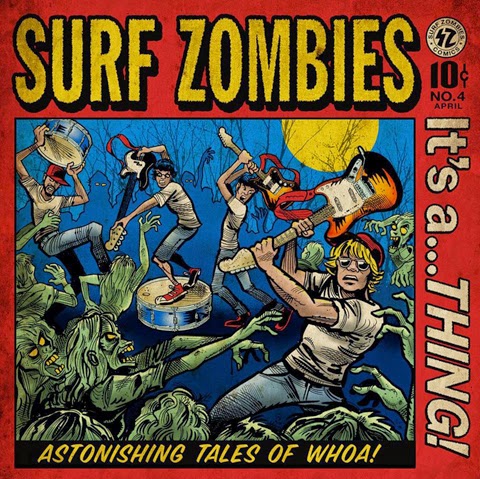
The Surf Zombies: It's a ... Thing!
Practitioners of the tsunami school of surf music, The Surf Zombies have recently issued their fourth album, It's a ... Thing!. A medley video of their latest tunes can be viewed on YouTube. Their first album, the self-titled Surf Zombies, appeared in 2008, and was followed by Something Weird in 2009, with Lust for Rust being released in 2012.
Their latest album can be purchased on CD Baby. For those interested in seeing the band perform live, the Surf Zombies will be appearing at Torque Fest 2014 in Dubuque, Iowa at 7 pm, Friday, May 2, 2014.
Sunday, April 27, 2014
Kickstarting the Morbid Anatomy Museum
Spearheaded by Joanna Ebenstein, creator of the Morbid Anatomy blog in 2007, the Kickstarter campaign for the new Morbid Anatomy Museum located in Brooklyn, New York has just surpassed its goal of $60,000. There is, however, still another five days to contribute to this worthwhile project, which will:
. . . feature permanent and temporary exhibitions, a cafĂ©/bar, a gift shop, an expanded library and more ambitious programming. It will be a beautiful and inspiring space to foster our unique international community of supporters, friends, artists, rogue scholars and like-minded enthusiasts; a place which enshrines that which we hold dear, a place to study, to delight; a place to “meet the others.”To learn more about this ambitious undertaking, visit the Morbid Anatomy Museum project page on Kickstarter. Ebenstein, along with co-editor Colin Dickey, recently concluded another highly successful Kickstarter project with the publication of The Morbid Anatomy Anthology, a well-illustrated and handsomely-produced volume of essays on a number of fascinating topics.
Labels:
Anatomy,
Common Curator,
Kickstarter,
Museums,
Video
Saturday, April 26, 2014
#NotABugSplat
The above image is an on-site installation in Pakistan. Produced by an artist collective, the large scale of the portrait is intended to put a visible human face on potential targets of drone missiles, which are sometimes referred to by drone operators as "bug splats." More information on the project is available at the #NotaBugSplat website.
Labels:
Art,
Common Curator,
Human Rights,
Images,
In the News,
Military,
Public Policy,
War
Friday, April 25, 2014
Plant a Tree, or a Million, for Arbor Day
Labels:
Biodiversity,
Common Curator,
Forests,
Images,
Iowa
Wednesday, April 2, 2014
The Laughing Song and Hallelujah among Latest Entries to the National Recording Registry
In the twelfth year of the National Recording Registry, Librarian of Congress James Billington has announced 25 sound recordings as the official entries for 2013, stating: "These recordings represent an important part of America’s culture and
history. As technology continually changes and
formats become obsolete, we must ensure that our nation’s aural legacy
is protected. The National Recording Registry is at the core of this
effort." Under the National Recording Preservation Act of 2000, selected recordings must be "culturally, historically, or aesthetically significant" and at least ten years old.
In chronological order, the selections for 2013 are as follows:
- "The Laughing Song" (single)—George Washington Johnson (c. 1896)
- "They Didn’t Believe Me"—Harry Macdonough and Alice Green (1915)
- "Brother, Can You Spare a Dime" (singles)—Bing Crosby; Rudy Vallee (both 1932)
- "Franz Boas and George Herzog Recordings of Kwakwaka’wakw Chief Dan Cranmer (1938)
- "Were You There" (single)—Roland Hayes (1940)
- "The Goldbergs": Sammy Goes Into the Army (July 9, 1942)
- "Caldonia" (single)—Louis Jordan (1945)
- "Dust My Broom" (single)—Elmore James (1951)
- "A Night at Birdland" (Vols. 1 and 2) (albums)—Art Blakey (1954)
- "When I Stop Dreaming" (single)—The Louvin Brothers (1955)
- "Cathy’s Clown" (single)—The Everly Brothers (1960)
- "Texas Sharecropper and Songster" (album)—Mance Lipscomb (1960)
- "The First Family" (album) (1962)
- Lawrence Ritter’s Interviews with Baseball Pioneers of the Late 19th and Early 20th Century (1962-1966)
- Presidential Recordings of Lyndon B. Johnson (Nov. 22, 1963 – Jan. 10, 1969)
- "Carnegie Hall Concert with Buck Owens and His Buckaroos" (album)—Buck Owens and His Buckaroos (1966)
- "Fortunate Son" (single)—Creedence Clearwater Revival (1969)
- "Theme from ‘Shaft’" (album)—Isaac Hayes (1971)
- "Only Visiting This Planet" (album)—Larry Norman (1972)
- "Celia & Johnny" (album)—Celia Cruz and Johnny Pacheco (1974)
- "Copland Conducts Copland: Appalachian Spring"—Aaron Copland (1974)
- "Heart Like a Wheel" (album)—Linda Ronstadt (1974)
- "Sweeney Todd" (album)—Original Cast Recording (1979)
- "The Joshua Tree" (album)—U2 (1987)
- "Hallelujah" (single)—Jeff Buckley (1994)
Labels:
Audio,
Common Curator,
Library of Congress,
Music,
Preservation
Monday, March 31, 2014
Play It Hard: A Tribute to Norman Borlaug
Biology Fortified and The International Center for Maize and Wheat Improvement (CIMMYT) have produced a tribute video to Nobel Laureate, Dr. Norman Borlaug, who would have turned 100 on March 25, 2014. For further information on Borlaug's work, see the related Common Curator post, Statue for the Green Revolution.
Labels:
Agriculture,
Common Curator,
In the News,
Iowa,
Nobel Prize,
Video
Tuesday, March 25, 2014
Statue for the Green Revolution
A newly commissioned statue by the State of Iowa was unveiled today in the U.S. Capitol Building's National Statuary Hall to mark the 100th anniversary of the birth of Nobel Laureate Norman E. Borlaug, known as the father of the Green Revolution [video]. An Iowa native, Dr. Borlaug [1914-2009] spent his career developing disease-resistant and high-yielding wheat varieties and other cereal grains that greatly increased food production around the world. His work is estimated by some to have saved as many as one billion people from starvation.
Borlaug was awarded the Nobel Peace Prize in 1970, and later received the Congressional Gold Medal, the Presidential Medal of Freedom, and the National Medal of Science, the only American to have ever earned all four honors. In his Nobel Lecture, entitled "The Green Revolution, Peace, and Humanity," Borlaug stated:
In 1986, Borlaug created the World Food Prize to recognize those who have "advanced human development by improving the quality, quantity or availability of food in the world."
The Borlaug statue, shown above, was created by artist Benjamin Victor. Each state is permitted two statues in National Statuary Hall; the statue of Borlaug will replace James Harlan, and will join Samuel Jordan Kirkwood's statue, which was installed in 1913 by Vinnie Ream, the first woman and youngest artist to receive a U.S. Government commission. She is known for her statue of Abraham Lincoln in the Capitol Rotunda.
Borlaug was awarded the Nobel Peace Prize in 1970, and later received the Congressional Gold Medal, the Presidential Medal of Freedom, and the National Medal of Science, the only American to have ever earned all four honors. In his Nobel Lecture, entitled "The Green Revolution, Peace, and Humanity," Borlaug stated:
. . . the first essential component of social justice is adequate food for all mankind. Food is the moral right of all who are born into this world. Yet today fifty percent of the world's population goes hungry. Without food, man can live at most but a few weeks; without it, all other components of social justice are meaningless.
The Borlaug statue, shown above, was created by artist Benjamin Victor. Each state is permitted two statues in National Statuary Hall; the statue of Borlaug will replace James Harlan, and will join Samuel Jordan Kirkwood's statue, which was installed in 1913 by Vinnie Ream, the first woman and youngest artist to receive a U.S. Government commission. She is known for her statue of Abraham Lincoln in the Capitol Rotunda.
Labels:
Agriculture,
Art,
Common Curator,
Food,
Images,
In the News,
Iowa,
Nobel Prize
Thursday, March 20, 2014
Wednesday, March 19, 2014
Sunshine Week 2014
A popular Government without popular information or the means of acquiring it, is but a Prologue to a Farce or a Tragedy or perhaps both. Knowledge will forever govern ignorance, and a people who mean to be their own Governors, must arm themselves with the power knowledge gives.Such sunshine laws as the Freedom of Information Act (FOIA) and open meetings laws provide essential legal rights and remedies for citizen access to government records and information. FOIA, which was signed into law by President Lyndon Johnson on July 4, 1966 and went into effect one year later, created a "right to know" as the basis for access whereas previously citizens needed to demonstrate a "need to know." As Johnson observed at the time:
This legislation springs from one of our most essential principles: a democracy works best when the people have all the information that the security of the Nation permits. No one should be able to pull curtains of secrecy around decisions which can be revealed without injury to the public interest.For further information, the following resources may be of interest: The National Freedom of Information Coalition; The National Security Archive; The OMB Watch; The American Civil Liberties Union; The Electronic Frontier Foundation; and, for news of international freedom of information advocacy, FreedomInfo.org.
Labels:
Common Curator,
Event,
Freedom of Information,
Images,
Law
Saturday, March 8, 2014
International Women's Day 2014
March 8, 2014 marks the 103st anniversary of International Women's Day. The United Nations' theme for International Women's Day 2014 is "Equality for Women Is Progress for All." The video above features remarks by UN Women Executive Director Phumzile Mlambo-Ngcuka.
First celebrated on March 19, 1911 by more than one million people in Austria, Denmark, Germany, and Switzerland after a proposal by Clara Zetkin [1857-1933] in 1910 at the second International Conference of Working Women in Copenhagen, International Women's Day is now observed in many nations throughout the world.
The United Nations first began celebrating March 8 as International Women's Day during International Women's Year in 1975, and in 1977 approved a resolution proclaiming a United Nations Day for Women's Rights and International Peace for member states.
Labels:
Common Curator,
Event,
Human Rights,
United Nations,
Video,
Women's History
Saturday, February 22, 2014
WFMU Marathon 2014: Support Free-Form Radio
Love free-form radio? Then consider supporting independent station WFMU during its annual fundraising Marathon that runs February 23 through March 9, 2014. WFMU first hit the airwaves on April 24, 1958
at the now-defunct Upsala College and has never looked back.
Currently based in Jersey City, New Jersey, WFMU broadcasts at 91.1
Mhz and via a second signal at 90.1 Mhz in Mount Hope, New York.
WFMU has also long been an Internet pioneer, streaming its programming
24/7 in multiple formats, including iPhone and Android. Past shows are archived at the station's website, which also features WFMU's entertaining and content-rich blog.
What is free-form radio you might ask? WFMU describes itself as follows:
WFMU's programming ranges from flat-out uncategorizable strangeness to rock and roll, experimental music, 78 RPM Records, jazz, psychedelia, hip-hop, electronica, hand-cranked wax cylinders, punk rock, gospel, exotica, R&B, radio improvisation, cooking instructions, classic radio airchecks, found sound, dopey call-in shows, interviews with obscure radio personalities and notable science-world luminaries, spoken word collages, Andrew Lloyd Webber soundtracks in languages other than English as well as country and western music.And because the station is listener-supported, WFMU DJs have for years maintained complete autonomy and control over their own programming, which is extraordinarily eclectic. Check out the current WFMU audio smorgasbord, and see for yourself!
Wednesday, February 19, 2014
Mary Poppins and Pulp Fiction among Additions to 2013 National Film Registry
Established by the National Film Preservation Act of 1988, the National Film Preservation Board
is an advisory body for the Librarian of Congress. The Board helps
shape national film preservation planning policy, and also recommends
films for the National Film Registry.
Chosen for their cultural, historic, or aesthetic significance, the Board's 25 selections for 2013 cover a wide gamut of genres and time periods, from such early films as A Virtuous Vamp and King of Jazz to such later works as Judgment at Nuremberg and The Right Stuff. The full list is as follows:
2000s
Decasia (2002)
1990s
Pulp Fiction (1994)
1980s
Roger & Me (1989)
The Lunch Date (1989)
Bless Their Little Hearts (1984)
The Right Stuff (1983)
1960s
Brandy in the Wilderness (1969)
Who’s Afraid of Virginia Woolf (1966)
Cicero March (1966)
Mary Poppins (1964)
The Hole (1962)
Judgment at Nuremberg (1961)
The Magnificent Seven (1960)
1950s
Forbidden Planet (1956)
The Quiet Man (1952)
Notes on the Port of St. Francis (1951)
1940s
Gilda (1946)
Men & Dust (1940)
1930s
Martha Graham Early Dance film (1931-44)
Midnight (1939)
Wild Boys of the Road (1933)
King of Jazz (1930)
1920s
Ella Cinders (1926)
Daughter of Dawn (1920)
1910s
A Virtuous Vamp (1919)
Further information on the Registry as well as the films themselves can be found on the Library of Congress' web site. All 500+ films selected for the Registry since 1989 can also be browsed online. In addition, the public is encouraged to make nominations for selections to the 2014 National Film Registry.
Chosen for their cultural, historic, or aesthetic significance, the Board's 25 selections for 2013 cover a wide gamut of genres and time periods, from such early films as A Virtuous Vamp and King of Jazz to such later works as Judgment at Nuremberg and The Right Stuff. The full list is as follows:
2000s
Decasia (2002)
1990s
Pulp Fiction (1994)
1980s
Roger & Me (1989)
The Lunch Date (1989)
Bless Their Little Hearts (1984)
The Right Stuff (1983)
1960s
Brandy in the Wilderness (1969)
Who’s Afraid of Virginia Woolf (1966)
Cicero March (1966)
Mary Poppins (1964)
The Hole (1962)
Judgment at Nuremberg (1961)
The Magnificent Seven (1960)
1950s
Forbidden Planet (1956)
The Quiet Man (1952)
Notes on the Port of St. Francis (1951)
1940s
Gilda (1946)
Men & Dust (1940)
1930s
Martha Graham Early Dance film (1931-44)
Midnight (1939)
Wild Boys of the Road (1933)
King of Jazz (1930)
1920s
Ella Cinders (1926)
Daughter of Dawn (1920)
1910s
A Virtuous Vamp (1919)
Further information on the Registry as well as the films themselves can be found on the Library of Congress' web site. All 500+ films selected for the Registry since 1989 can also be browsed online. In addition, the public is encouraged to make nominations for selections to the 2014 National Film Registry.
Labels:
Common Curator,
Film,
Library of Congress,
Preservation
Sunday, February 16, 2014
2014 RAGBRAI Overnight Towns Announced
Registration for the world's oldest, largest, and longest recreational bike touring event is currently open, with a deadline of April 1, 2014 for online applications. Lottery results will be announced May 1, 2014.
Subscribe to:
Posts (Atom)