Saturday, July 20, 2019

First Humans on the Moon: 07.20.69

Today marks the 50th anniversary of the moon landing of the Apollo 11 Lunar Module Eagle (20:17 UTC, July 20, 1969). Some six hours later (02:56:15 UTC), Neil Armstrong became the first human to set foot on the moon, whereupon he uttered the immortal words: "That's one small step for [a] man, one giant leap for mankind." Edwin "Buzz" Aldrin joined him on the lunar surface a few minutes later, while the third NASA astronaut on the  Apollo 11 mission, Michael Collins, remained in orbit around the moon. A vast archive of the entire spaceflight, including 11,000 hours of Mission Control audio and other original historical documentation, is available at Apollo 11 in Real Time.

The Sixties in America were an especially tumultuous period of social protest by many constituencies, so it is not too surprising that the moon landing itself was also the subject of criticism. Indeed, no less a figure than the highly accomplished space scientist Dr. James Van Allen [1914-2006] of the University of Iowa objected throughout his career to the vast resources that were expended on manned space flight as opposed to other more economical and efficient means of exploration and research.

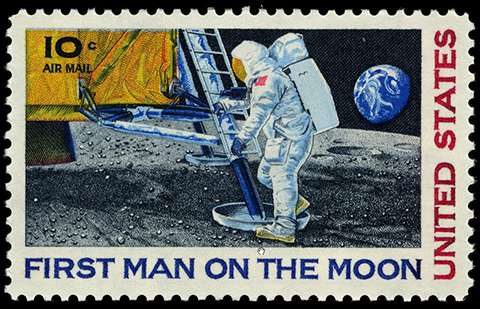
On the cultural front, poet, musician, and activist Gil Scott-Heron in 1970 composed and recorded the song, "Whitey on the Moon," which contrasts the poverty and medical expenses of the song's protagonist to the fact that astronauts are now going to the moon. The lyrics raise poignant questions about how society allocates limited resources to fundamental needs such as health care. And in what is perhaps a reference to the air mail stamp that was issued in 1969 to commemorate the moon landing (pictured above), the song concludes: "I think I'll send these doctor bills, airmail special (to Whitey on the moon)." Various versions of this song, as well as Scott-Heron's "The Revolution Will Not Be Televised" are available on YouTube.

The last man on the moon (and all twelve NASA astronauts that walked on the moon were male--and white) was Eugene Cernan, who commanded the Apollo 17 mission in December 1972. His parting words as the lunar module left the celestial body closest to Earth were: "We leave as we came and, god willing, as we shall return, with peace, and hope for all mankind."

Friday, July 19, 2019

Moon Hoax Not


Moon Hoax Not by S.G. Collins of Postwar Media is a short video describing the technical implausibilities and impossibilities that would have been involved in any attempt to fabricate the visual documentation of NASA's moon shot in 1969. Extensive original documentation of the actual mission to the moon is available at Apollo 11 in Real Time.

Wednesday, July 17, 2019

U.S. House of Representatives Resolution 489

116th CONGRESS 1st Session H. RES. 489

Condemning President Trump's racist comments directed at Members of Congress.
_______________________________________

IN THE HOUSE OF REPRESENTATIVES

July 15, 2019

Mr. Malinowski (for himself, Ms. Jayapal, Mr. Ted Lieu of California, Mr. Garcia of Illinois, Mr. Carbajal, Ms. Omar, Mr. Krishnamoorthi, Ms. Mucarsel-Powell, Mrs. Torres of California, Ms. Ocasio-Cortez, Ms. Tlaib, Ms. Pressley, Mr. Raskin, Ms. Jackson Lee, and Mr. Espaillat) submitted the following resolution; which was referred to the Committee on the Judiciary _______________________________________

RESOLUTION

Condemning President Trump's racist comments directed at Members of Congress.

Whereas the Founders conceived America as a haven of refuge for people fleeing from religious and political persecution, and Thomas Jefferson, Alexander Hamilton, and James Madison all emphasized that the Nation gained as it attracted new people in search of freedom and livelihood for their families;

Whereas the Declaration of Independence defined America as a covenant based on equality, the unalienable Rights of life, liberty and the pursuit of happiness, and government by the consent of the people;

Whereas Benjamin Franklin said at the Constitutional convention, ``When foreigners after looking about for some other Country in which they can obtain more happiness, give a preference to ours, it is a proof of attachment which ought to excite our confidence and affection'';

Whereas President Franklin D. Roosevelt said, ``Remember, remember always, that all of us, and you and I especially, are descended from immigrants and revolutionists'';

Whereas immigration of people from all over the Earth has defined every stage of American history and propelled our social, economic, political, scientific, cultural, artistic, and technological progress as a people, and all Americans, except for the descendants of Native people and enslaved African Americans, are immigrants or descendants of immigrants;

Whereas the commitment to immigration and asylum has been not a partisan cause but a powerful national value that has infused the work of many Presidents;

Whereas American patriotism is defined not by race or ethnicity but by devotion to the Constitutional ideals of equality, liberty, inclusion, and democracy and by service to our communities and struggle for the common good;

Whereas President John F. Kennedy, whose family came to the United States from Ireland, stated in his 1958 book ``A Nation of Immigrants'' that ``The contribution of immigrants can be seen in every aspect of our national life. We see it in religion, in politics, in business, in the arts, in education, even in athletics and entertainment. There is no part of our nation that has not been touched by our immigrant background. Everywhere immigrants have enriched and strengthened the fabric of American life.'';

Whereas President Ronald Reagan in his last speech as President conveyed ``An observation about a country which I love'';

Whereas as President Reagan observed, the torch of Lady Liberty symbolizes our freedom and represents our heritage, the compact with our parents, our grandparents, and our ancestors, and it is the Statue of Liberty and its values that give us our great and special place in the world;

Whereas other countries may seek to compete with us, but in one vital area, as ``a beacon of freedom and opportunity that draws the people of the world, no country on Earth comes close'';

Whereas it is the great life force of ``each generation of new Americans that guarantees that America's triumph shall continue unsurpassed'' through the 21st century and beyond and is part of the ``magical, intoxicating power of America'';

Whereas this is ``one of the most important sources of America's greatness: we lead the world because, unique among nations, we draw our people -- our strength -- from every country and every corner of the world, and by doing so we continuously renew and enrich our nation'';

Whereas ``thanks to each wave of new arrivals to this land of opportunity, we're a nation forever young, forever bursting with energy and new ideas, and always on the cutting edge'', always leading the world to the next frontier;

Whereas this openness is vital to our future as a Nation, and ``if we ever closed the door to new Americans, our leadership in the world would soon be lost''; and

Whereas President Donald Trump's racist comments have legitimized fear and hatred of new Americans and people of color: Now, therefore, be it

Resolved, That the House of Representatives--

(1) believes that immigrants and their descendants have made America stronger, and that those who take the oath of citizenship are every bit as American as those whose families have lived in the United States for many generations;

(2) is committed to keeping America open to those lawfully seeking refuge and asylum from violence and oppression, and those who are willing to work hard to live the American Dream, no matter their race, ethnicity, faith, or country of origin; and

(3) strongly condemns President Donald Trump's racist comments that have legitimized and increased fear and hatred of new Americans and people of color by saying that our fellow Americans who are immigrants, and those who may look to the President like immigrants, should ``go back'' to other countries, by referring to immigrants and asylum seekers as ``invaders,'' and by saying that Members of Congress who are immigrants (or those of our colleagues who are wrongly assumed to be immigrants) do not belong in Congress or in the United States of America.
Thursday, July 4, 2019

We the People Have the Power

Patti Smith and Fred "Sonic" Smith [1948-1994] are shown here performing "People Have the Power," a song they co-wrote and which was included on Patti Smith's 1988 album, Dream of Life. The official music video for the song is viewable here.

Of related interest on the Fourth of July are Mark Twain's Independence Day Peroration and the Declaration of Independence, which is housed at the National Archives in Washington, D.C. The parchment document is thought to have been engrossed by Timothy Matlack, and although it is dated July 4, 1776, it was not signed by members of the Continental Congress until August 2, 1776; additional delegates later signed it, for a total of 56 signatories.

Tuesday, June 4, 2019

1989 Democracy Movement at Tiananmen Square: 八九民运在天安門廣場


Friday, May 31, 2019

Walt Whitman Sings Out at 200

The bicentennial of the birth of the great poet Walt Whitman [1819-1892] is today, May 31, 2019. The irrepressible Whitman still sings in the 21st century, but if you would like to check out his sole surviving recording, circa 1889-90, you can listen to it here. The recording is a recitation of the following poem, though the last two lines are not captured on the wax cylinder:


Centre of equal daughters, equal sons, 
All, all alike endear'd, grown, ungrown, young or old, 
Strong, ample, fair, enduring, capable, rich, 
Perennial with the Earth, with Freedom, Law and Love, 
A grand, sane, towering, seated Mother, 
Chair'd in the adamant of Time.

The story of how it came about, and its technical aspects, can be read in Professor Ed Folsom's "The Whitman Recording." The scholarship on Whitman is of course vast, with (re)discoveries in recent years including Whitman's novel, Life and Adventures of Jack Engle, and a lengthy newspaper series curiously called "Manly Health and Training," both texts being uncovered by Zachary Turpin.

The University of Iowa has long been a center for Whitman scholarship, with Prof. Folsom and others maintaining the extensive Walt Whitman Archive and editing the Walt Whitman Quarterly Review. The first MOOC (or Massive Open Online Course) that Iowa's International Writing Program ever offered, in 2014, was "Every Atom: Walt Whitman's 'Song of Myself.'"

In 2005, Iowa mounted a major exhibition that drew heavily upon the Whitman collection of Dr. Kendall Reed, and for which Prof. Folsom wrote an extensive illustrated catalog, Whitman Making Books/Books Making Whitman: A Catalog & Commentary. The catalog delves deeply into not only Whitman's writing practice but how his knowledge of printing influenced the design and make-up of his ever-evolving masterpiece, Leaves of Grass. A fascinating study (and freely available online), it begins:  

Walt Whitman is the only major American poet of the nineteenth century to have an intimate association with the art of bookmaking. Everyone knows Whitman as a poet and the author of one of the most studied books of American poetry, Leaves of Grass. What is less well known is that Whitman was trained as a printer and throughout his life spent time in printing shops and binderies, often setting type himself and always intimately involved in the design and production of his books. Whitman did not just write his book, he made his book, and he made it over and over again, each time producing a different material object that spoke to its readers in different ways.

No nineteenth-century American author was more involved in the range of actual activities of bookmaking than Whitman. He began his career as a newspaper worker, learning typesetting at the young age of twelve as an apprentice on the Long Island Patriot under the tutelage of William Hartshorne (1775–1859), a master printer (Whitman called him "the veteran printer of the United States") who later became Brooklyn's city printer. Late in his life, Whitman wrote a poem called "A Font of Type," in which he imagines all the "unlaunch'd voices—passionate powers, / Wrath, argument, or praise, or comic leer, or prayer devout" that lie "within the pallid slivers slumbering" in "This latent mine" of the type-box . . . .

To commemorate Whitman's enduring body of work, the University of Iowa Libraries offers the exhibition, Walt Whitman: A Bicentennial Celebration, through August 9, as well as Walt Whitman at 200: The Bicentennial Symposium, on June 18-19. Additional events and programming nationally can be found at the Walt Whitman Initiative website

Note: The illustration above is from the frontispiece for the first edition of Leaves of Grass (1855), as found in the University of Iowa Libraries' copy

Tuesday, May 21, 2019

The Path to Women's Suffrage: The 19th Amendment to the U.S. Constitution


House Joint Resolution 1 (H. J. Res. 1), proposing an amendment to the Constitution extending the right of suffrage to women, was introduced in the House of Representatives on May 19, 1919, and passed on May 21, 1919--100 years ago today. The resolution was soon approved by the Senate, on June 4, 1919, and over the course of the next 14-1/2 months was ratified by three-fourths of the states (with Tennessee becoming the 36th and last state necessary for ratification on August 18, 1920). On August 26, 1920, U.S. Secretary of State Bainbridge Colby certified H. J. Res. 1 as the 19th Amendment to the Constitution, the text of which reads: "The right of citizens of the United States to vote shall not be denied or abridged by the United States or by any State on account of sex. Congress shall have power to enforce this article by appropriate legislation."

Sunday, May 5, 2019

Pete Seeger on Vellum


Pete Seeger [1919-2014], who would have turned 100 on May 3rd, featured a wise and well-worn calligraphic inscription on his banjo head, also known as a "vellum," for the parchment out which it was made. The credo, "This machine surrounds hate and forces it to surrender," parallels one that fellow traveller Woody Guthrie displayed prominently on his guitar, namely, "This machine kills fascists."

To mark his birthday centennial, Smithsonian Folkways has just released "Pete Seeger: The Smithsonian Folkways Collection," a career-spanning anthology that contains 137 tracks on 6 CDs (including 20 previously unreleased), as well as a book of essays and other documentation. Seeger himself once offered some curatorial advice to the archivists and production staff at Smithsonian Folkways, recommending that they "find the homemade honesty of great folk music in every country of the world."

Wednesday, May 1, 2019

MayDay 2019: Saving Our Cultural Heritage

Since 2006, the Society of American Archivists (SAA) has designated May 1st as MayDay, or a day of action for both individuals and organizations such as archives, libraries, museums, and historical societies to improve their capacities to deal with emergencies that can threaten or destroy historical collections. The ravages of natural disasters such as the tornadoes and hurricanes of recent years are just some of the physical risks facing cultural heritage institutions.

Although the landmark study, A Public Trust at Risk: The Heritage Health Index Report on the State of America's Collections (2005), systematically documented that most institutions lack an adequate disaster preparedness plan, the SAA has worked to mitigate these deficiencies. The SAA web site provides recommendations for MayDay activities, as well as a compilation of resources, including technical literature and tools, disaster plan templates and examples, tutorials and courses, bibliographies, and other resources.

In recent years, the State Historical Society of Iowa (SHSI) has undergone severe cuts to both collections and services, which are documented in detail in a White Paper produced by the Save Iowa History Alliance. Leading historians on both a state and national level have addressed their concerns directly to the Iowa Governor and to the Director of the Iowa Department of Cultural Affairs, which oversees the SHSI.

Further details on these efforts, as well as contact information for key decision-makers, is available in the previous Common Curator posts: Save Iowa History and Save Iowa History 3. The complete White Paper on the State Historical of Iowa can be downloaded as a PDF.

Monday, April 22, 2019

Earth Day: 1970 to the Present

Earth Day was first celebrated on April 22, 1970. Founded by former US Senator Gaylord Nelson as an environmental teach-in, Earth Day is now coordinated by Earth Day Network, with extensive programming and events around the world. In 2009, the United Nations also declared April 22 to be International Mother Earth Day, an observance that "recognizes a collective responsibility, as called for in the 1992 Rio Declaration, to promote harmony with nature and the Earth to achieve a just balance among the economic, social and environmental needs of present and future generations of humanity." Look magazine first published the ecology flag shown above on April 21, 1970.

Wednesday, April 10, 2019

The First Observed Black Hole

Scientists with the National Science Foundation (NSF) and the Event Horizon Telescope (EHT) announced on April 10, 2019 that they have obtained the first visual record of a supermassive black hole and its shadow. Utilizing an international network of eight ground-based radio telescopes, a collaborative team of more than 200 researchers captured images of the black hole at the center of Messier 87, a massive galaxy in the Virgo galaxy cluster. The black hole is some 55 million light years from Earth and has a mass 6.5 billion times that of the Sun. The results of the years-long effort were published in a series of six papers in The Astrophysical Journal Letters, and were announced in a joint NSF/EHT press conference.

Sunday, March 24, 2019

Ritchie Valens, Dexter Gordon & Nina Simone among Artists Added to the National Recording Registry

Now in its seventeenth year, the National Recording Registry has grown to 525 entries with Librarian of Congress Carla Hayden having just announced 25 additional sound recordings as the official entries for 2018, stating: “The National Recording Registry honors the music that enriches our souls, the voices that tell our stories and the sounds that mirror our lives. The influence of recorded sound over its nearly 160-year history has been profound and technology has increased its reach and significance exponentially. The Library of Congress and its many collaborators are working to preserve these sounds and moments in time, which reflect our past, present and future.”

Under the National Recording Preservation Act of 2000, selected recordings must be "culturally, historically, or aesthetically significant" and at least ten years old.


Spanning the years 1901-2001, the selections for 2018 are as follows:


  1. Yiddish Cylinders from the Standard Phonograph Company of New York and the Thomas Lambert Company (c. 1901-1905)
  2. “Memphis Blues” (single), Victor Military Band (1914)
  3. Melville Jacobs Collection of Native Americans of the American Northwest (1929-1939)
  4. “Minnie the Moocher” (single), Cab Calloway (1931)
  5. “Bach Six Cello Suites” (album), Pablo Casals (c. 1939)
  6. “They Look Like Men of War” (single), Deep River Boys (1941)
  7. “Gunsmoke” — Episode: “The Cabin” (Dec. 27, 1952)
  8. Ruth Draper: Complete recorded monologues, Ruth Draper (1954-1956)
  9. “La Bamba” (single), Ritchie Valens (1958)
  10. “Long Black Veil” (single), Lefty Frizzell (1959)
  11. “Stan Freberg Presents the United States of America, Vol. 1: The Early Years” (album), Stan Freberg (1961)
  12. “GO” (album), Dexter Gordon (1962)
  13. “War Requiem” (album), Benjamin Britten (1963)
  14. “Mississippi Goddam” (single), Nina Simone (1964)
  15. “Soul Man” (single), Sam & Dave (1967)
  16. “Hair” (original Broadway cast recording) (1968)
  17. Speech on the Death of Dr. Martin Luther King, Jr., Robert F. Kennedy (April 4, 1968)
  18. “Sweet Caroline” (single), Neil Diamond (1969)
  19. “Superfly” (album), Curtis Mayfield (1972)
  20. “Ola Belle Reed” (album), Ola Belle Reed (1973)
  21. “September” (single), Earth, Wind & Fire (1978)
  22. “You Make Me Feel (Mighty Real)” (single), Sylvester (1978)
  23. “She’s So Unusual” (album), Cyndi Lauper (1983)
  24. “Schoolhouse Rock!: The Box Set” (1996)
  25. “The Blueprint” (album), Jay-Z (2001)
The full National Recording Registry can be viewed online here. The Registry solicits nominations annually for inclusion on the registry; further information on the criteria and procedures for making nominations for 2019 is available at the Registry website.

Friday, March 8, 2019

International Women's Day: #ThinkEqual


March 8th marks the 108th anniversary of International Women's Day. The United Nations' theme for International Women's Day 2019 is "Think Equal, Build Smart, Innovate for Change." The video above features remarks by UN Women Executive Director Phumzile Mlambo-Ngcuka as well as the UN Secretary-General António Guterres and other UN leaders.

First celebrated on March 19, 1911 by more than one million people in Austria, Denmark, Germany, and Switzerland after a proposal by Clara Zetkin [1857-1933] in 1910 at the second International Conference of Working Women in Copenhagen, International Women's Day is now observed in many nations throughout the world.

The United Nations first began celebrating March 8 as International Women's Day during International Women's Year in 1975, and in 1977 approved a resolution proclaiming a United Nations Day for Women's Rights and International Peace for member states.

Sunday, March 3, 2019

WFMU: Freeform Station of the Nation

Love free-form radio? Then consider supporting independent station WFMU during its annual fundraising Marathon that runs March 2-17, 2019. WFMU first hit the airwaves sixty years ago on April 24, 1958 at the now-defunct Upsala College and has never looked back. Currently based in Jersey City, New Jersey, WFMU broadcasts at 91.1 Mhz in New York and via a second signal at 90.1 Mhz in the Hudson Valley. WFMU has long been an Internet pioneer, and has multiple online streams, as well as an extensive archive of past shows.

What is free-form radio you might ask? WFMU describes itself as follows:
WFMU's programming ranges from flat-out uncategorizable strangeness to rock and roll, experimental music, 78 RPM Records, jazz, psychedelia, hip-hop, electronica, hand-cranked wax cylinders, punk rock, gospel, exotica, R&B, radio improvisation, cooking instructions, classic radio airchecks, found sound, dopey call-in shows, interviews with obscure radio personalities and notable science-world luminaries, spoken word collages, Andrew Lloyd Webber soundtracks in languages other than English as well as country and western music. 
And because the station is listener-supported, WFMU DJs have for years maintained complete autonomy and control over their own programming, which is extraordinarily eclectic. Check out the current WFMU audio smorgasbord, and see for yourself.

Note: The image above is the Common Curator's antiquarian twist on WFMU's classic "Woof-Moo" logo designed by Aaron Taylor Waldman. The premiums for this year's marathon can be viewed here.