Sunday, February 24, 2019

A Student Free Speech Landmark: Tinker v. Des Moines Independent School District (1969)


Fifty years ago today, on February 24, 1969, the U.S. Supreme Court in a landmark decision held that First Amendment free speech rights applied to students in public schools. The case, Tinker et al. v. Des Moines Independent School District et al., 393 U.S. 503 (1969), was decided by a 7-2 vote, with Justice Abe Fortas delivering the majority opinion of the Court; Justices Hugo Black and John M. Harlan II each wrote dissenting opinions.

At issue was the right of several students to wear black armbands in protest against the Vietnam War and to support the Christmas truce called for by Senator Robert F. Kennedy in December 1965. The students included four members of the Tinker family (John, 15; Mary Beth, 13; Hope, 11; and Paul, 8) and Christopher Eckhardt, 16, who wore black armbands at their respective schools in the Des Moines Independent School District. Mary Beth Tinker and Eckhardt were suspended on December 16, and John Tinker on December 17. The controversy lead the Iowa Civil Liberties Union and the American Civil Liberties Union to support the suspended students, and after losing in U.S. District Court, the case was appealed to the U.S. Court of Appeals for the 8th Circuit, and eventually the U.S. Supreme Court, where attorney Dan L. Johnston argued for the petitioners on November 12, 1968.

In his opinion, Justice Fortas observed that:
"First Amendment rights, applied in light of the special characteristics of the school environment, are available to teachers and students. It can hardly be argued that either students or teachers shed their constitutional rights to freedom of speech or expression at the schoolhouse gate. This has been the unmistakable holding of this Court for almost 50 years."
Fortas articulated further that:
"In order for the State in the person of school officials to justify prohibition of a particular expression of opinion, it must be able to show that its action was caused by something more than a mere desire to avoid the discomfort and unpleasantness that always accompany an unpopular viewpoint. Certainly where there is no finding and no showing that engaging in the forbidden conduct would 'materially and substantially interfere with the requirements of appropriate discipline in the operation of the school,' the prohibition cannot be sustained."
The standard of material and substantial disruption has subsequently become known as the Tinker Test in determining free speech rights for students.

Pictured to the right are Mary Beth and John with armbands, circa March 4, 1968, when the U.S. Supreme Court agreed to hear their case. The armbands originally worn in protest were simple strips of black cloth, unadorned with peace symbols, as shown below by Mary Beth in a photo from December 1965.

The Tinkers have ever since remained strong advocates for free speech and civil liberties, particularly for the young. Mary Beth and John, along with other Tinker family members, guests, and students, are featured in the video above that commemorates the 50th anniversary of their landmark case. The event was held at the State Historical Museum in Des Moines on February 22, 2019, and aired on Iowa Public Television.

Tuesday, February 5, 2019

Happy Year of the Pig / 豬 年 快 樂 !


The image above is featured on the reverse of a 2019 Australian gold proof coin issued to commemorate the Lunar New Year. The coin was struck by the Perth Mint and has a nominal value of $15 Australian. The obverse of the coin depicts the effigy of Queen Elizabeth II, which is based on the design of Ian Rank-Broadley.

Sunday, February 3, 2019

The Day the Music Died, 1959

Buddy Holly, Ritchie Valens, and J.P. "The Big Bopper" Richardson all played their last concert, which was part of the Winter Dance Party Tour, at the Surf Ballroom in Clear Lake, Iowa. Headed out to their next gig after the show, a plane crash killed all three and the pilot, Roger Peterson, shortly after takeoff at around 1am on February 3, 1959--60 years ago today.

Musician Don McLean released the song, "American Pie," which references the tragedy, on the American Pie album in 1971. In 2017, the song was selected for the National Recording Registry at the Library of Congress. The above video depicts a live performance at the BBC in 1972.

Thursday, January 31, 2019

The National Film Registry Hits 750 Films

Established by the National Film Preservation Act of 1988, the National Film Preservation Board is an advisory body for the Librarian of Congress. The Board helps shape national film preservation planning policy, and also recommends films for the National Film Registry.

Chosen for their cultural, historic, or aesthetic significance, the Board's 25 annual selections for 2018 cover a wide gamut of genres and time periods, from such early films as Something Good--Negro Kiss and The Girl Without a Soul to such later works as The Shining and Smoke Signals. The full list for 2018 is as follows:

2000s

Brokeback Mountain (2005)

1990s

Smoke Signals (1998)
Eve's Bayou (1997)
Jurassic Park (1993)                

1980s
Broadcast News (1987)
Hairpiece: A Film for Nappy-Headed People (1984)
The Shining (1980)

1970s
Hearts and Minds (1974)     
                                                                                                           
1960s
Monterey Pop (1968)
My Fair Lady (1964)
Hud (1963)
Days of Wine and Roses (1962)
One-Eyed Jacks (1961)

1950s
Bad Day at Black Rock (1955)
Pickup on South Street (1953)
Cinderella (1950)

1940s
On the Town (1949)
The Lady from Shanghai (1947)
Leave Her to Heaven (1945)
Rebecca (1940)

1930s
The Informer (1935)                       

1920s

The Navigator (1924)                   

1910s
The Girl Without a Soul (1917)         

1900s

Dixon-Wanamaker Expedition to Crow Agency (1908)   

1890s
Something Good--Negro Kiss (1898)    

Further information on the Registry as well as the films themselves can be found on the Library of Congress' web site. All 750 films selected for the Registry since 1989 can also be browsed online. In addition, the public is encouraged to make nominations for next year's selections to the National Film Registry.

Wednesday, January 30, 2019

The Spirit That Moves Us Press: Morty Sklar

For those who may not know, the poet and publisher, Morty Sklar [1935-2018], died at the end of December 2018 in Jackson Heights, Queens. Morty had ridden his motorcycle out to Iowa City circa 1971, and ended up staying until 1989, when he moved back to New York City. The Common Curator met him in 1988 at a rooming house, where Morty happened to be the resident manager (the property, incidentally, was owned by W.P. Kinsella, author of Shoeless Joe, which became The Field of Dreams phenomenon). Morty was a true character, with a bottomless reservoir of stories and anecdotes, all conveyed with a pronounced New York accent that was never tempered in the slightest by nearly two decades of Iowa living. 

Morty operated The Spirit That Moves Us Press out of his then-quarters in the house, and a key element of his enterprise was a large, archaic IBM composing machine with which he electronically typeset all his books. His most notable publication was no doubt Jaroslav Seifert's The Casting of Bells (1983). In the following year Seifert won the Nobel Prize for Literature, yet was not then widely known in literary circles outside his native Czechoslavakia. Needless to say, after the prize was announced, journalists and critics from across the U.S. and abroad were scrambling to find copies of Seifert's work in English translation, and inundated Morty with book orders. Unfortunately, according to Morty's recounting, he had recently moved, and the phone company had messed up his call-forwarding request, hence he lost many potential sales as well as a good portion of once-in-a-lifetime publicity. Such are the travails of small presses! 

The Spirit That Moves Us magazine was the first thing Morty published, in 1975, and he went on to issue a number of books of poetry, fiction & essays, including: The Actualist Anthology; Nuke-Rebuke; Editor's Choice (a series); Patchwork of Dreams: Voices from the Heart of the New America; and similar collections. In addition, he published volumes by individual poets, including Seifert (several titles), local Chuck Miller, and others. His own poetry, The Smell of Life: Poems 1969-2005, was also published under the TSTMUP imprint. Morty's final book was The Ultimate Actualist Convention: A Detailed View of Iowa City Actualism in the 1970s & 1980s and Its Migration to the San Francisco Bay Area, which came out in 2017.

The Common Curator last saw Morty in the late 1990's/early 2000's at the annual Small Press Fair held in Manhattan, where they both periodically exhibited their wares after leaving Iowa. There's a lot more that could be related, of course, and for those who are interested, below are compiled various resources that touch on Morty's life and career as an author, editor, and small press publisher. He was still giving readings as of last summer, and video of that and other things can be found at his YouTube channel

Morty was always a New Yorker through and through, but it seemed that he nevertheless found Iowa to be fertile ground for his fertile mind, and that in the end he gave as much to the City of Literature as he harvested.

May the Spirit Move Us All in 2019!

   *  *  *  *

-- Obituary [Iowa City Press-Citizen, January 1, 2019]

-- The Spirit That Moves Us Press [established circa 1975]

-- YouTube Channel [including readings and miscellanea]

-- The Reminiscences of Morty Sklar [Phoenix House Foundation Oral History Project, Columbia University, September 25, 2014]

-- Poet & Writers Biography

-- Poetry City Actualized: A Look Back at the Birth of an Iowa City-based Literary Movement [Little Village, January 9, 2015]

-- Vibrant Tales In Small Book On Queens [New York Times article about the anthology, Patchwork of Dreams, December 7, 1996]

-- Little-Known in U.S., Nobel Poet Praised Here [New York Times article about Jaroslav Seifert, whom Sklar published the year prior, October 12, 1984]


. . . ''The Casting of Bells,'' a 64-page collection translated by Tom O'Grady and Paul Jagasich, and published in August 1983 by The Spirit That Moves Us Press in Iowa City, Iowa. Morty Sklar, who described himself yesterday as ''publisher, editor, typesetter and stamp licker'' of the press, said his is a small, independent press that publishes two books a year. He published 1,000 copies of the Seifert book, but yesterday, upon hearing the news from Sweden, he reordered 2,500 more. It is available in paperback for $6.

Monday, December 24, 2018

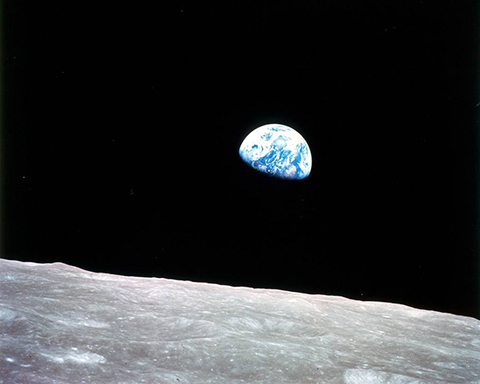
Earthrise, 12.24.68


Fifty years ago today, on December 24, 1968, NASA astronaut William Anders, a member of the three-person Apollo 8 crew then orbiting the moon, took the photograph above, which later came to be known as "Earthrise." It was the first time such a view of Earth had been documented by humans in space. As Anders later recounted
"And up came the Earth. We had had no discussion on the ground, no briefing, no instructions on what to do. I jokingly said, 'well it's not on the flight plan,' and the other two guys were yelling at me to give them cameras. I had the only color camera with a long lens. So I floated a black and white over to [Frank] Borman. I can't remember what [James] Lovell got. They were all yelling for cameras, and we started snapping away."
The iconic photo is available from NASA's website; NASA has also just released a new video describing the world's first mission to orbit the moon: "Apollo 8: Around the Moon and Back."

Monday, December 10, 2018

The Univeral Declaration of Human Rights at 70

Human Rights Day is celebrated annually on December 10 to mark the anniversary of the Universal Declaration of Human Rights (UDHR). This year's campaign theme is Stand Up 4 Human Rights. At the recent UN event, "Good Human Rights Stories," Secretary-General António Guterres observed:
"As we mark the 70th anniversary of the Universal Declaration of Human Rights, we should never forget the profound progress that has been made over the decades--and, indeed, that is happening as we speak. The good stories deserve to be shared--not only to celebrate the achievements of those who made it happen. But to serve as an example and inspiration for others around the world. Just as the denial of human rights is part of the problem, the active promotion of human rights is part of the solution. So, too, is spreading the stories and the lessons of doors opened, rights secured, and victories won."
The Declaration was proclaimed on December 10, 1948 through United Nations General Assembly Resolution 217 A (III):
. . . as a common standard of achievement for all peoples and all nations, to the end that every individual and every organ of society, keeping this Declaration constantly in mind, shall strive by teaching and education to promote respect for these rights and freedoms and by progressive measures, national and international, to secure their universal and effective recognition and observance, both among the peoples of Member States themselves and among the peoples of territories under their jurisdiction.
Although not itself a binding legal document, it has "inspired more than more than 60 human rights instruments which together constitute an international standard of human rights." 

The Declaration has been translated into more than 500 languages and dialects, from Abkhaz to Zulu. The English version is available here, while other versions are available via an online database. A guide to UN Human Rights documentation as well as various related UN databases are also accessible on the UN Human Rights website. A showcase of UDHR-related materials from around the world is available here.

Friday, December 7, 2018

The Final Number of the Wapsipinicon Almanac

The latest--and final--annual installment of the eclectic Wapsipinicon Almanac is now available for purchase and perusal. Published and letterpress printed since 1988 by Timothy Fay of Route 3 Press, the present issue, as with previous numbers, features an engaging mix of essays, reviews, fiction, poetry, art, wit, and wisdom.

Number 25 can be purchased at bookstores and other establishments or by writing the publisher directly at Wapsipinicon Almanac, 19948 Shooting Star Road, Anamosa, Iowa 52205. Single copies are $9, plus $2.70 for postage; Iowa residents should also include 63-cents for sales tax.

The front cover shown here was designed by Will Thomson of Iowa City, his seventh cover overall for the almanac. A brief history of the publication can be viewed at the Almanac's website, and a video of "Linotype Operator Emeritus" Eldon Meeks in action can be viewed here.

Tuesday, November 20, 2018

Corita Kent: Artist Extraordinaire at 100

Corita Kent [1918-1986] was born 100 years today, on November 20, 1918, in Fort Dodge, Iowa, and subsequently became world renowned for her work as a serigrapher (or screen printer), as well as for commissioned works both large (the Rainbow Swash on a massive gas storage tank outside of Boston) and small (the 1985 U.S.P.S. Love stamp, of which more than 700 million were sold).

As a Catholic nun, Sister Corita headed for several years the Art Department at the Immaculate Heart College in Los Angeles, California, where she instilled her artistic values of close observation, imagination, and social justice in her many students. A creative iconoclast in her own work, she famously formulated what could be considered "Corita's Decalogue," otherwise known as the "Immaculate Heart College Art Department Rules," of which Rule 7 is: "The only rule is work. If you work it will lead to something. It's the people who do all of the work all of the time who eventually catch on to things." Although she plainly cites artist John Cage in Rule 10, the ten rules are frequently misattributed to Cage rather than Corita herself.

Corita eventually left the order of the Sisters of the Immaculate Heart of Mary, and reentered secular life in 1968. She continued her prolific artistic output, which rivalled or surpassed many other artists of the era, including fellow screen printer, Andy Warhol. Corita was posthumously awarded an AIGA medal in 2016, and her legacy is sustained today by the Corita Art Center, which offers her original prints as well as ongoing programming. A recent major exhibition catalogue, Someday Is Now: The Art of Corita Kent, features much of her artwork and serves as an excellent introduction to her life and philosophy.

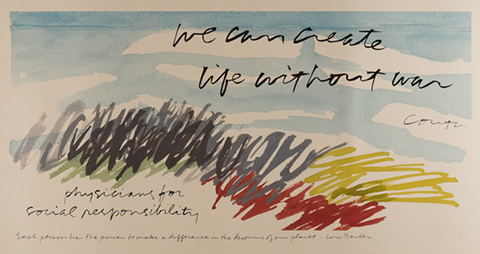
Corita died on September 18, 1986 at age 67, and her obituary in the Los Angeles Times can be read here. The video above, "Become a Microscope: 90 Statements on Sister Corita," is a short documentary produced by Aaron Rose to celebrate the 90th anniversary of her birthday. Below is one example of Corita's work, "We Can Create Life Without War," a poster commissioned in 1983 by the organization, Physicians for Social Responsibility. An illustrated chronology of Corita's life can be viewed at the Corita Art Center website.


Sunday, November 11, 2018

The Eleventh Hour of the Eleventh Day of the Eleventh Month 1918: Armistice!


Chronicling America, the Library of Congress' historic newspaper database, includes a selection of around 90 newspapers that on November 11, 1918 hailed the news of the Armistice which brought World War I to an end.

A number of foreign language newspapers published in the United States also carried the momentous news, such as La Prensa (Spanish, San Antonio, TX); Tägliche Omaha Tribüne (German, Omaha, NE); Svět (Czech, Cleveland, OH); America (Romanian, Cleveland, OH); Draugas (Lithuanian, Chicago, IL); and Dziennik Chicagoski (Polish, Chicago, IL). The full issue of the The Washington Times shown above can be viewed here.

Sunday, November 4, 2018

Vote Early, Vote Surely


As everyone surely knows, the midterm general elections are this Tuesday, November 6th. For those still needing to register, Iowa and 14 other states, as well as the District of Columbia, allow election day registration. Further information regarding voting regulations can be found at USA.gov.

The above Common Curator graphic is based on Robert Indiana's iconic "Love" logo. Indiana died earlier this year at 89; his obituary can be read in the New York Times.

Thursday, October 11, 2018

Quiet Pride: The Elizabeth Catlett Project

Jazz bassist and composer Rufus Reid will be performing "Quiet Pride: The Elizabeth Catlett Project" along with his large jazz ensemble at Hancher Auditorium on Saturday, October 13, 2018. Reid's composition was inspired by the sculptural work of artist Elizabeth Catlett [1915-2012], an African American woman who in 1940 was among the first three students to earn a Master of Fine Arts degree from the University of Iowa. Catlett's thesis advisor was Grant Wood. A video interview with Catlett conducted toward the end of her life can be viewed at the National Visionary Leadership Project.

Reid is currently undertaking a short residency at the University of Iowa as an Ida Cordelia Beam Distinguished Visiting Professor.

Monday, October 8, 2018

Knock the Vote: A Public Service Announcement

Time is running out to register to vote. One can register on many platforms, including of course the official U.S. government voter registration site, which details rules, deadlines, etc. for all jurisdictions. The HeadCount web site also offers information for young, first-time voters, who in most cases can register even before turning age 18. The above public service announcement was produced by ACRONYM, and employs a bit of reverse psychology to cajole indifferent voters as the midterm elections quickly approach; their registration website can be found at Knockthe.vote.

Monday, October 1, 2018

NASA Turns Sixty


The National Aeronautics and Space Administration (NASA) began operations on October 1, 1958, and was created by the National Aeronautics and Space Act which was signed by President Eisenhower on July 29, 1958. NASA supplanted the National Advisory Committee for Aeronautics (NACA), and T. Keith Glennan served as its first administrator. On October 11, 1958, NASA launched its first mission, the Pioneer 1 satellite (note that the first U.S. satellite overall was Explorer 1, launched January 31, 1958). A timeline of NASA's rich and illustrious history can be found at NASA's 60th anniversary website.

Sunday, September 30, 2018

Books Are Weapons in the War of Ideas

Sponsored by the American Library Association and allied organizations, Banned Books Week is an annual celebration of the freedom to read. It began in 1982 in response to widespread censorship of books, and since that time over 11,000 books have been challenged in communities throughout the United States.

The American Library Association's Office for Intellectual Freedom has been documenting cases of challenged and banned books since 1990, and the ALA's Library Bill of Rights strongly supports free and unfettered access to information and ideas. Internationally, the Index on Censorship is an organization that promotes and defends the right to freedom of expression.

Note: The World War II poster shown here features a quotation by Franklin Roosevelt and was illustrated by S. Broder. Published in 1942 by the U.S. Government Printing Office, it was distributed by the Division of Public Inquiry within the Office of War Information.